
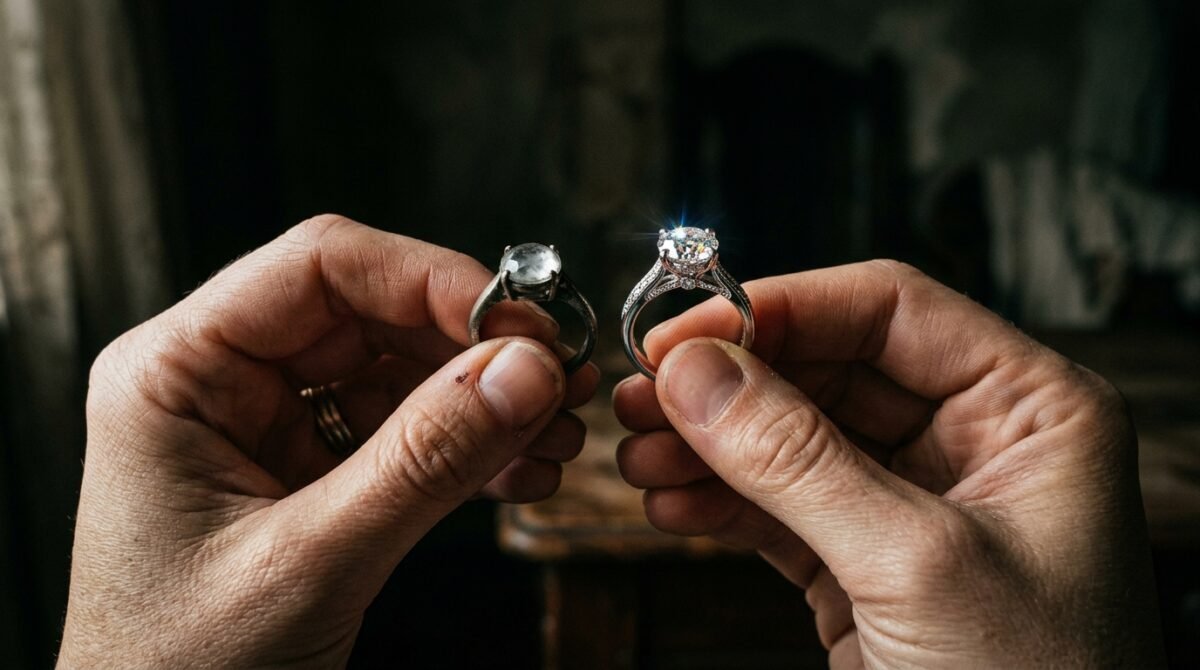
The sparkle of a diamond is supposed to represent a promise, a future, and a legacy. For my family, that specific ring was a symbol of generational love, passed down from my great-grandmother to my mother, and finally, placed onto my finger by the man I intended to marry. It was more than just a piece of jewelry; it was a connection to the women who came before me, a physical manifestation of stability in a world that often feels chaotic.
However, that legacy was shattered in the span of an afternoon. The betrayal didn’t come from a stranger or a thief in the night; it came from the person who grew up in the same house as me, the one person who supposedly knew the weight of that ring’s history. My sister, Clara, had always struggled with a deep-seated, simmering envy, but I never imagined it would manifest into a crime of such calculated coldness.
When the discovery was made, the world didn’t just stop; it tilted on its axis. The realization that I was wearing a twenty-dollar piece of glass while my family heirloom was likely sitting in a pawn shop—or worse, adorning the hand of someone who didn’t deserve it—changed the trajectory of my life. This isn’t just about a ring; it’s about the erosion of trust and the moment you realize that blood, in fact, is not always thicker than water.
As I navigate the aftermath of this discovery, I am left grappling with the moral dilemma of how to confront a sibling whose jealousy has crossed into criminality. Should I involve the police, or is there a way to handle this within the fraying seams of our family? The internet has weighed in, and the discourse has been as polarizing as the event itself, revealing the dark side of sibling rivalry.
The Day the Light Died in the Living Room

It was three days before my official engagement party. My mother had insisted I bring the ring over for a quick appraisal and cleaning, as she knew a local jeweler who specialized in antique settings. I arrived at her house, feeling a sense of nervous excitement, and placed the ring on the velvet tray she had set out. The afternoon sun hit the diamond, causing it to refract light in a way that had always made me feel protected.
Clara was there, too. She was unusually quiet, sipping tea while scrolling through her phone. I didn’t think much of it at the time, though in hindsight, the silence should have been a red flag. My mother went to the kitchen to fetch some refreshments, and I stepped out to the patio to take a call from my fiancé regarding the guest list. That was my mistake. Those ten minutes were all it took.
When I returned, the ring was back in its box. I didn’t inspect it closely; I simply slipped it into my bag, kissed my mother goodbye, and went about my week, still basking in the glow of my upcoming nuptials. It wasn’t until I visited my own jeweler two days later to finalize the resizing that the truth came screaming into focus.
“I’m afraid I have some bad news. This isn’t the stone we looked at three months ago. This is a synthetic cubic zirconia, and honestly, it’s a poor cut. This is costume jewelry, not an antique diamond.”
— The Jeweler, Mr. Henderson
The room seemed to shrink. I felt a cold wave of nausea wash over me as I stared at the jeweler, waiting for him to tell me it was a mistake. But he didn’t. He looked genuinely concerned, his spectacles perched on the tip of his nose as he pointed out the lack of inclusion and the tell-tale refraction patterns that defined the replica. My heart hammered against my ribs, not for the value of the diamond, but for the devastating realization of who had been in that room with me.
I drove home in a daze, the traffic blurring into streaks of light. My mind raced through the events of the afternoon at my mother’s house. I remembered Clara’s strange smile as I left, her sudden interest in my jewelry, and the way she had looked at the ring with a gaze that felt less like admiration and more like calculation. I didn’t want to believe it, but the puzzle pieces were locking into place with terrifying precision.
The Confrontation That Cracked the Foundation
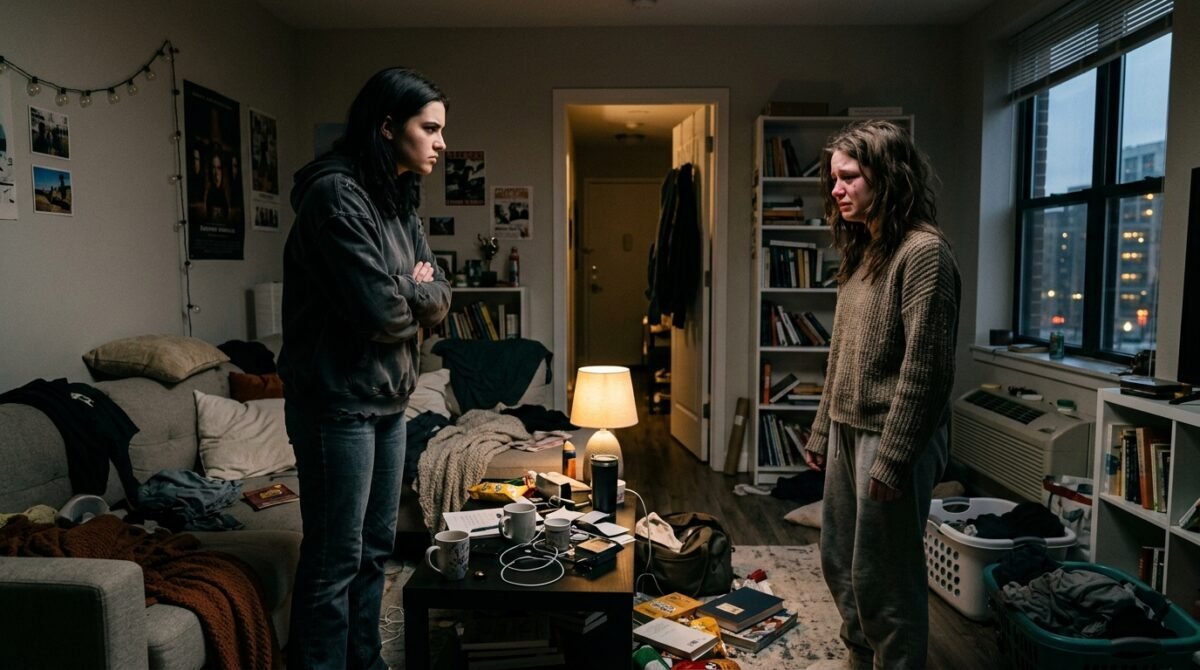
I didn’t wait. I drove straight to Clara’s apartment. I didn’t bother calling ahead or softening the blow. When she opened the door, she looked surprised, her face quickly shifting into a mask of feigned innocence. She was wearing a new outfit—something I hadn’t seen before—and as I walked past her into the living room, I noticed a stack of shopping bags from a high-end designer boutique on her coffee table.
The air in the room was thick with unspoken tension. I stood in the center of her rug, my hands shaking. I didn’t scream; I didn’t cry. I was in a state of clinical shock. I pulled the box out of my purse and set it on the table. The ring sat there, looking like a mockery of everything I held dear. I asked her point-blank: where is the real stone?
“I don’t know what you’re talking about. Are you accusing me of stealing your ring? You’ve always been the golden child, but this is a new low, even for you.”
— Clara’s response
Her defensiveness was instantaneous. She didn’t look confused; she looked prepared. It was that preparation that broke me. She had anticipated this, which meant she had been planning for it. I told her that I had just come from the jeweler and that I knew for a fact it was a fake. I told her that if she didn’t return the original, I would be calling the police before I left the building.
The shift in her expression was subtle but chilling. The mask of innocence slipped, replaced by a cold, hard glare. She stood up, crossing her arms, and began to pace the room. She started listing all the ways I had been ‘lucky’ in life—how I had the ‘perfect’ fiancé, the ‘perfect’ job, and now, the ‘perfect’ heirloom. The jealousy wasn’t just beneath the surface anymore; it was the entire foundation of her personality.
I realized then that this wasn’t about the money. It was about taking something from me, something that mattered. She wanted me to feel the same sense of inadequacy that she felt every day. She looked at me and said that I didn’t deserve it because I didn’t appreciate the history. She told me she had already sold it to cover her debts, and there was nothing I could do to get it back.
The Group Chat Explosion
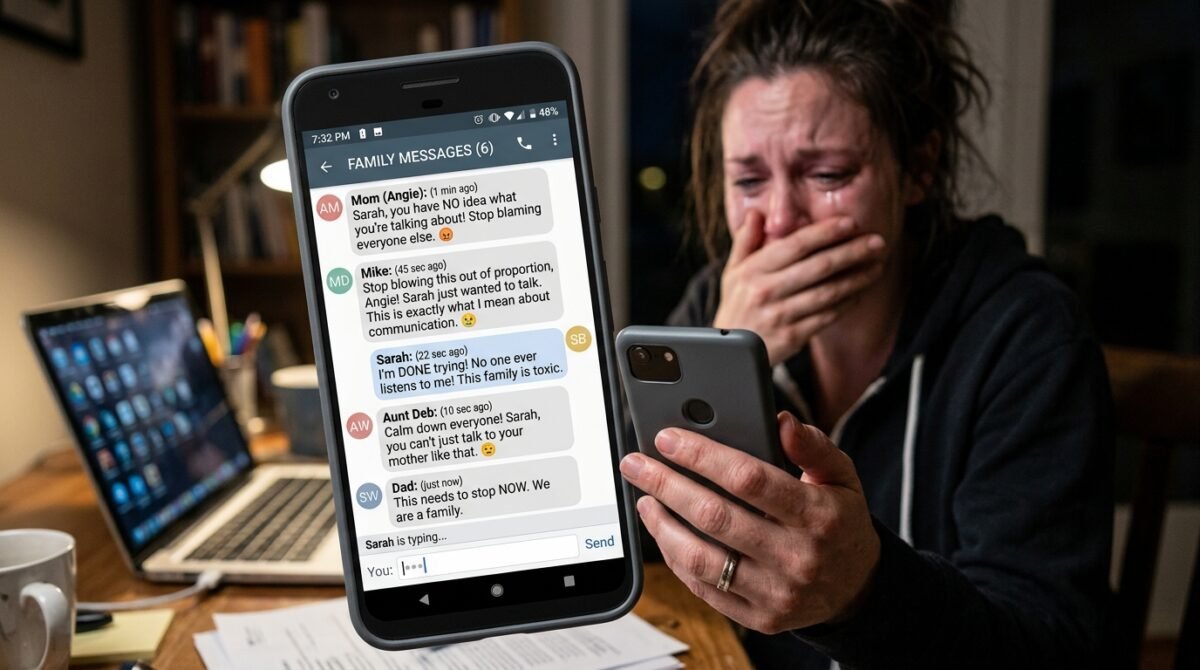
The next morning, I did what any person in the middle of a nervous breakdown does: I opened the family group chat. I didn’t leave anything out. I provided the jeweler’s statement, the timestamp of when the ring was last seen at my mother’s, and the confirmation that my own sister had admitted to the theft to cover her own financial irresponsibility. The silence that followed was deafening.
My mother was the first to chime in. She was panicked, trying to mediate, trying to tell me to ‘calm down’ and ‘keep this in the family.’ The flying monkeys started descending immediately. My aunt, who had always favored Clara, accused me of being dramatic and suggested that maybe I had lost it myself and was just looking for someone to blame. The gaslighting was immediate and total.
“Can we please not do this in the group chat? Clara has been going through a hard time. Maybe we can find a way to replace the stone without involving the police?”
— Mother, in the family group chat
“Replace the stone? It was my great-grandmother’s! It isn’t a commodity you pick up at the mall. She stole it, she sold it, and she admitted it. I’m going to the police today.”
— My reply in the group chat
The responses became increasingly hostile. My uncle told me that ‘family stands by family’ and that reporting her would be a betrayal of our lineage. I sat at my computer, reading these messages, realizing that the people who were supposed to protect me were prioritizing the reputation of the family over the integrity of the truth. It was a masterclass in toxicity.
I didn’t reply to them. I blocked the most vocal ones and kept the chat open just long enough to take screenshots for the police. I realized then that my relationship with my family had effectively ended the moment that ring left my finger. They were willing to sacrifice my trust to keep the peace, and that was something I could never forgive.
The final message came from my father, who hadn’t spoken up in years. It was short, cold, and told me that if I called the police, I was effectively ‘disowning’ myself from the family. I realized that they had been enabling Clara’s behavior for her entire life, and I was just the latest casualty of their collective denial.
The Police Report and the Reality of Crime

Walking into the police station felt like stepping into an alternate reality. I had to explain the situation to a bored officer who had clearly seen everything. I laid out the timeline, the evidence from the jeweler, and the text messages where Clara essentially admitted to the act. The officer took down the information, his pen scratching against the paper like a ticking clock.
He warned me that this would be a long, difficult process. Since it was a domestic matter involving family, the legal system would be reluctant to press charges if my family refused to testify or if they claimed it was a ‘misunderstanding.’ He asked me if I was prepared to burn every bridge I had left in my family. I told him that the bridges were already gone; they had burned them when they asked me to stay silent about a felony.
I left the station feeling a strange sense of lightness. For the first time in weeks, I wasn’t carrying the secret. I wasn’t trying to manage my family’s reputation. I was just a person who had been wronged and was seeking justice. The officer told me to expect a call from a detective, and that I should prepare for the possibility that the ring might be gone forever.
“Do you realize that if you file this report, your sister will likely face jail time? Are you absolutely certain you want to proceed with this, knowing the fallout?”
— The Intake Officer
I didn’t hesitate. I told him that actions have consequences, and if my sister was willing to steal from me to pay her debts, she needed to face the reality of the law. He looked at me with a kind of grim respect. He told me that most people in my position would have backed down, especially when family pressure was involved.
The legal process began, and with it, the formal estrangement. I had to change my locks, tighten my digital security, and prepare for a series of depositions. It was draining, but it was also clarifying. I saw my life for what it was: a series of obligations that I had been fulfilling at the expense of my own well-being. By letting go of the need for their approval, I was finally free to be myself.
The Internet Weighs In: The Reddit Verdict

I posted my story on a popular forum, seeking advice on how to handle the inevitable fallout. I didn’t expect the response I got. Within hours, the thread had thousands of comments, ranging from absolute, visceral support to cynical warnings about the legal hurdles. The collective voice of the internet was surprisingly united: I was NTA (Not the Asshole).
“This isn’t just about a ring. This is about a pattern of behavior that your family has clearly enabled for years. If you don’t press charges, she will do this again. She needs to face the consequences, or she will never stop.”
— u/JusticeSeeker_88 (Top Comment, 32.4k upvotes)
“Your family is just as guilty as she is. By asking you to ‘keep it in the family,’ they are complicit in the crime. You need to cut them all off. You are not losing a family; you are losing a burden.”
— u/TruthTeller_2024 (15.2k upvotes)
The feedback was a mirror. It reflected back to me the truth I had been trying to suppress: my family’s dysfunction was the soil in which Clara’s entitlement had grown. Reading through the comments, I realized that I wasn’t crazy for feeling hurt, and I wasn’t wrong for seeking justice. The validation of thousands of strangers helped me stay the course when the doubt crept back in.
There were, of course, the contrarians. A few users suggested that maybe there was a ‘misunderstanding’ or that I was being too harsh by involving the police. These comments usually came from people who clearly struggled with their own family dynamics and felt personally attacked by my decision to set a hard boundary. I learned to ignore them, focusing on the advice that empowered me rather than the noise that tried to diminish my reality.
The consensus was clear: the ring was a catalyst, but the problem was a lifetime of boundary-crossing. The community urged me to document everything, to keep my legal council informed, and to prioritize my own mental health above the expectations of people who clearly didn’t have my best interests at heart. It was the most honest advice I had ever received.
The $1,400 Restaurant Bill and Other Tales of Entitlement

The ring incident wasn’t an isolated event. As I sat down to write my statement for the police, I began to remember other moments—the $1,400 dinner bill Clara had ‘forgotten’ to pay, the time she walked off with my designer bag, the way she would casually wear my clothes without asking. It was a lifetime of small, incremental thefts, each one ignored by our parents because ‘she was the younger one’ or ‘she just needs a little bit of grace.’
I started a ledger. I documented every dollar, every item, and every broken promise. Looking at the list, I felt like a fool. I had been subsidizing her life for a decade, and I had simply called it ‘being a good sister.’ The ring was just the final, most expensive item in a long list of things that were never meant to be hers.
| Incident | Estimated Value | Family Response |
|---|---|---|
| Designer Handbag | $800 | ‘She just borrowed it.’ |
| Restaurant Tab | $1,400 | ‘She’s going through a hard time.’ |
| Antique Ring | $15,000 | ‘Don’t go to the police.’ |
The realization was devastating. I hadn’t been a good sister; I had been a target. By refusing to hold her accountable, I had enabled her to see me as an infinite resource, someone whose boundaries could be crossed whenever she felt the need. The anger I felt wasn’t just at her; it was at myself for allowing it to go on for so long. I had built a relationship on one-way generosity, and that, I realized, is not a relationship at all.
I shared this list with my lawyer. He told me it would be useful in demonstrating a ‘pattern of behavior’ if the case ever went to trial. It helped me frame the narrative in a way that wasn’t just ‘my sister took my ring’ but ‘my sister has a history of theft, and this was the final escalation.’ It made the police report look like a logical conclusion to years of unchecked behavior.
The Sunday Dinner Table That Stayed Silent
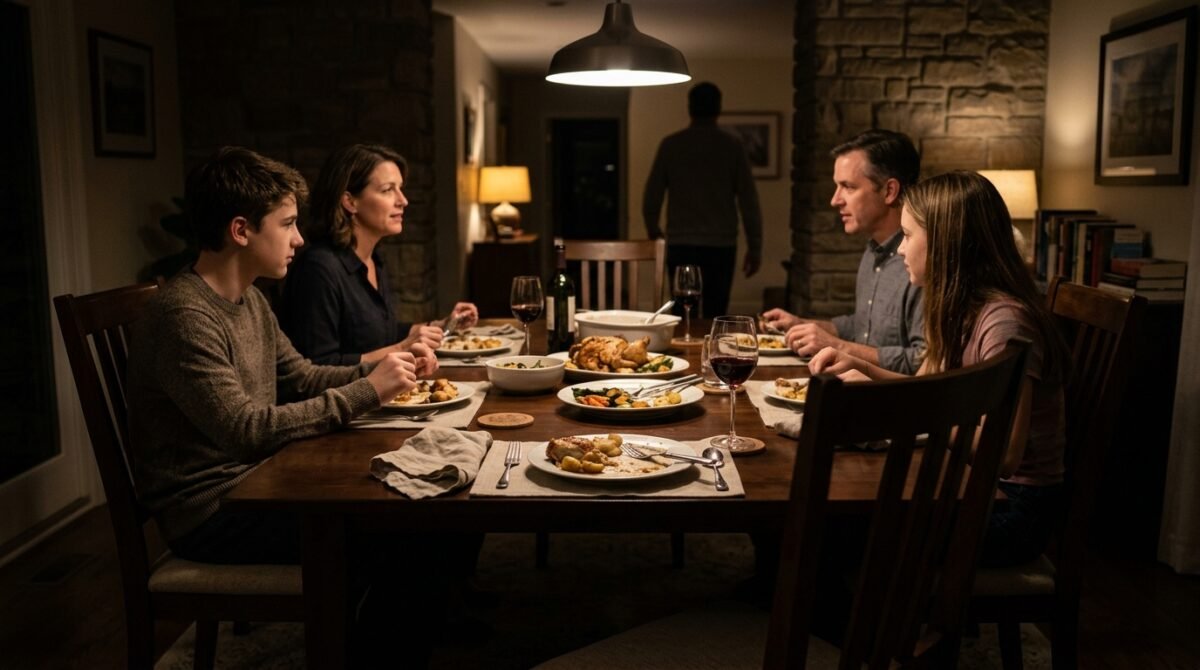
The last time I saw my family before going no-contact was at a Sunday dinner. The tension was so thick you could cut it with a knife. My mother had invited me, hoping for a ‘reconciliation,’ but I knew the script. They wanted me to drop the charges so Clara could avoid the consequences. I walked in, and the conversation stopped. Nobody said hello; nobody offered me a drink.
I sat at the table, listening to them talk about the weather and the latest office gossip, as if I hadn’t just filed a report against their daughter/sister. They were performing normalcy, trying to convince themselves that nothing had changed. I sat there, arms crossed, waiting for someone to mention the elephant in the room. When nobody did, I stood up and addressed it myself.
“Are we really going to sit here and eat roast chicken while pretending my life hasn’t been turned upside down? Are we really doing this?”
— My voice, trembling but firm
My father looked at me and told me I was ruining the meal. My mother started to cry, saying that I was ‘tearing the family apart.’ I looked at them, and for the first time, I saw them clearly. They were cowards. They were more afraid of the truth than they were concerned about my well-being. I realized that my presence wasn’t wanted; my compliance was.
I left before the main course was served. I didn’t say goodbye, and I didn’t look back. As I walked to my car, I could hear my mother screaming my name, but I didn’t stop. I felt a strange sense of relief, the kind that comes when you finally stop fighting a battle you were never going to win. I was officially the black sheep, and honestly, it felt like the most honest label I had ever earned.
That night, I changed my number. I deleted the group chats and blocked every member of my family on social media. I realized that the hardest part wasn’t the theft; it was the realization that the people I loved weren’t capable of being the people I needed them to be. I was grieving a loss, but it wasn’t the ring. It was the family I had been pretending to have.
The Legal Discovery and the Truth About the Pawn Shop
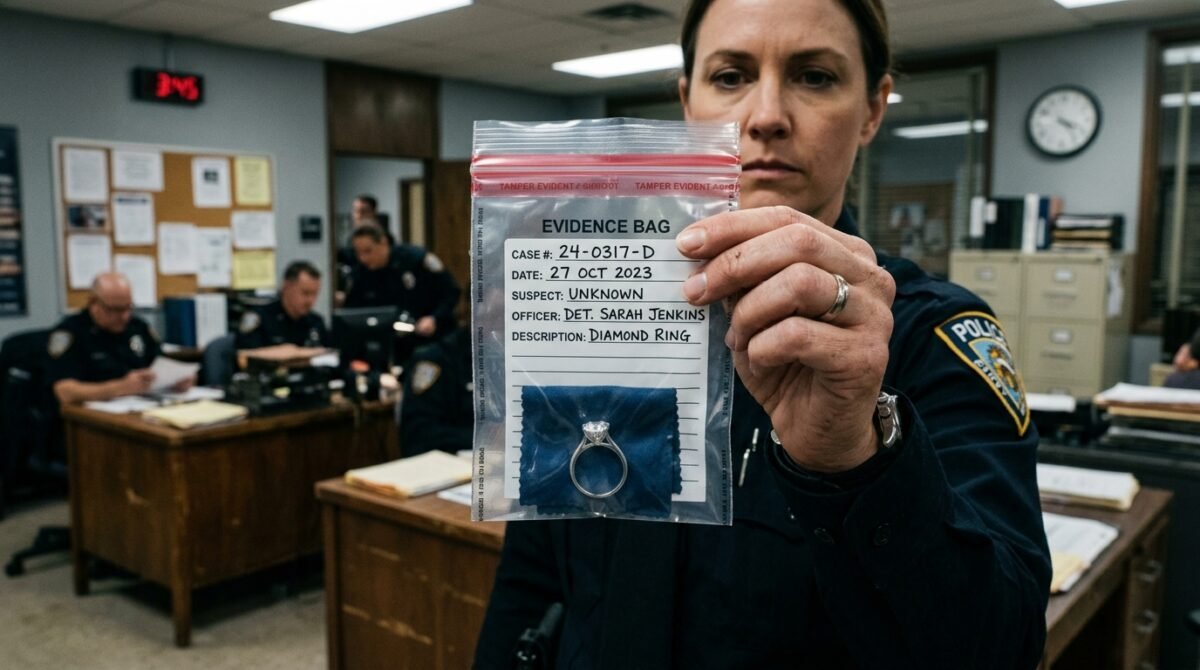
Six months later, the detective called. They had found the ring. It hadn’t been sold at a high-end auction; it had been pawned at a seedy shop on the edge of town for a fraction of its value. Clara had claimed she needed the money for ’emergency expenses,’ but the records showed she had used it to pay off a credit card that was maxed out from a shopping spree. The irony was almost too much to bear.
The detective told me that the shop owner had been cooperative and that the ring was in an evidence locker. I was expected to provide a statement to retrieve it. When I saw the ring again, it was dirty, the gold dull from being tossed in a drawer. It looked like a survivor, just like me. I held it in my hand and felt nothing—no joy, no attachment, just a cold realization that it was, in fact, just a piece of metal and stone.
“We’ve recovered the property. Your sister has been charged with grand larceny. The trial is set for the fall. Do you intend to testify?”
— The Detective
I told him I would be there. I would stand in that courtroom, and I would tell the truth. I wouldn’t do it for the ring, and I wouldn’t do it to spite my family. I would do it because I had promised myself that I would never be silent again. The legal process had been long and exhausting, but it had also been the catalyst for my own transformation.
Clara’s lawyer reached out, asking if we could settle out of court. They wanted me to drop the charges in exchange for a ‘restitution payment.’ I refused. I didn’t want her money; I wanted her to understand that she couldn’t just pay her way out of the wreckage she caused. The restitution would be decided by a judge, not a backroom deal with my parents.
By the time I left the police station with the ring in a plastic bag, I felt like I had closed a chapter. I didn’t put it back on my finger. I took it to a jeweler and had it appraised, then sold it. I donated the proceeds to a charity that helps victims of domestic abuse. It felt like the right way to end the cycle of entitlement that had defined that ring’s history.
Reflections on the Cost of Boundaries

I often think about what my life would look like if I had just kept quiet. I’d still be in the family group chat, still attending those awkward Sunday dinners, still pretending that Clara was just ‘going through a hard time.’ I’d have the ring on my finger, but I’d also have the weight of their expectations, the quiet resentment, and the constant fear of what she would take next. The price of peace, I realized, was simply too high.
Setting boundaries is often framed as a selfish act, especially when it involves family. But I’ve learned that it’s actually an act of survival. By walking away, I wasn’t abandoning them; I was reclaiming my own space. I was saying that my life, my possessions, and my history were worthy of respect. If they couldn’t provide that, then they didn’t get to be a part of my life.
“You are not defined by your family’s dysfunction. You are defined by how you respond to it. Choosing yourself is not a betrayal; it is a necessity.”
— My therapist, during our final session
I have a new circle of friends now—people who respect my space, who are transparent about their needs, and who wouldn’t dream of taking something from me to solve their own problems. It’s a different kind of life, one that is quieter, more stable, and entirely mine. The trauma of the last year has receded, leaving behind a version of myself that is stronger and more decisive.
I still get messages from my mother from time to time, usually on my birthday or a holiday, asking if I’m ‘ready to talk yet.’ I don’t respond. I know that for them, ‘talking’ means ‘going back to the way things were.’ And that is the one thing I will never do. I have moved forward, and I am finally living for myself.
The ring is gone, the sister is a stranger, and the family is a memory. But I have my integrity, and for the first time, that feels like the most valuable thing I own. I hope that by sharing my story, others who are struggling with toxic family dynamics will see that they have the right to put themselves first, even when the pressure to stay silent is overwhelming.
The Final Verdict: Lessons in Radical Honesty

If I could go back and change anything, I would have set boundaries years ago. I would have said ‘no’ when Clara asked for money, I would have called her out when she took my things, and I would have been honest about my feelings long before the ring incident. I thought I was being ‘nice,’ but I was actually just being a doormat. The lesson here is that kindness without boundaries is just a way of sacrificing yourself for someone else’s comfort.
Being ‘the black sheep’ isn’t as scary as I thought it would be. In fact, it’s quite liberating. You stop worrying about what people think, you stop trying to please everyone, and you start focusing on what actually makes you happy. I’ve discovered that the people who judge you for setting boundaries are usually the ones who benefit the most from your lack of them.
“The truth will set you free, but first it will make you miserable. Don’t be afraid of the misery. It’s the necessary cost of your freedom.”
— A quote I found on a wall in my local coffee shop
I’m planning my wedding now—my real wedding, with my fiancé. It’s small, intimate, and entirely devoid of the drama that would have surely surrounded it if my family were involved. We’re doing things our own way, and it feels authentic. We don’t have an heirloom, but we have a relationship built on trust and mutual respect, and that is worth more than any diamond.
The legal case has reached its conclusion, and Clara has been sentenced. It wasn’t the outcome I wanted—I don’t think I wanted any specific outcome—but it was the outcome that justice demanded. I hope that in the time she has to reflect, she realizes that the only person she truly stole from was herself. She lost the trust of her family, and that is a loss that no amount of stolen jewelry can replace.
I’m sharing this now because I know there are others out there in the middle of these situations, feeling the weight of family pressure and the fear of being the ‘bad guy.’ I’m here to tell you: you are not the bad guy. You are a person who deserves to be respected. Don’t let the fear of losing your family stop you from finding yourself.
Conclusion
My journey from a victim of a calculated betrayal to a woman who chose her own integrity has been the most challenging experience of my life. The loss of a ring, while painful, was ultimately the catalyst for a much-needed evolution. I walked away from a family that valued appearances over truth, and in doing so, I found a life that is truly my own.
The discourse surrounding this story has shown me that I am far from alone. Millions of people are navigating the treacherous waters of family dysfunction, and the fear of speaking out is universal. However, the cost of silence is always higher than the cost of speaking the truth. I hope my story serves as a reminder that no one has the right to treat you like an infinite resource, and your value is not defined by their expectations.
What about you? Have you ever had to draw a line in the sand with someone you loved, even when it meant losing them? Have you ever had to choose your own integrity over the peace of your family? I want to hear your stories in the comments below. Let’s create a space where we can share the reality of these hard choices and support each other in the pursuit of a life lived on our own terms.
What's your verdict on this dilemma?
Vote below to contribute to the official community consensus.

Have a Dilemma Keeping You Up at Night?
Share your real-life feud, wedding chaos, or relationship crossroads anonymously with our editorial team.
What do you think ?
0 Comments🛡️ Comments are moderated to protect community integrity. Your comment will appear once approved by the editorial team.