
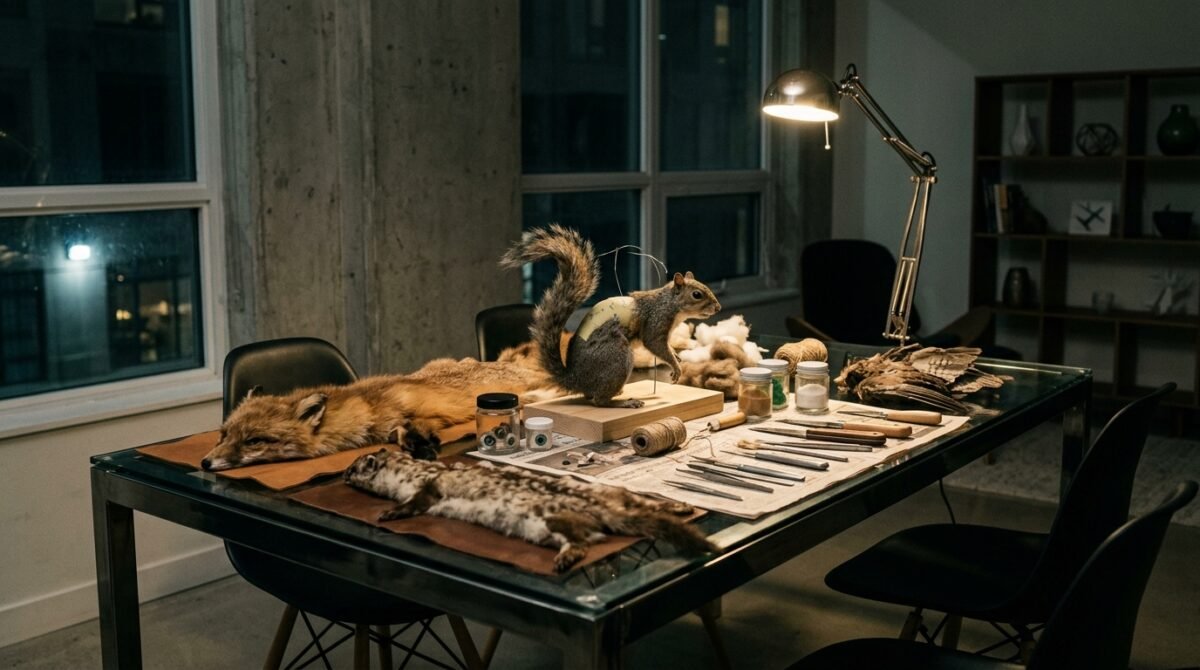
Living with a roommate is an exercise in compromise. You negotiate chores, fridge space, and the occasional guest, but there is an unspoken social contract regarding the ‘living areas’ of a shared home. My roommate, Sarah, had always been a bit eccentric—she was an art student with a penchant for oddities—but I never imagined our apartment would eventually resemble a Victorian-era anatomy lab.
It started with a few framed beetles, which I thought were a quirky decor choice. Then came the ‘preserved specimens’ in jars. But last Tuesday, I came home from a twelve-hour shift to find the dining room transformed into a staging ground for something far more visceral. There, on our expensive glass dining table, was a dead squirrel being meticulously peeled back by a stranger with a scalpel.
Sarah didn’t even look up as I entered. She was busy explaining the finer points of ‘skin tension’ to two wide-eyed students who had paid fifty dollars each to sit in my dining room and gut rodents. The smell was the first thing that hit me—a metallic, chemical tang of formaldehyde and musk that clung to the upholstery.
This wasn’t just a hobby; it was a business, and I was the unwilling silent partner in an enterprise that violated every lease agreement and hygiene standard imaginable. When I finally found my voice to object, the reaction I received was not one of apology, but of complete and total bewilderment at my lack of ‘artistic support.’ This is the story of how our home became a gruesome studio, and the battle that followed to reclaim my sanity.
The Tuesday Night Intrusion
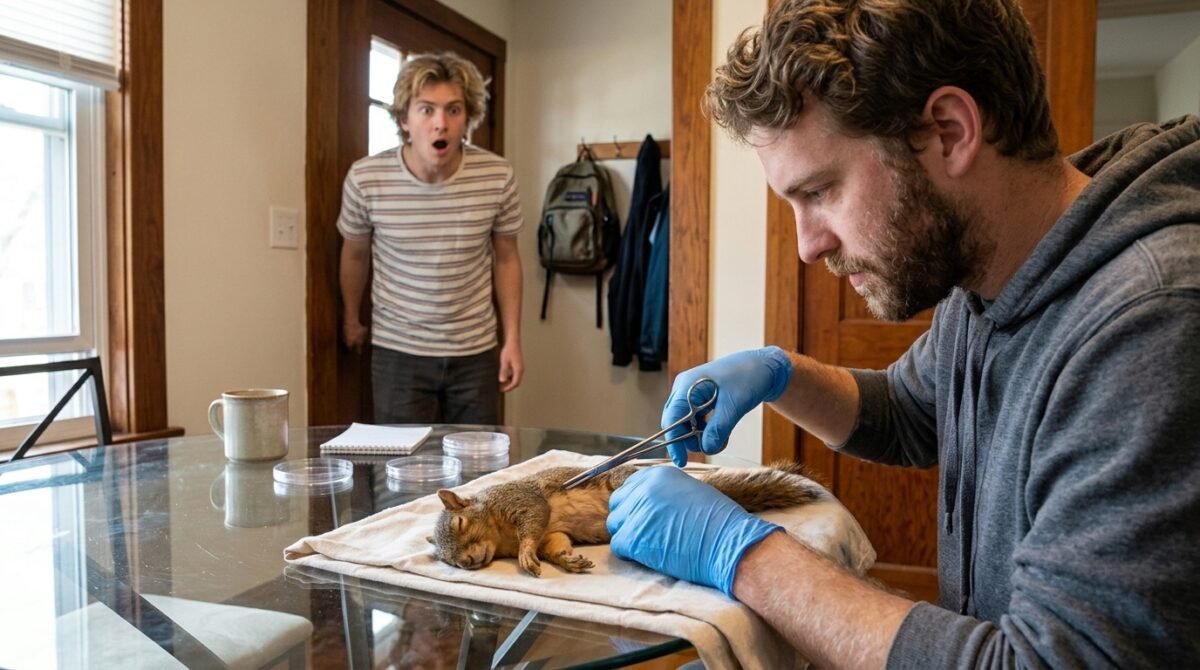
I opened the front door expecting the quiet sanctuary of my apartment after a grueling day at the firm. Instead, the smell of formaldehyde punched me in the gut. The lights in the dining room were dimmed, but the center of the table was illuminated by a harsh, surgical-grade LED lamp that Sarah had clearly purchased just for this occasion.
Three people were hunched over the glass surface. Sarah was holding a pair of tweezers, demonstrating how to remove the tail fur of a squirrel. My dining table, which I had saved up for six months to purchase, was covered in a thin layer of sawdust and what I could only describe as ‘biological debris.’ I stood frozen, my coat still on, watching as they worked with terrifying precision.
“Sarah, what in the hell is happening? Why is there a dead animal on our table? And who are these people?” I asked, my voice trembling with a mix of exhaustion and rage.
Sarah looked up, her hands covered in a dark, tacky residue. She didn’t look guilty. She looked annoyed that I had interrupted her ‘masterclass.’ She shrugged, motioning to the people sitting in my chairs—chairs I’d bought, mind you—and acted as if I were the one making an unreasonable scene.
“It’s a workshop, Mark. I told you I was getting into professional preservation. These people are paying to learn the craft. Don’t be so dramatic; it’s just a squirrel, and it’s completely sanitized. I’m doing this to build my portfolio for the grad school applications. You should be happy for me.”
The two ‘students’ looked at me with varying degrees of discomfort, clearly having been told that I was ‘on board’ with this. I had never seen these people in my life. The audacity of it—turning my private living space into a commercial classroom without a single word of discussion—made my blood boil. It wasn’t just about the dead animal; it was about the total erasure of my boundaries in my own home.
The Financial Breakdown of a Nightmare

Later that night, after the ‘students’ had packed up their kits and left behind a collection of bloody paper towels and a lingering scent of rot, I cornered Sarah in the kitchen. I demanded to know how long this had been planned and exactly how much money she was making off my furniture. It turned out, she had been running these workshops for weeks while I was at my late-night shifts.
She had been advertising on a niche local arts forum. She charged sixty dollars per head, with a limit of three students per session, twice a week. That meant she was grossing nearly seven hundred dollars a month, all while using my electricity, my cleaning supplies, and my furniture. She hadn’t offered to split a dime of the proceeds or even cover the extra utility costs.
“You’re profiting off my home, Sarah. That table is going to be stained. The smell is embedded in the curtains. How did you think this would end? Did you think I wouldn’t notice the sawdust in the rug?” I asked, gesturing to the floor.
Sarah’s response was chillingly dismissive. She pulled out her phone and started scrolling through her ‘business’ messages. She insisted that because she paid half the rent, she had ‘equal authority’ over the use of the common areas. She viewed the table as a communal asset that she was ‘utilizing for entrepreneurship.’
I asked her if she had considered the liability. If one of her students cut themselves—or worse, if we got evicted because the landlord walked in on a DIY taxidermy class—who would be responsible? She rolled her eyes and claimed that everyone signed a waiver. A waiver. She was running an illegal commercial operation in a two-bedroom apartment and thought a piece of paper made it legal.
The financial disparity between us was also clear. She was struggling with her bills, which I understood, but that did not entitle her to turn our home into a horror movie set. I told her the sessions stopped immediately. Her response was a cold, calculated silence that signaled she had no intention of backing down.
The Escalation of Passive-Aggressive Notes
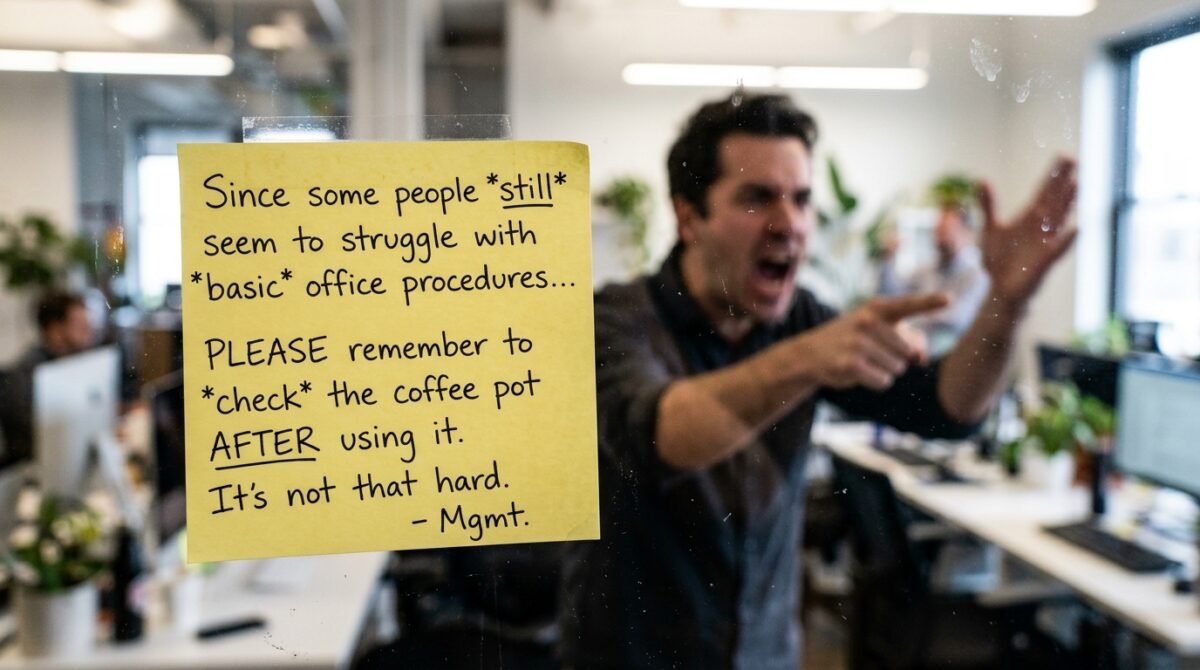
The next day, I woke up to find a sticky note on the bathroom mirror. It read: ‘Please don’t touch the curing rack in the guest room.’ I walked into the guest room, which I rarely use, and discovered that she had turned the closet into a drying rack for bird carcasses. The stench was unbearable, a sickly sweet odor of decaying feathers that had permeated the entire apartment.
I ripped the note down and went to work, but the anger simmered under my skin all day. I spent my lunch break looking up local zoning laws and the terms of our lease. Nothing in our contract allowed for ‘commercial activity,’ and certainly not the kind that involved biohazards. I was ready to call the landlord, but I knew that would mean an automatic eviction for both of us.
When I got home, I found a new, even more insulting sign taped to the dining table: ‘Reserved for Workshop: Tuesday 7 PM – 10 PM. Please vacate the area.’ She was literally scheduling me out of my own living room. I didn’t say a word. I walked over to the table, peeled the sign off, and shredded it into the trash can.
“You’re really going to act like a child, Mark? It’s just until the end of the month. I have three more sessions booked and paid for. If I cancel, I lose my reputation on the forum. Are you really that selfish?” Sarah shouted from her bedroom.
I realized then that she had completely dissociated from reality. She saw herself as a visionary artist, and me as a petty obstacle in the way of her ‘greatness.’ The fact that she was willing to jeopardize our housing and my comfort for a few hundred dollars a month was staggering. I started documenting everything—the smell, the carcasses, the students, the notes.
I texted my landlord, but I didn’t send it yet. I wanted to see if she would come to her senses. I gave her one final warning: either the workshops stopped by Friday, or I would involve the building management. She just laughed. She truly believed that I was bluffing, that I wouldn’t have the guts to go nuclear on our living situation.
The Reddit Community Weighs In
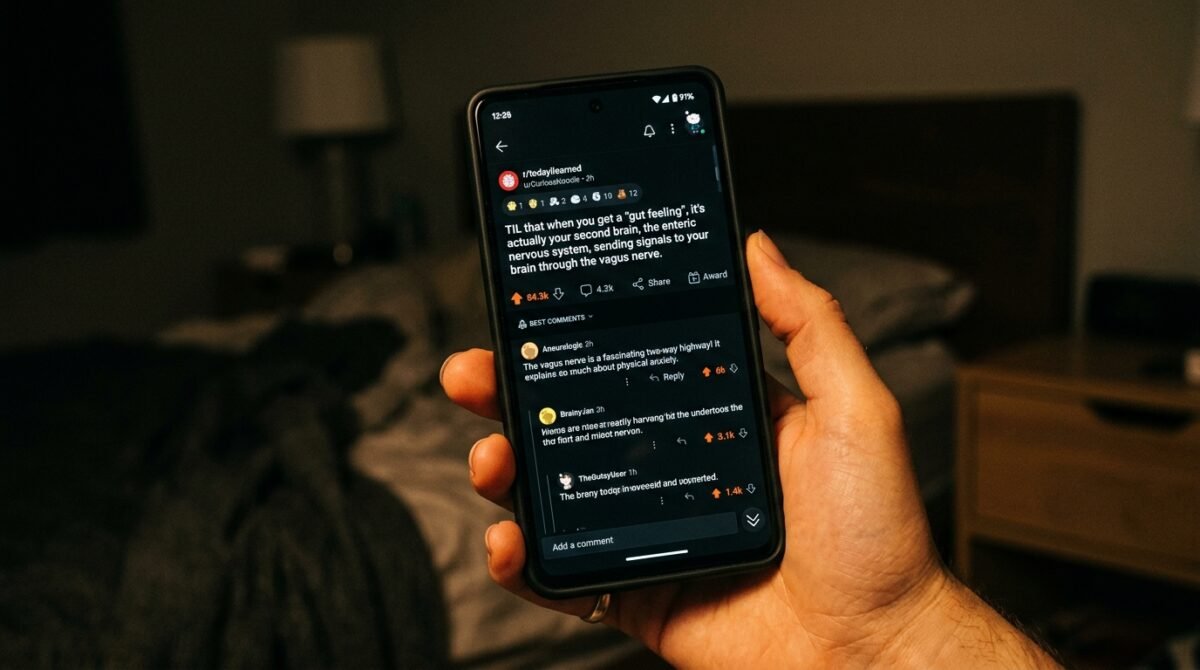
I turned to the AITA subreddit that evening. I posted a throwaway account, detailing the situation with as much neutrality as I could muster. I wanted to know if I was the jerk for being ‘intolerant’ of her ‘art.’ The response was instantaneous and overwhelming. Within three hours, the post had five thousand upvotes and a deluge of comments that ranged from horror to practical legal advice.
The collective consensus was that I was absolutely not the jerk. Many users pointed out that the health risks alone—handling raw, potentially diseased animal carcasses in a residential kitchen—were grounds for an immediate health department investigation. People were sharing similar stories of ‘creative’ roommates who had pushed boundaries until the lease was voided.
“This isn’t ‘taxidermy,’ this is a health hazard. You are living with someone who is actively inviting strangers into your home to handle raw meat on your dining table. This is a massive liability. If one of those students gets sick from a bacteria-ridden squirrel, you’re on the hook too because you’re a tenant on the lease.”
— u/LegalEagleEye (15.2k upvotes)
Reading the comments made me realize that I hadn’t been overreacting; I had been under-reacting. I was concerned about being polite, while Sarah was concerned about nothing but her own ego. The comments gave me the spine I needed. I realized that my fear of conflict was the very thing she was counting on to keep her business running.
Another user noted that the ‘waivers’ she was making people sign were likely worthless in a residential setting. If someone got a staph infection, they wouldn’t sue the ‘artist’; they would sue the person whose name was on the lease. The realization that I was literally liable for her recklessness was the final straw. I was going to shut this down, one way or another.
I saved the best comments, including the ones that detailed how to report a lease violation without getting myself kicked out immediately. I was going to use this as leverage. If she didn’t stop, she was going to be the one on the street, not me. The support of the community made the confrontation feel less like a personal feud and more like a necessary act of self-preservation.
The Confrontation in the Kitchen
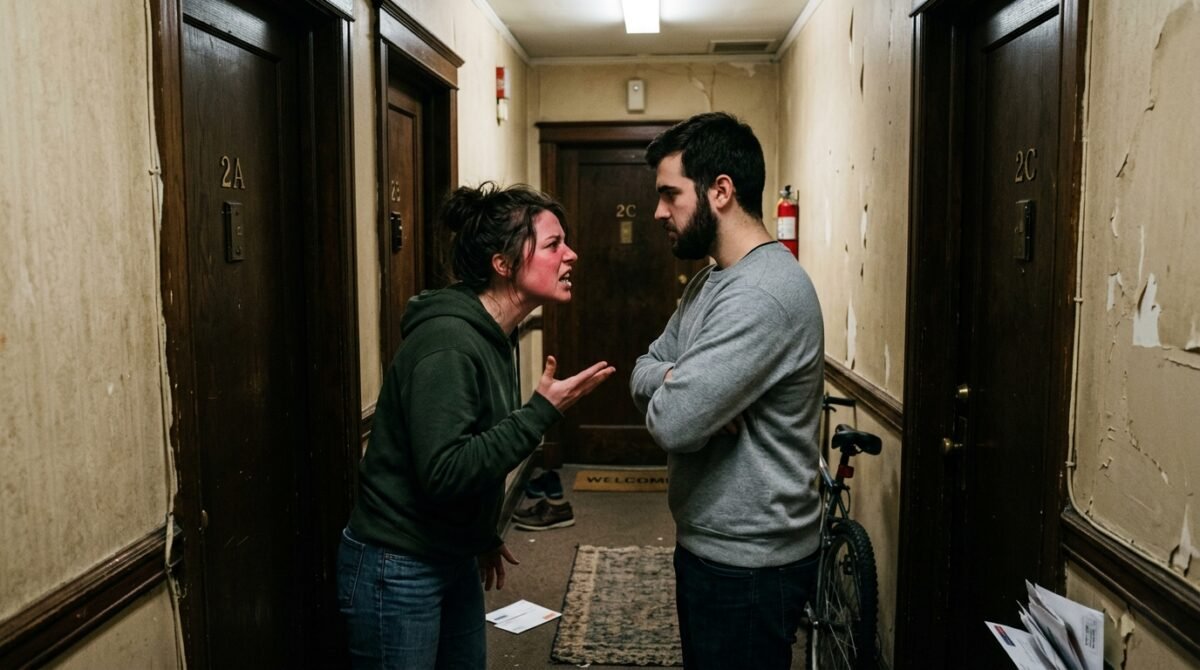
Friday arrived, and with it, the scheduled workshop. I walked through the door at 6:55 PM, just as a stranger was knocking. I opened the door before Sarah could. I looked the person directly in the eye and said, ‘There is no workshop here. You should go home.’ The person looked confused, then looked at Sarah, who was rushing into the hallway with a face of pure fury.
She tried to shove past me to talk to the ‘student,’ but I blocked the hallway. I told her firmly that the workshop was cancelled and that if another person entered our apartment, I would be calling the police for trespassing. The student, sensing the intense toxicity, quickly turned around and left. Sarah exploded.
“Who do you think you are? You don’t own me! You’re just a miserable person who hates seeing anyone else succeed. I am doing something creative, something real, and you’re just a corporate drone who spends their life at a desk!” she screamed.
I stayed calm, which only made her angrier. I told her that her ‘creativity’ was a sanitation nightmare and that I had documented the entire thing. I mentioned the health department and the lease violations. Her face went pale for a second before she regained her composure, trying to downplay the severity of what I was saying. She tried to tell me I was exaggerating, that the carcasses were ‘ethically sourced’ and ‘clean.’
I asked her for proof of where she sourced the animals. She couldn’t provide it. She admitted she had been picking them up from the side of the road and from a local butcher who gave her ‘leftovers’ for free. The horror of it—she was handling roadkill on our dining table—made me physically ill. I told her that she had until tomorrow morning to remove every single ‘specimen’ and every piece of ‘workshop’ equipment from the common areas.
She threatened to move out, but she knew she couldn’t afford the rent on her own. She was trapped by her own financial mismanagement, and I was the one holding the leash. She retreated to her room, slamming the door so hard that a picture frame fell off the wall. The apartment was finally quiet, but the air still felt heavy with the tension of the last few weeks.
The Cleanup Operation
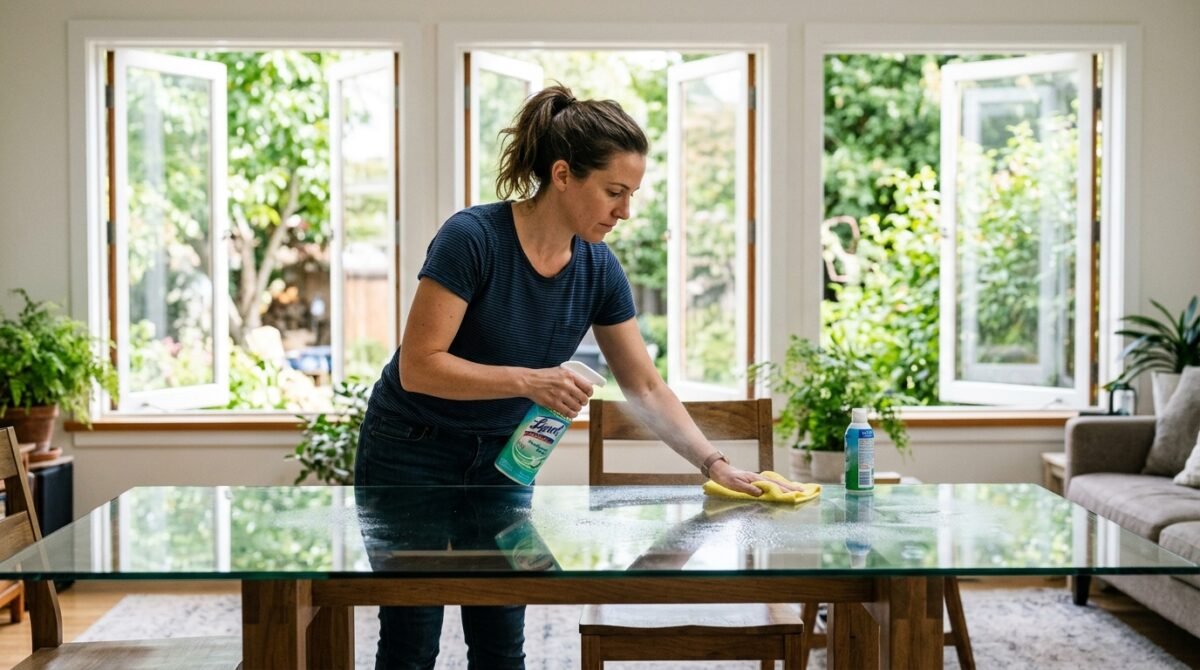
The next morning, I woke up to the sound of Sarah moving boxes. She was finally complying, albeit with a level of bitterness that was palpable. I didn’t help her; I went to the store and bought three different types of heavy-duty disinfectant, a steam cleaner, and a new tablecloth. I was determined to reclaim my space.
As she cleared out the guest room closet, the smell that billowed out was nauseating. I had to wear a mask while cleaning. I spent four hours steam-cleaning the rug and scrubbing the dining table with industrial-strength cleaner. I felt like I was purging the apartment of some kind of curse. Every time I found a stray needle or a piece of wire, I felt another layer of frustration peeling away.
“I hope you’re happy. My career as an artist is basically ruined because you couldn’t be a supportive roommate for even a month. You’re going to be living in this boring, soulless apartment by yourself soon enough,” she muttered as she dragged a box to the car.
I didn’t argue. I just kept cleaning. I didn’t care about being ‘supportive’ of a business that put my housing and health at risk. I realized then that our friendship—or at least the thin veneer of it—was dead. You can’t be friends with someone who doesn’t respect your basic humanity, and turning our shared home into a biohazard zone was the ultimate sign of disrespect.
By the afternoon, the apartment was finally clear. I opened all the windows, letting the crisp air circulate, and for the first time in weeks, the smell of formaldehyde faded. It felt like I had finally breathed real air again. I sat down at the table, now clean and bare, and realized how much I had sacrificed just to keep the peace. Never again, I promised myself.
Sarah stayed in her room for the rest of the day. We didn’t speak. The silence was the most honest conversation we’d had in a long time. I knew that the living situation was untenable long-term, but for now, the war was over. I had won the battle for the table, but I had lost any remaining shred of respect I had for my roommate.
The Aftermath and The Unspoken Truth
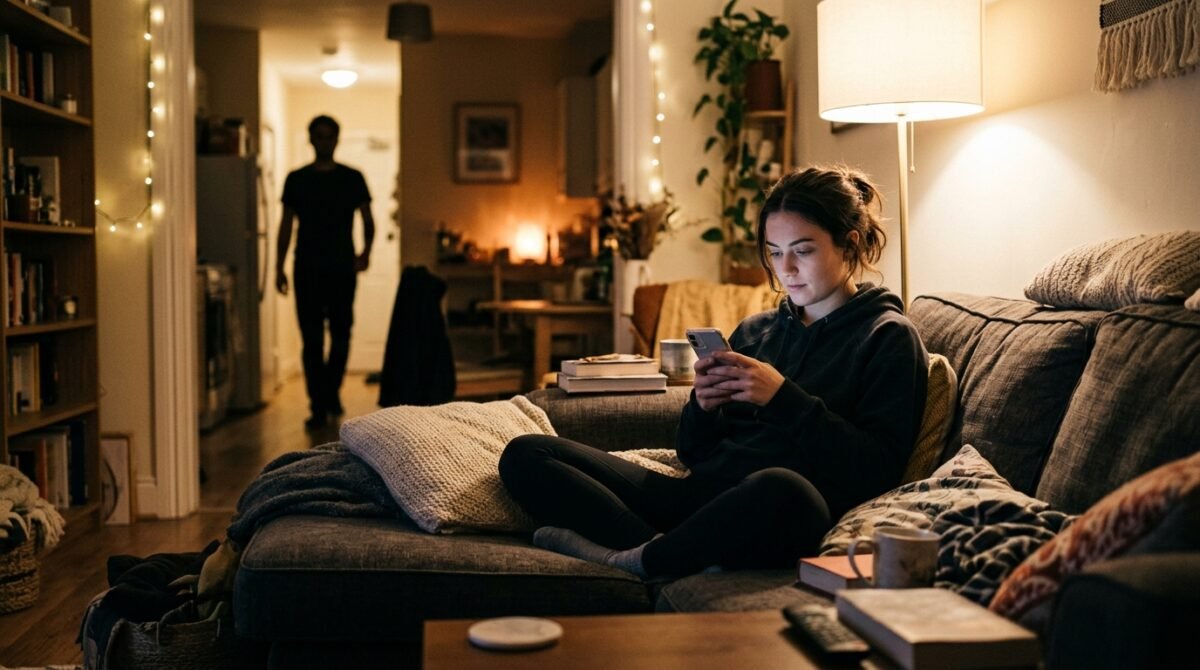
Life in the apartment became incredibly awkward. We moved through the space like ghosts, avoiding eye contact and keeping our interactions to the barest of necessities. She no longer invited people over, and I made sure to be home at odd hours just to keep an eye on things. The ‘artistic’ phase was clearly over, but the resentment remained as a thick, suffocating cloud.
I spent my evenings in the living room, listening to music or reading, and every time I heard her door open, my heart would speed up, expecting some new disaster. The stress of the situation had taken a toll on my sleep and my work performance. I was constantly on edge, waiting for the other shoe to drop, which made me realize that I couldn’t live like this for much longer.
“Are you going to keep treating me like a criminal for the rest of the lease? We live together, Mark. Can’t we just move past this and be normal again?” she asked one evening, trying to sound casual.
I looked at her, really looked at her, and realized that she still didn’t get it. She thought the problem was my ‘reaction’ and my ‘lack of support,’ not her behavior. She thought I was the one being difficult because I wouldn’t let her run an illegal, unsanitary business in our living room. She had no capacity for self-reflection.
I told her that we weren’t ‘normal’ because she had violated my trust in a way that couldn’t be fixed with an apology. I told her that while the workshops were over, the breach of boundaries was something I couldn’t forget. She rolled her eyes, confirming that she still believed she was the victim. That was the moment I decided I was moving out as soon as the lease was up.
I started secretly looking for apartments. I didn’t tell her. I wanted to surprise her with my exit. I didn’t owe her any more of my time or my energy. The apartment that I had once loved was now just a place I slept in, a temporary residence until I could find my own sanctuary. The lesson was learned: never assume your roommate has the same standard of living as you do.
The Final Moving Day
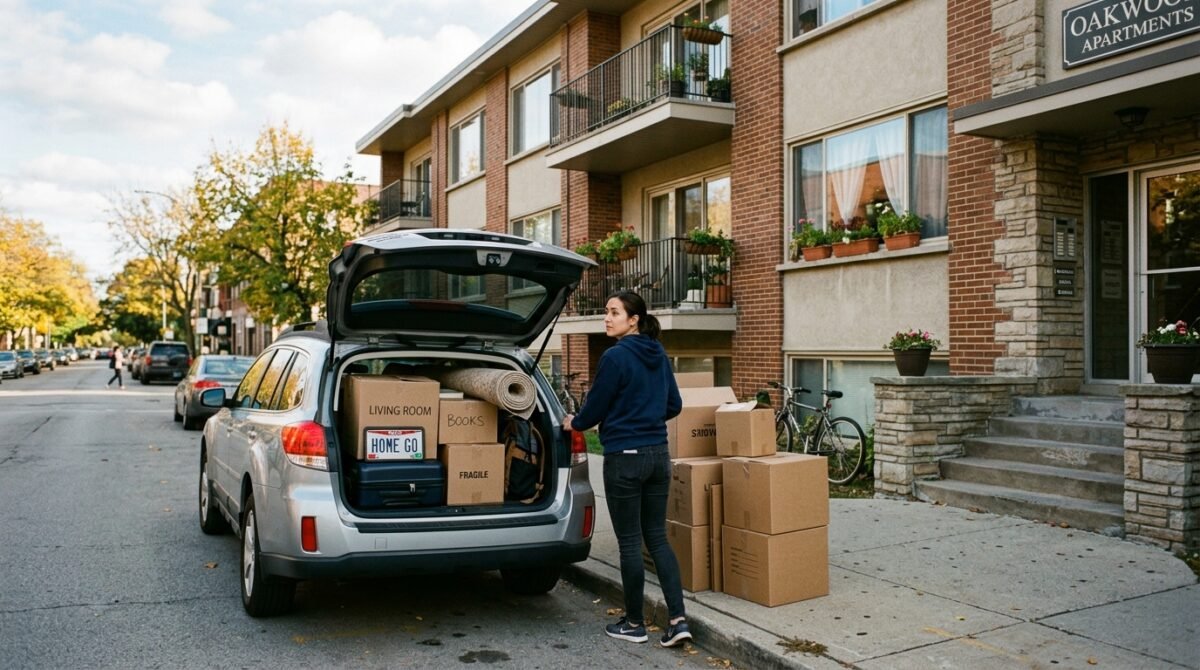
When the lease expiration date finally approached, I gave my notice to the landlord, and then told Sarah. The look on her face was priceless—a mix of shock and pure, unadulterated anger. She realized that she wouldn’t be able to afford the place on her own, and she would have to move back in with her parents or find a new, cheaper, and likely much worse apartment.
I spent the last two weeks of the lease packing, carefully wrapping every piece of furniture that I owned. I wanted to make sure that I didn’t leave a single trace of myself behind. I was meticulous, almost surgical, about my departure. I wanted to leave the apartment exactly as it was when I moved in, minus the trauma and the lingering scent of chemicals.
“So, you’re just abandoning me? After everything we’ve been through, you’re just going to leave me to deal with the rent by myself? You’re the most selfish person I’ve ever met, Mark. You’re truly pathetic,” she shouted as I carried my final box to the car.
I paused at the door, took a breath, and looked back at her. She was standing in the middle of the kitchen, looking small and angry. I didn’t feel the need to argue back. I simply said, ‘I’m not abandoning you, Sarah. I’m choosing to live in a place where I feel comfortable. You made your choice, and now I’m making mine.’ It was the most satisfying sentence I had ever uttered.
As I drove away from the complex, I felt a weight lifting off my shoulders that I hadn’t realized I was carrying. The apartment wasn’t just a place; it was a cage. And as I turned onto the highway, headed toward my new, quiet, solitary studio, I knew I was finally free. The taxidermy nightmare was a dark chapter, but it was over.
I look back on that time now and I don’t feel anger anymore, just a strange sense of disbelief. How did it get so far? How did I let myself be pushed around for so long? I learned that your home is your sanctuary, and you have to protect it with everything you have. Sometimes that means being the ‘bad guy,’ and that’s perfectly okay.
Reflecting on the Boundaries We Keep

Now that I’ve been living on my own for a few months, I’ve had time to reflect on why it was so hard to say ‘no’ in the first place. I think it comes down to a fear of being perceived as the ‘difficult’ one. Society often pressures us to be easygoing, to compromise, to ‘go with the flow,’ even when our boundaries are being trampled. But I’ve learned that there’s a massive difference between compromise and self-betrayal.
Living in my own space has taught me that the peace of mind that comes from having a clean, safe, and private home is worth more than any amount of social harmony. I’ve realized that people who push your boundaries will always frame your resistance as a moral failing on your part. They’ll call you selfish, cold, or petty, but that’s just a tactic to keep you from asserting yourself.
“Boundaries aren’t about being mean. They are about maintaining your own integrity. When someone violates your home, they are violating your safety. You don’t owe anyone the right to make you uncomfortable in your own sanctuary.”
I also think about the students who came to those workshops. I wonder if they ever realized how inappropriate the setting was. Did they ever wonder why they were paying to cut up a squirrel in someone’s dining room? It’s a testament to how easily people can be led into uncomfortable situations if the person in charge acts confident enough. Confidence is not the same thing as correctness.
I’ve started a new life, and for the first time in years, I’m truly at peace. I have my dining table, and it’s pristine. I have my kitchen, and it’s clean. And most importantly, I have my silence. I don’t worry about what’s happening in the next room, and I don’t worry about who is coming through my front door. It’s a luxury I’ll never take for granted again.
I often check in on that original Reddit thread to see if there’s any new advice or if anyone else has shared their story. The community support was a lifeline, and it showed me that there are plenty of people out there who understand the struggle of dealing with a nightmare roommate. It’s comforting to know I wasn’t alone in this, even if it felt like it at the time.
Community Echoes: Lessons Learned Together

Looking back at the comments on my post, I see that this is a much more common issue than I realized. Many people have written to tell me about their own experiences—roommates who started unauthorized businesses, or who filled the house with strange collections, or who simply didn’t understand the concept of shared living. It’s a universal human struggle, this negotiation of space and respect.
One commenter, who had been through a similar situation, said something that really stuck with me: ‘A roommate is not a friend, and they are not family. They are a business partner in the venture of housing.’ That’s a cold way to put it, but it’s accurate. If you don’t treat the living situation like a partnership with clear rules and expectations, it will inevitably turn into a disaster.
“The moment you start being afraid of your own home, you have lost. The only way to win is to leave, or to set such firm boundaries that they have no choice but to change. Don’t let them make you the villain for wanting a livable space.”
— u/HomeownerReflections (8.2k upvotes)
I feel a sense of camaraderie with everyone who has had to stand up for themselves in their own home. It’s a hard thing to do, especially when you value being a ‘good person.’ But being good doesn’t mean being a doormat. Being good means knowing when to stand your ground, not just for yourself, but to teach others that your boundaries are non-negotiable.
I’m finally able to laugh about the ‘Taxidermy Incident,’ though the smell of formaldehyde still makes me shudder. It was a bizarre, surreal, and deeply stressful chapter of my life, but it was also a turning point. It made me more assertive, more protective of my well-being, and much more careful about who I choose to share my life and my space with.
If you find yourself in a situation like this, don’t wait. Don’t hope they’ll change. Don’t think that being polite will fix a fundamental lack of respect. Take control, document everything, and protect your peace. Your home is your foundation; don’t let anyone turn it into a, quite literally, dead space.
Conclusion
The story of my taxidermy-obsessed roommate is a strange one, but it carries a powerful lesson about the fragility of our personal sanctuaries. It’s easy to let things slide, to prioritize ‘keeping the peace’ over protecting our own mental and physical health. But we have to remember that our homes are the places where we are supposed to feel the most safe, the most grounded, and the most ourselves. When that safety is compromised, we have a duty to ourselves to act.
The moral of this story isn’t just about taxidermy; it’s about the entitlement that can manifest when we don’t set clear, firm boundaries from the start. Whether it’s a business being run out of your kitchen or just a disregard for cleanliness, the pattern is the same: one person’s convenience comes at the cost of another’s peace. And that, in any healthy relationship, is never okay.
I hope that by sharing this, I’ve given someone else the courage to stand up for their own living space. You deserve to be comfortable in your home, and you should never have to feel like a guest in your own apartment. Have you ever had a roommate who crossed the line with a ‘side hustle’ or an odd habit? What did you do to handle it, and what did you learn? Let’s talk about it in the comments below.
What's your verdict on this dilemma?
Vote below to contribute to the official community consensus.

Have a Dilemma Keeping You Up at Night?
Share your real-life feud, wedding chaos, or relationship crossroads anonymously with our editorial team.
What do you think ?
0 Comments🛡️ Comments are moderated to protect community integrity. Your comment will appear once approved by the editorial team.