
Living with roommates is a gamble, a delicate social contract built on the assumption that everyone understands the basic tenets of shared space. For three years, Mark and I had existed in a state of benign indifference. We split the utility bills, occasionally shared a carton of milk, and kept our personal dramas confined to our respective bedrooms. That was, until Mark decided that his true calling wasn’t accounting, but the lucrative and highly toxic world of boutique resin paperweights.
It started innocently enough—a few bottles of clear resin appearing on the kitchen counter, then moving to the master bathroom because, as he claimed, it was ‘better ventilated.’ I didn’t think much of it until the slow, creeping dread of a clogged drain turned into an emergency plumbing nightmare that cost me a month’s salary and nearly destroyed our friendship. The issue wasn’t just the mess; it was the audacity of the invoice that followed.
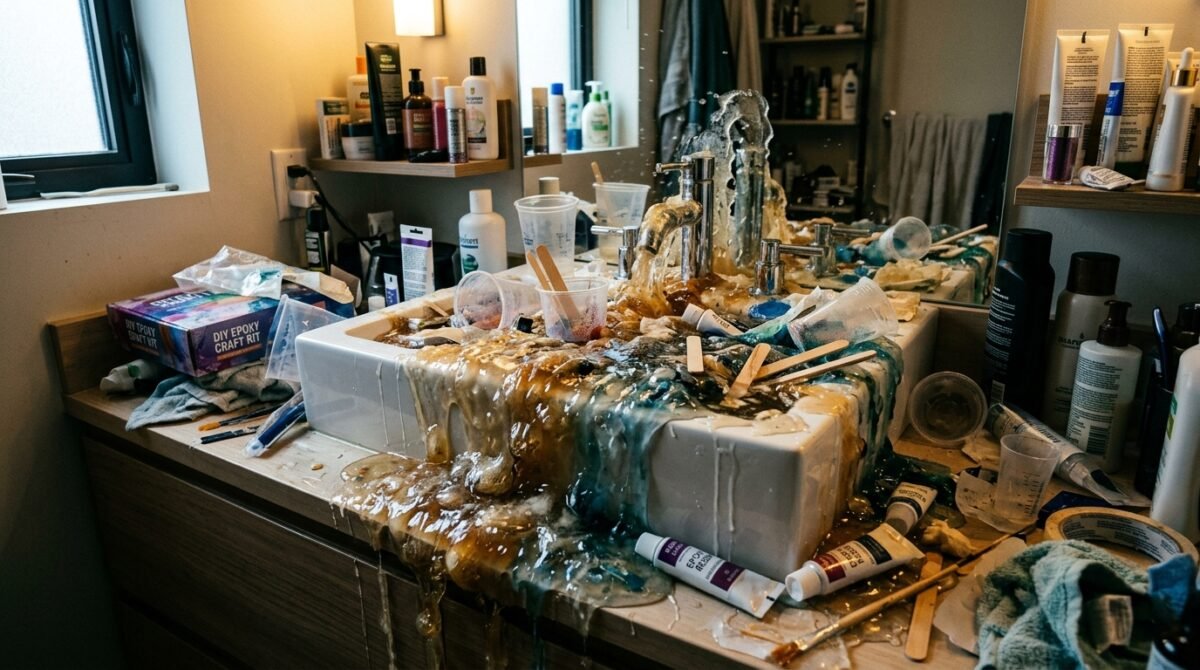
When I walked into the master bathroom that Tuesday evening, the smell of chemical hardener hit me like a physical blow. The sink, which had been perfectly functional, now appeared to be growing a crystalline, calcified tongue of hardened goop. I didn’t realize until later that what I was seeing was the aftermath of a catastrophic failure in judgment: an entire batch of industrial-grade epoxy, improperly mixed, poured, and then hastily rinsed away when things went sideways.
The moral dilemma here isn’t just about the money; it’s about the absolute refusal to take accountability. Mark didn’t see himself as a vandal. In his mind, he was an entrepreneur whose business had hit a ‘small, external logistical snag.’ This article chronicles the descent into madness that occurred over the next seventy-two hours, the terrifying phone calls with the plumber, and the shocking group chat reveal that proved I was never really his friend—I was just a subsidized facility.
The Subtle Smell of Chemical Decay
It began as a faint, acrid scent, the kind of sharp chemical sting that lingers at the back of your throat. I initially assumed Mark had purchased a new cleaning product or perhaps a particularly aggressive air freshener. Little did I know that my bathroom—the one I paid an extra two hundred dollars in rent for—had become a makeshift laboratory for his failing startup.
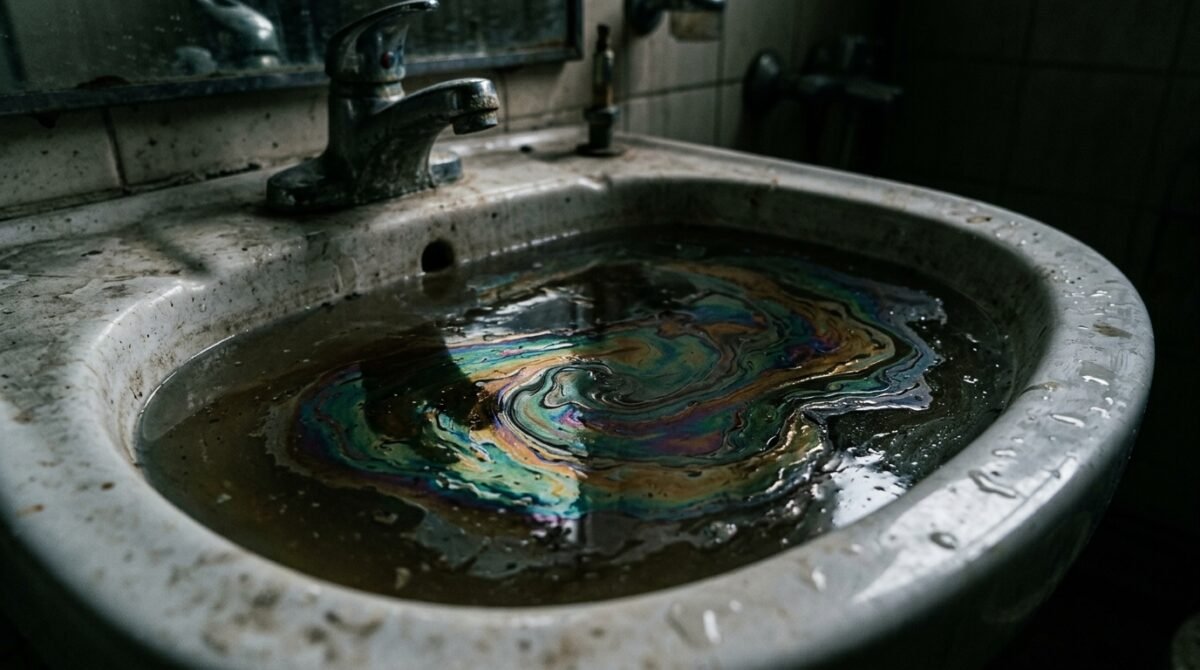
I remember standing at the sink to brush my teeth, noticing a viscous, sticky residue clinging to the ceramic basin. I scrubbed it with soap, assuming it was just hair gel or toothpaste, but the texture was wrong. It felt like rubber, or perhaps softened plastic. At the time, I didn’t connect it to the ‘Artisan Epoxy Co.’ stickers that had started appearing on cardboard boxes in the hallway.
The denial was my first mistake. By ignoring the subtle changes in the environment, I allowed the hazard to grow. I didn’t confront him because I didn’t want to be the ‘nagging roommate.’ I wanted to keep the peace, a recurring theme in my life that Mark had learned to exploit with calculated precision over the last few months.
“Hey, have you noticed a strange smell in the bathroom lately? It’s kind of giving me a headache,” I texted him on Monday. He replied, “It’s just my new project. It’s non-toxic, man. Don’t worry about it. It’ll clear out by tomorrow.”
Of course, it didn’t clear out. It got worse. The chemical scent evolved into a heavy, suffocating odor of burnt plastic. By Tuesday, the sink was no longer just sticky; it was beginning to hold water for minutes at a time, a sign that the pipes were already beginning to harden from the inside out.
The Midnight Gurgle That Ended Our Friendship

The sound didn’t wake me up, but the absence of it did. I woke up at 3:00 AM to the sound of a rhythmic, wet ‘thwack’ coming from the master bathroom. I groggily walked down the hall, expecting to find a leak. What I found was a disaster in motion. The water in the sink wasn’t just draining slowly; it was backing up with a thick, gelatinous sludge that looked like industrial-grade amber.
Mark was standing there, staring at the sink with a look of absolute confusion. He was holding a plastic mixing cup, his hands covered in gloves that were also caked in semi-hardened resin. He had clearly tried to pour the ‘failed’ batch down the drain, thinking it would wash away before it set. The heat from the exothermic reaction had caused the resin to cure almost instantly inside the P-trap.
“What did you do?” I shouted, my voice cutting through the silence of the apartment. He didn’t even look at me. He just continued to poke at the drain with a metal screwdriver, which was now permanently glued to the sink basin. The realization hit me then: this wasn’t just a clog. This was a structural installation of solid plastic within our plumbing system.
“I just poured the excess, it shouldn’t have hardened that fast! It’s supposed to stay liquid for twenty minutes!” Mark stammered, his face pale. “I thought it would just flush through. You have to help me get this out before it cures completely.”
I didn’t help. I backed away, realizing that the entire sink, the pipes beneath it, and likely the main stack of the building were now at risk. I stood there, watching my roommate attempt to chisel away at a hardened epoxy cast that was quickly becoming a permanent part of our home’s infrastructure.
The $4,000 Plumber’s Verdict
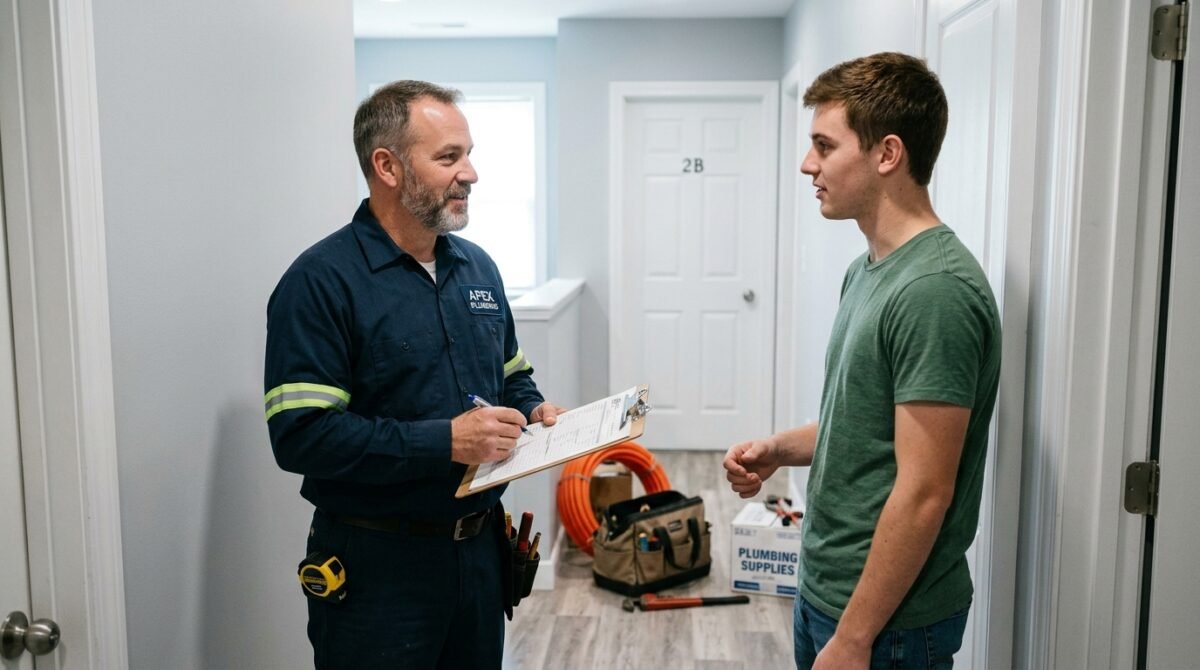
The next morning, the plumber arrived. He was a middle-aged man with a look of profound exhaustion. He took one glance at the sink, then at the drain, and let out a long, heavy sigh. He didn’t even bother with the snake. He just opened his toolbox and started laying out specialized cutting tools that looked like they belonged in an operating room rather than a bathroom.
He spent three hours working. The noise of him cutting through the pipes—and the resin that had now traveled into the wall—was agonizing. When he finally emerged from the bathroom, he was covered in dust and sweat. He handed me a tablet to sign, and my jaw dropped. The total for the emergency repair, parts, and the massive amount of labor required to clear the ‘industrial obstruction’ was exactly $4,120.
I held the tablet, shaking. I looked over at Mark, who was sitting on the couch, scrolling on his phone as if this were an everyday occurrence. I walked over and shoved the tablet in his face. “You’re paying this,” I said, my voice shaking with rage. He looked at the screen, scoffed, and then stood up, crossing his arms.
“Four thousand dollars? For a drain? That’s a total scam, man. I’m not paying that. They’re price-gouging because they see a ‘disaster.’ Tell them to charge us for the actual labor, not for some hypothetical ‘emergency’ fee.”
It was at that moment I realized Mark had absolutely no grasp of reality. He genuinely believed that because the plumber was expensive, he was somehow the victim of a corporate conspiracy, rather than the person who had personally destroyed a plumbing system by treating it like a toxic waste disposal site.
The Audacious ‘Split’ Proposal

Two days passed, and the bill remained unpaid. The plumber had given us a deadline, threatening a lien on the property if the bill wasn’t settled. When I confronted Mark again, he had the audacity to suggest that we should split the cost ‘to be fair.’ He argued that since I used the bathroom too, I was partially responsible for the state of the pipes.
“Are you joking?” I asked, my blood pressure rising. “I haven’t used the sink in three days because you turned it into a resin sculpture. I’ve been brushing my teeth in the kitchen. You poured the epoxy. You caused the damage. This isn’t a shared utility bill, Mark. This is a liability you created through pure negligence.”
He didn’t budge. He started making excuses about how his ‘business’ was just starting to take off and that he was ‘strapped for cash’ because he had invested everything in his raw materials. He tried to guilt-trip me by talking about his dreams and how difficult it was to be an entrepreneur in today’s economy. I didn’t care about his dreams; I cared about my credit score and the fact that I was currently living with a man who felt entitled to destroy my property.
“I thought we were friends, man. Why are you coming at me like this over a couple of grand? I’m going to make it back next month when my shop launches. Just cover half for now, and I’ll pay you back when I get my first payout.”
I knew then that I would never see that money. If I paid it, it would be gone. If I waited, I would be the one getting a collections notice. I had to make a choice: be the ‘nice guy’ and lose thousands, or be the ‘bad guy’ and get my money back.
The Secret Group Chat Revelation

The real betrayal came when I was forced to use Mark’s laptop to print a document while he was out. His notifications were still logged in, and a group chat titled ‘The Epoxy Bros’ popped up on the screen. Curious—and honestly, feeling justified given the circumstances—I opened it. What I found made my stomach turn.
There were messages from three weeks ago, long before the disaster, discussing how to ‘get around’ the apartment rules. They were laughing about how they could use the master bathroom to mix resin because the roommate (me) was ‘too much of a coward’ to actually say anything. They were mocking my tidiness, my job, and my general lifestyle choices.
Then, I found the messages from the night of the incident. They weren’t panicking about the plumbing. They were joking about how they hoped the landlord wouldn’t notice until after they had finished their ‘production run.’ One of his friends even suggested that they could just ‘gaslight’ me into thinking it was a faulty pipe that had been on the verge of breaking for months anyway.
“Don’t worry about the roommate, he’ll pay half if you look sad enough. He’s a pushover. Just say the pipes were old and it’s a shared cost. Works every time.” — Mark’s friend in the ‘Epoxy Bros’ group chat.
Seeing that text message was like a cold bucket of water. I wasn’t just dealing with an accidental spill. I was dealing with a premeditated, malicious disregard for my living situation. The mask of the ‘struggling artist’ fell away, revealing a calculated manipulator who didn’t respect me at all.
The Confrontation of the Century

I didn’t wait for him to get home. I took screenshots of the entire chat history and sent them to his private email. Then, I changed the Wi-Fi password and put his boxes of resin in the hallway. When he walked in, I was sitting at the kitchen table, waiting for him with a printed copy of the plumber’s invoice and the transcript of his group chat.
He walked in, laughing at something on his phone, but stopped the moment he saw me. The room was heavy with silence. I didn’t say a word. I just slid the papers across the table. He picked them up, his face losing all color as he realized that the ‘pushover’ had finally reached his breaking point. He tried to lie, but the evidence was right there in black and white.
“You’ve been talking about me behind my back for weeks,” I said, my voice cold and steady. “You weren’t an accidental victim of a plumbing error. You were plotting to defraud me. You’re paying the entire bill, Mark. And after that, you’re moving out. I don’t care where you go, but you aren’t staying here.”
“You had no right to go through my stuff! That’s a total invasion of privacy! You’re literally acting like a stalker right now!” Mark yelled, his face turning red. I just looked at him and said, “The privacy argument died the moment you started destroying my apartment and plotting against me.”
He tried to argue that I couldn’t kick him out, but I reminded him that I was the primary leaseholder. I had the power to terminate his sublet with legal notice. The look of panic on his face was almost worth the four thousand dollars, but not quite.
The Reddit Community Weighs In

I knew I was in the right, but the gaslighting had left me feeling uncertain. I posted the story to a popular subreddit, keeping the details anonymous but clear. Within an hour, the post had blown up. The validation I received from complete strangers was the emotional support I didn’t realize I needed. They didn’t just support me; they provided legal avenues to hold him accountable.
The consensus was overwhelming. People who had experienced similar situations chimed in with advice on how to handle the financial recovery and how to protect myself from further retaliation. One user in particular, who claimed to be a paralegal, gave me a step-by-step guide on how to file a small claims suit if Mark refused to pay.
“This is text-book financial abuse and property damage. Do not pay a single cent of that bill. Take him to small claims court, show the landlord the proof, and get him evicted. He isn’t your friend, he’s a parasite. NTA (Not The Asshole) a thousand times over.” — u/LegalEagle88 (Top Comment, 32.4k upvotes)
Reading through thousands of comments, I realized that I wasn’t alone. So many people have been in the position where they allowed someone to walk all over them in the name of ‘keeping the peace.’ The community helped me realize that boundaries are not acts of aggression; they are acts of self-preservation.
The Legal Threat and the Sudden Change of Heart

When Mark realized that I wasn’t bluffing about the small claims court, his attitude shifted dramatically. He went from indignant to pleading in the span of an afternoon. He started calling me, texting me, and even trying to get mutual friends to intervene. He insisted that if I took him to court, it would ‘ruin his career’ and ‘bankrupt his startup.’
I told him I didn’t care. I gave him a strict ultimatum: pay the full $4,120 by the end of the week, or I would file the claim and send the screenshots of his group chat to his family and his investors. It wasn’t a bluff. I had already spoken to a lawyer who confirmed that I had a solid case for damages based on his negligence and clear intent.
It’s amazing how fast people find money when they realize their reputation is on the line. By Thursday, I received a notification that a transfer had been made to my account. It wasn’t an apology, and it certainly wasn’t a friendship, but it was the money. The plumbing was finally paid for, and the weight of the financial burden was lifted off my shoulders.
“Here’s the money. I hope you’re happy. You really know how to burn bridges when things get tough. I never thought you were the type to be this vindictive.” — Text from Mark, shortly after the payment arrived.
I didn’t respond to his text. I didn’t need to have the last word. The money in the account was the only statement I needed. He was moving out at the end of the month, and for the first time in three years, I was going to have my home back.
The Eviction Process

Getting him to actually leave was another hurdle. Even after paying the bill, he seemed to think that he could ‘make it work’ by being a better roommate. He started cleaning more, being quieter, and trying to act like nothing had happened. He clearly didn’t understand that the trust was fundamentally broken beyond repair.
I stood my ground. I had already given notice to the landlord that I would be ending the sublease agreement. I had documentation of the damages, the plumber’s report, and the correspondence where he admitted to pouring the epoxy. The landlord was more than happy to help me get him out, especially after seeing the state of the plumbing.
The day he finally moved out was one of the best days of my life. I watched as he hauled his boxes of resin, his mixing cups, and his failed paperweight prototypes out the front door. He didn’t say goodbye, and I didn’t offer to help. I simply stood by the door, making sure he took everything and left no trace of his chemical disasters behind.
“You’re really doing this? Over a plumbing issue?” Mark asked as he loaded his last box into his car. I looked at him and replied, “It’s not about the plumbing. It’s about the fact that you thought you were entitled to destroy my home and treat me like a joke. Good luck with your business, Mark. I hope it’s worth it.”
The empty apartment felt huge and quiet. I spent the next week scrubbing, painting, and restoring the master suite to its original state. Every time I turned on the faucet, I felt a sense of relief knowing that the water was flowing into a clear, functioning pipe, untainted by the ego of a bad roommate.
Reflections on Boundary Setting

Looking back at the whole ordeal, I realize that the epoxy was just the catalyst for a much-needed change in my life. I had spent so much time trying to be the ‘easy’ roommate that I had turned into a doormat. I allowed boundaries to be blurred, respect to be eroded, and my finances to be treated as a communal resource for someone who didn’t care about me.
The lesson here isn’t just about vetting your roommates; it’s about recognizing when someone is taking advantage of your kindness. I learned that saying ‘no’ is not a failure of character, and that standing up for yourself is the most important thing you can do for your mental and physical health. It’s okay to have rules, and it’s okay to enforce them, even if it makes you unpopular in the moment.
I also learned that transparency is key. If I had brought up the ‘smell’ of the resin on day one, maybe the disaster could have been avoided. But I chose to stay quiet to avoid conflict, and that silence cost me dearly. Now, I have a new roommate—a friend I’ve known for years—and we sat down and wrote out a formal roommate agreement, including strict clauses about property damage and shared costs.
“Boundaries aren’t walls; they’re gates. They don’t shut people out; they keep the right people in and the wrong people out. I finally learned how to close the gate.”
Today, I’m in a much better place. I have my home, my finances are stable, and most importantly, I have my peace of mind. Mark is still out there somewhere, likely trying to sell his resin paperweights, but he’s no longer my problem. And that, in the end, is worth more than any amount of money.
Conclusion
The saga of the $4,000 plumbing disaster was a wake-up call that changed the way I interact with everyone in my life. It wasn’t just about the money or the epoxy; it was about reclaiming the space that I worked so hard to maintain. I’ve learned that when you refuse to set boundaries, you are effectively giving others permission to disrespect you. By standing up for myself, I gained back my dignity and the respect of those who actually matter.
I am now a firm believer in the power of the ‘roommate contract.’ It sounds formal and cold, but in reality, it’s the best way to ensure that everyone is on the same page. It prevents assumptions, eliminates ambiguity, and, most importantly, provides a clear roadmap for what to do when things go wrong. Don’t be afraid to have those difficult conversations at the start—it’s much easier than having them at the end with a plumber and a lawyer.
What about you? Have you ever had a roommate who treated your home like their own personal experiment? Or perhaps you’ve been the one who had to learn a hard lesson about boundaries? I’d love to hear your experiences in the comments below. Let’s create a space where we can share these stories and learn from one another’s mistakes—or successes. Should I have handled it differently, or was the ‘hard’ approach the only way to get through to someone like Mark?
What's your verdict on this dilemma?
Vote below to contribute to the official community consensus.

Have a Dilemma Keeping You Up at Night?
Share your real-life feud, wedding chaos, or relationship crossroads anonymously with our editorial team.
What do you think ?
0 Comments🛡️ Comments are moderated to protect community integrity. Your comment will appear once approved by the editorial team.