
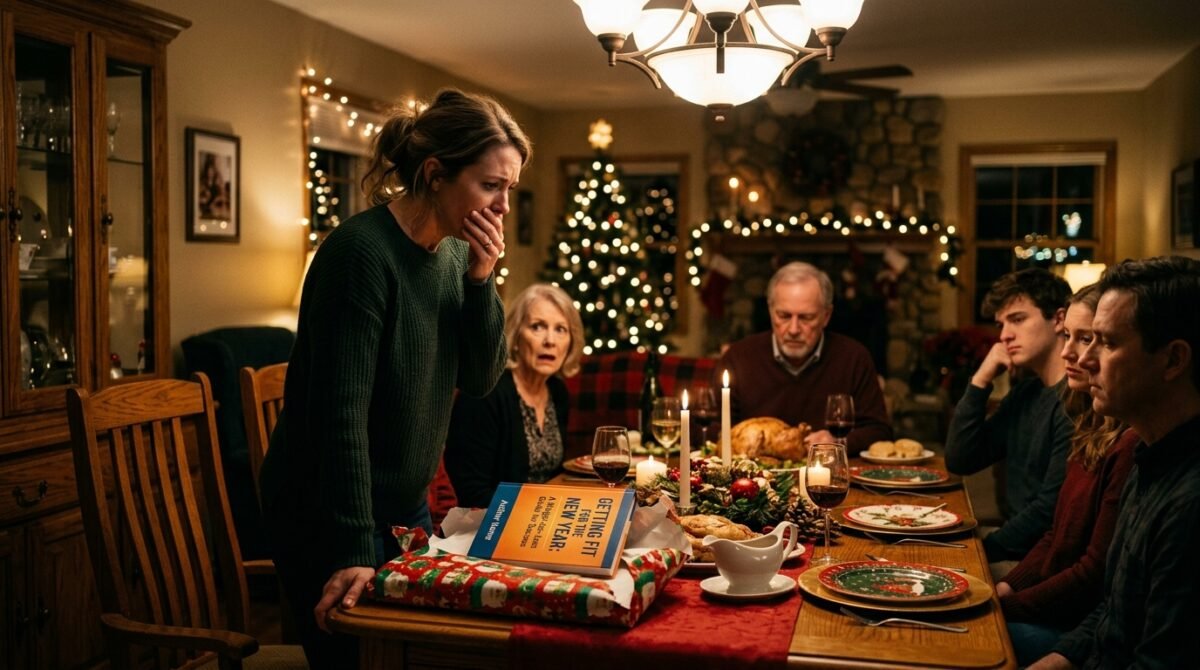
The holiday season is supposedly a time for warmth, reconciliation, and the quiet comfort of tradition. For my family, however, it has always been a thin veneer stretched over decades of unspoken critiques, passive-aggressive barbs, and the heavy, suffocating expectation that I, the youngest daughter, should somehow magically transform into the version of myself my mother has constructed in her head. I had spent weeks mentally preparing for this year’s Christmas dinner. I had curated my outfit, practiced my detachment techniques, and even brought a bottle of expensive wine to soften the inevitable jagged edges of the evening.
I arrived at my childhood home at 5:00 PM sharp, heart hammering against my ribs. The house smelled of rosemary and roasted turkey, a scent that usually triggered nostalgia but now only brought a wave of nausea. My mother, Margaret, met me at the door with a smile that never quite reached her eyes—a practiced, performative greeting she reserved for guests and holidays. The living room was filled with relatives I saw exactly once a year, people who were experts at asking invasive questions about my career and relationship status while simultaneously judging the choices I had already made.
The ritual of the gift exchange was supposed to be the highlight, a lighthearted moment of giving that usually kept the peace. But this year, the tension was palpable from the moment I stepped inside. My mother had been sending subtle, biting texts for weeks about ‘getting back on track’ and ‘prioritizing health,’ messages I had chosen to ignore to preserve my own sanity. I didn’t know then that she had been planning a public display of her disapproval, a tactical strike meant to dismantle my confidence right in front of the people whose opinions I was supposed to value.
As we moved to the tree, I felt a strange, cold dread wash over me. The box she handed me was heavy, wrapped in festive red paper with a gold bow that looked far too perfect. When I shook it, the sound was tell-tale: the dull, heavy thud of a hardcover book. I knew, with the kind of primal, sinking intuition that only a child of a critical parent possesses, that I was not about to receive a novel or a cookbook. I was about to be put on display.
Ten minutes into the party, the silence that followed the opening of that gift was the loudest sound I had ever heard. It wasn’t just a book; it was a ‘lifestyle transformation manual’ paired with a meal-tracking journal. She had waited for the entire room to look my way before handing it over, her eyes gleaming with a mix of false concern and thinly veiled triumph. I stood there, the paper fluttering to the floor, watching the smiles of my relatives curdle into uncomfortable smirks, and in that moment, I realized that my presence was no longer required.
The Pre-Dinner Ambush of Passive-Aggression
The weeks leading up to Christmas were a gauntlet of digital toxicity. It started with ‘accidental’ forwards of articles about the dangers of inflammation and ‘simple tips for shedding holiday bloat.’ I knew what she was doing. My mother, Margaret, had never been one for subtle communication, but this season she had ramped up her efforts to a frantic, almost desperate degree. Every text was a reminder that I was, in her eyes, a work in progress that was failing to progress.
I tried to set boundaries. I replied with neutral, non-committal emojis or simply didn’t engage with the links she sent. But she viewed my silence not as a boundary, but as a challenge. She called twice, her voice dripping with that specific, sickly-sweet tone of a martyr who just wants the best for her child. ‘I’m only saying this because I love you,’ she would say, and I would feel the familiar sting of that lie. It was a language we had spoken my entire adult life, a lexicon of criticism masquerading as maternal love.
By the time I walked into her house, my nerves were frayed. I hadn’t slept well in days, anticipating some form of confrontation. I had promised myself that if she crossed the line, I would not stay. I would not perform the role of the dutiful daughter who takes the abuse with a smile. I had a bag in my car, a full tank of gas, and an exit strategy that felt like a lifeline. I just hadn’t expected the strike to be so overt and so immediate.
“I just thought it might be helpful since you’ve been struggling with your weight lately. It’s a gift of health, dear, not a criticism.”
— Margaret, moments before the incident
Looking back, I wonder if she truly believed her own lie. Did she think I would thank her? Did she think I would weep with gratitude for the ‘gift’ of her judgment? The cognitive dissonance required to believe that shaming your daughter in front of an audience is an act of love is staggering. I stood there in the entryway, the silence in the room stretching out, feeling the heavy, suffocating gaze of aunts and cousins who were suddenly very interested in the floorboards.
The Red-Papered Weapon of Mass Humiliation
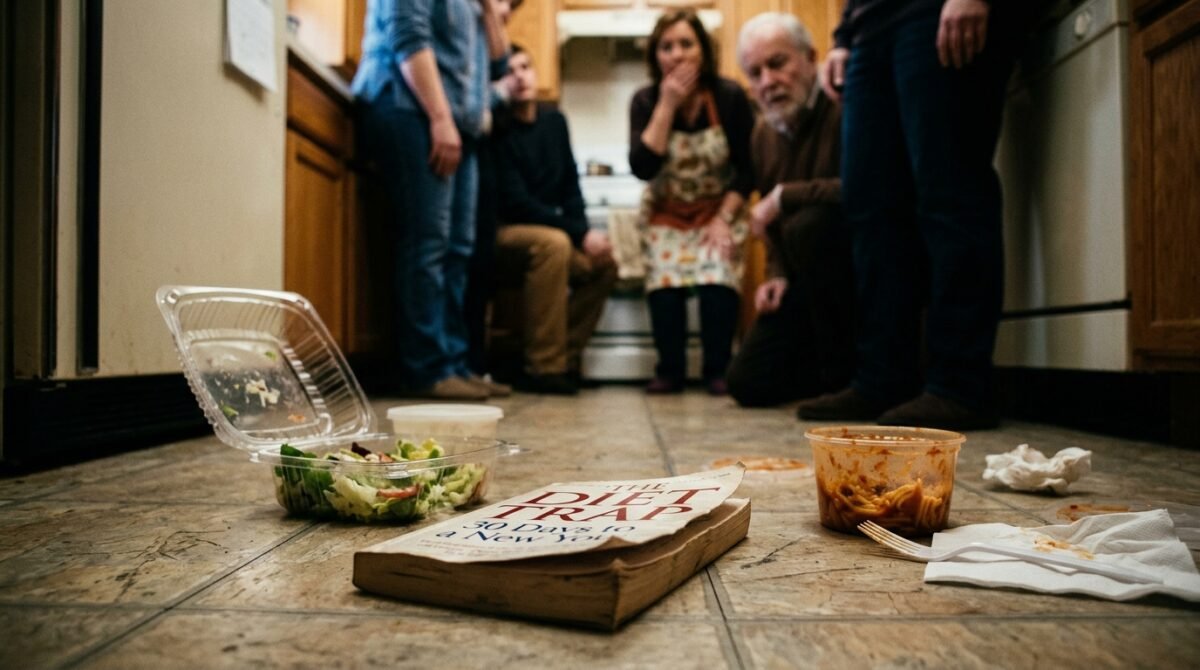
The box was sitting on the coffee table like a ticking bomb. When I unwrapped it, the glossy cover of the book stared back at me with the aggressive, neon-font confidence of a thousand ‘new you’ promises. It wasn’t just a book; it was a tactical weapon. Beside the book lay a set of color-coded portion control containers, the kind that promised to turn your entire life into a series of measured, sad, plastic-encased portions. The room seemed to shrink, the Christmas lights blurring into harsh, stinging points of light.
I looked up at her, waiting for a wink, a whisper, anything to suggest this was a joke. But her expression was one of cool, clinical detachment. She was wearing her ‘I have successfully corrected a problem’ face. The audacity of it—to turn a holiday tradition into a public intervention—was almost impressive in its cruelty. She had clearly spent time planning this, selecting the most ‘effective’ tool to ensure I felt as small and exposed as possible.
The relatives were frozen. Aunt Linda had a glass of wine halfway to her mouth, her eyes darting between me and my mother. The air felt thin, like the oxygen had been sucked out of the room. It was the kind of moment that defines a lifetime of suppressed rage. I could feel the heat rising in my neck, a physical manifestation of the boundary I had finally drawn in my own mind. I didn’t want to scream; I didn’t want to cry. I simply wanted to be anywhere else.
I took a breath, the kind that clears your head and steadies your hands. I didn’t look at the book again. I looked directly at my mother, past the practiced smile, and into the cold, calculated eyes of someone who valued control over connection. The decision wasn’t made in a fit of rage; it was made with a chilling, sudden clarity. I was done. Not just with the dinner, but with the entire cycle of performing for an audience that enjoyed watching me squirm.
“I am not hungry for your advice, and I am certainly not interested in your gifts. Keep it, Mom. Maybe you can use it to figure out why your daughter doesn’t want to be around you.”
— My response to the gift
The words tumbled out, flat and firm. I didn’t shout them; I didn’t need to. The room was so quiet that even a whisper would have sounded like a gunshot. The shock on her face was momentary, quickly replaced by a flicker of genuine confusion, as if she couldn’t fathom why I wouldn’t just accept the shame as I always had.
The Ten-Minute Exit Strategy
Turning on my heel felt like the most liberating action of my adult life. I didn’t offer a polite excuse or a hollow promise to call later. I simply walked. My heels clicked rhythmically against the hardwood floors, a steady, unwavering beat that sounded like a drum roll for my departure. I grabbed my coat from the rack, not bothering to zip it, and pushed open the front door, the cold December air rushing to greet me like an old friend.
Behind me, the chaos finally broke. My mother’s voice rose, a sharp, indignant protest that was cut off as the door swung shut. ‘Get back here!’ she commanded, but the authority was gone, replaced by the frantic edge of someone who realized they had lost their grip. I didn’t look back. I reached my car, threw my bag in the passenger seat, and started the engine. My hands were shaking, but they were steady enough to steer.
As I pulled out of the driveway, I saw a light flicker in the upstairs window. I wondered who was watching, who was whispering, and frankly, I didn’t care. The distance between that house and the rest of the world felt like a chasm that I had just successfully bridged. I drove for miles, not really knowing where I was going, just needing to put as much pavement between me and that living room as possible.
My phone started buzzing instantly. First a text, then a call, then another text. It was a digital assault. I kept the phone on the passenger seat, watching the notifications pile up like falling snow. My sister, my cousins, my mother—they were all reaching out, some in confusion, some in anger, some in performative sympathy. I ignored them all, focusing on the road, on the freedom of the dark, winding highway.
“You are being incredibly dramatic. It was a thoughtful gift. Everyone is so embarrassed for you right now. Come back and apologize before you ruin the whole night.”
— Text from my sister, 5:14 PM
I laughed, a short, sharp sound that startled me. Embarrassed for *me*? The level of delusion required to frame my exit as the dramatic act rather than the public shaming was staggering. I didn’t reply. I stopped at a gas station, bought a pack of gum, and just sat in the car, breathing the air that didn’t smell like turkey and manipulation.
The Digital Fallout and the Group Chat Siege
When I finally checked my phone an hour later, the notifications were a tapestry of family dysfunction. The group chat, which I had long ago muted but never left, was exploding. It was a repository of every opinion, every judgment, and every attempt to guilt-trip me back into the fold. My mother was silent there, which was almost more chilling. She was letting the flying monkeys do the work for her.
My cousins were debating whether I had ‘gone too far.’ My aunts were wondering if I had been drinking. One of my uncles, who I thought was the cool one, sent a message that essentially called me ungrateful. It was a masterclass in gaslighting, a collective effort to rewrite the narrative of the last ten minutes so that my mother became the victim of my ‘unpredictable’ behavior.
I read through them, feeling a detached, clinical fascination. It was like reading a script for a play I had quit. I realized then that none of these people were my allies. They were accessories to my mother’s behavior, willing to look the other way as long as the status quo remained intact. By standing up for myself, I hadn’t just insulted my mother; I had disrupted their comfortable, predictable world, and that was the true sin.
“Seriously, OP? It’s Christmas. Your mom didn’t mean anything by it. You just made everyone miserable because you can’t take a little constructive help. So selfish.”
— Cousin Sarah in the Family Group Chat
I took a screenshot of that message. I didn’t know why—maybe just to remind myself of the gaslighting later. I didn’t type a single word in response. I didn’t defend myself, I didn’t explain, and I didn’t apologize. The silence, I was discovering, was the most powerful weapon I possessed. It forced them to sit with their own reactions, with their own complicity, and that seemed to bother them more than any argument ever could.
The Unexpected Ally in the Comments
I ended up posting a sanitized version of the events on a throwaway account, just to see if I was crazy. The response was immediate and overwhelming. Thousands of people, strangers, understood exactly what had happened. They didn’t see a ‘sensitive, dramatic daughter’; they saw a woman who had finally hit her limit after years of sustained psychological warfare. It was the validation I didn’t know I needed.
The comments weren’t just ‘NTA’ (Not The Asshole). They were deep, personal, and profoundly moving. People shared stories of their own ‘Christmas gift’ traumas, of mothers who measured their love in dress sizes and fathers who critiqued their worth in bank balances. The shared experience was a balm. I spent hours reading, feeling the weight of the last few years begin to lift, replaced by a strange, new sense of solidarity.
“Your mother didn’t give you a gift; she gave you a target. She wanted to see you squirm in public so she could feel superior. Leaving was the only way to win. Do not go back. Do not apologize. You owe her nothing but the distance you’ve already created.”
— u/BrokenBoundaries (Top Comment, 32.1k upvotes)
It was the advice I had been waiting to hear from someone who wasn’t part of the family ecosystem. Seeing the scenario laid out by an impartial observer made the gaslighting feel so much thinner. I wasn’t the problem. I was the person who had finally identified the problem and acted accordingly. It felt like stepping out of a fog that had been blinding me for years.
The Aftermath: When Silence Becomes a Boundary
The days after Christmas were quiet, but not in the way I expected. I was expecting a flurry of angry phone calls, maybe even someone showing up at my apartment. Instead, there was a tentative, confused radio silence. I think they didn’t know how to handle me when I wasn’t reacting. My mother didn’t reach out; she was probably waiting for me to break, for me to come groveling, but the silence remained.
I spent the time re-evaluating my relationships. If my cousin thought I was ‘selfish’ for not accepting public humiliation, what did that say about our relationship? If my aunt thought I was ‘dramatic’ for walking away from an insult, what did that say about her values? I realized that my circle was filled with people who valued my compliance over my comfort. It was a sobering realization, one that made me feel lonely, but also incredibly focused.
I started setting boundaries that were ironclad. I stopped responding to the family group chat. I blocked my mother’s number—not out of malice, but out of a need for peace. If she wanted to reach me, she would have to do so through a medium where she couldn’t hide behind ‘helpful’ links and passive-aggressive gifts. It was the first time in my life I felt like I was driving the car, rather than just being a passenger in someone else’s disaster.
“Maybe you should just text her and say you’re sorry. It’s not worth the drama. Family is family, no matter what.”
— My sister, via a private text message
I didn’t answer that one either. ‘Family is family’ is the mantra people use to excuse abuse. It’s the shield they hide behind when they don’t want to hold anyone accountable. I was done with that mantra. I was done with the idea that blood obligation superseded basic human decency. The silence, again, was my answer.
The Anatomy of a Toxic Tradition
I started digging into our family history, looking for the threads that led to this moment. It wasn’t just the weight-loss gift; it was years of subtle, calibrated undermining. It was the way my mother would ‘compliment’ my clothes by asking if they were ‘a bit tight,’ or how she would ‘wonder’ if I was doing okay at work while implying I was failing. It was a systematic effort to keep me in a state of self-doubt, where I would always be reaching for her approval.
I realized that for my mother, my body was a project—a physical manifestation of her own anxieties and her need for perfection. By gifting me those items, she wasn’t trying to ‘help’ me; she was trying to fix a reflection of herself that she found unacceptable. Once I viewed her actions through the lens of her own insecurities, they became less about me and more about her pathetic, desperate need for validation.
It’s a powerful thing, to strip your parent of their god-like status and see them as a flawed, scared, and deeply insecure individual. It didn’t make what she did okay, but it made it less powerful. It moved the conflict from a personal attack on my worth to a sad, small display of her own limitations. I was a person, not a product she was failing to market correctly.
I started writing things down—not to send to her, but just to get them out of my system. The memories, the small jabs, the moments where I had shrunk myself to fit into her expectations. It was a cathartic process, a way of reclaimining the narrative of my own life. I was no longer the daughter who was ‘struggling’; I was the woman who had walked away, and that felt like the biggest victory of all.
The realization hit me: I didn’t need her to understand. I didn’t need her to apologize. I didn’t need her to see me as I was. I only needed to see myself, and for the first time, I liked what I saw. I saw a person who was strong enough to leave, who was smart enough to recognize a trap, and who was brave enough to stand alone.
The Social Media Trial and the Verdict
The internet, as it turns out, is a harsh judge but a fair one. When the story went viral, the discourse was fascinating. People analyzed every aspect of the event, dissecting the power dynamics, the cultural expectations of Christmas, and the nuances of fatphobia in family settings. It became a masterclass in how society views the intersection of body image and familial obligation.
Some people argued that I should have stayed, that I could have ‘killed her with kindness’ or ‘taken the high road.’ I ignored those comments. The high road is usually just another way of saying ‘take the abuse.’ The people who defended my actions, however, were the ones who really got it. They understood that sometimes, you don’t ‘win’ by staying in the fight; you win by leaving it altogether.
“The ‘high road’ is just a path for people who want you to remain a doormat. Walking out was the only way to signal that the status quo is dead. Stay gone, OP.”
— u/RealTalkPro (Top Comment, 45.2k upvotes)
The sheer number of people who shared similar experiences was staggering. It wasn’t just me; it was a societal epidemic of mothers weaponizing diet culture against their children. The Reddit community became a support group, a place where people could share their hurt and find validation. It was, in its own way, a much better Christmas present than anything I could have ever hoped for.
The Inevitable Face-to-Face Confrontation

She finally tried to corner me at a coffee shop weeks later. She didn’t call; she just showed up at my local spot, the one I frequented on Sunday mornings. She looked older, smaller, and significantly more fragile than she had on Christmas day. But the look in her eyes—that was still the same. The same expectation that I would just fall back into line.
I didn’t let her speak first. I sat there, finished my coffee, and looked at her. ‘You don’t get to do this,’ I said. ‘You don’t get to ambush me, you don’t get to judge me, and you don’t get to treat me like a project. If you want a relationship with me, it has to be on my terms, with mutual respect, and without the passive-aggressive commentary on my life.’
She looked shocked, as if she were hearing a foreign language. She started to interrupt, to offer her usual ‘I only did it because I love you,’ but I stopped her. I held up my hand, a firm, non-negotiable barrier. ‘That’s enough. I’m not interested in the excuses anymore. If you can’t be supportive, then you can’t be in my life. The choice is yours.’
“I don’t know who you think you’re talking to. I am your mother. You owe me respect, regardless of how I express my love for you.”
— Margaret, attempting to reclaim authority
I stood up, put my coat on, and started to walk away. ‘I don’t owe you anything,’ I said, and for the first time, I felt the truth of it down to my bones. I walked out of the coffee shop and left her sitting there, with her half-drunk tea and her shattered sense of control. It was the final chapter in the story, or maybe, it was the first chapter of a new one.
Reflecting on the New Normal
Living without the pressure of my mother’s expectations has been a revelation. It’s like being able to breathe for the first time in years. I’m not saying it’s perfect; I still have days where the old doubts creep back in, where I hear her voice in my head telling me I’m not enough. But those days are becoming fewer and further between, replaced by a deep, resonant sense of self-assurance.
I’ve learned that family is something you choose, not something you’re stuck with. The people I surround myself with now—my friends, my partner, my chosen family—they celebrate me. They don’t try to change me, and they certainly don’t use gifts to shame me. That is the standard I now hold for everyone, and it has made my life exponentially better.
I still get messages from my sister, from time to time. ‘Mom is asking about you,’ she says. ‘Why can’t you just let it go?’ I don’t answer anymore. I’ve realized that I don’t need to explain myself to people who are invested in keeping me small. The distance is the answer, and it’s an answer I’m finally comfortable with.
The weight of the world, it turns out, wasn’t on my body; it was on my soul, placed there by people who didn’t know how to love me. I’ve shed that weight, and I feel lighter than I ever have. The journey hasn’t been easy, but it has been mine, and that is all that matters.
Conclusion
The story of that Christmas dinner is not just about a weight-loss gift; it is about the fundamental right to exist without being policed by those who claim to love us. It is about the power of saying ‘no’ and the courage it takes to walk away from a toxic environment, even when it feels like the world is watching. The ripple effects of my choice have been profound, forcing me to redefine my identity and the boundaries that keep me safe.
I hope this story serves as a reminder that your worth is not defined by anyone else’s opinion, and that you have the agency to protect your peace. You do not have to accept abuse as a form of affection, and you do not have to stay in situations that diminish your light. The most important relationship you will ever have is the one you have with yourself, and that is a relationship worth fighting for.
What about you? Have you ever had to walk away from a family tradition to protect your mental health? How did you handle the fallout? Let’s keep the conversation going in the comments below—I want to hear your stories of boundary setting and personal reclamation. We are stronger together.
What's your verdict on this dilemma?
Vote below to contribute to the official community consensus.

Have a Dilemma Keeping You Up at Night?
Share your real-life feud, wedding chaos, or relationship crossroads anonymously with our editorial team.
What do you think ?
0 Comments🛡️ Comments are moderated to protect community integrity. Your comment will appear once approved by the editorial team.