
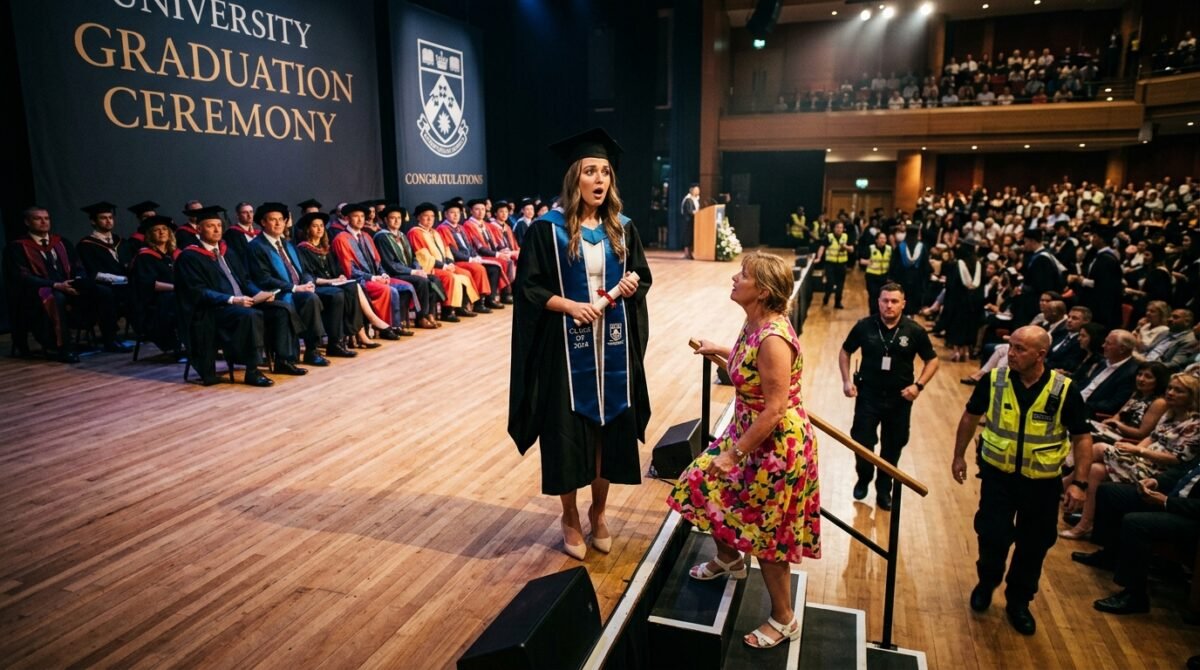
Medical school is an endurance sport. For four years, my life was defined by the scent of formaldehyde, the crushing weight of student loans, and the relentless pressure of clinical rotations. I had sacrificed my social life, my sleep, and my mental health to reach the stage where I would finally be hooded as a Doctor of Medicine. It was supposed to be a day of triumph, a celebration of the resilience I had cultivated after my mother walked out of my life during my sophomore year of college.
My mother, Sarah, had not been part of this journey. She hadn’t been there when I pulled all-nighters studying for the USMLE Step 1, nor had she offered a word of encouragement when I struggled through the isolation of the pandemic. In fact, she had been a source of profound instability for most of my upbringing. When she suddenly decided that my graduation was the perfect place to ‘reconnect’ and demanded to join me on stage, the violation of my boundaries was not just an annoyance—it was an assault on the peace I had spent years building.
The dilemma I faced wasn’t just about a ceremony; it was about the fundamental right to choose who shares in our greatest accomplishments. Could I force her away without ruining the day for my friends and mentors? Was I being too harsh for denying her a moment she felt ‘entitled’ to? The following account details the sequence of events that led to my decision to call campus security on my own mother, and the fallout that ensued within our fractured family tree.
This isn’t just a story about a graduation ceremony; it is a case study in the trauma of parent-child estrangement and the agonizing decision to prioritize one’s own healing over social expectations. As the day approached, the tension had been building for weeks, masked behind polite text messages and feigned ignorance. I knew something was coming, but I never imagined the audacity of her arrival.
The Ominous Silence Before the Storm
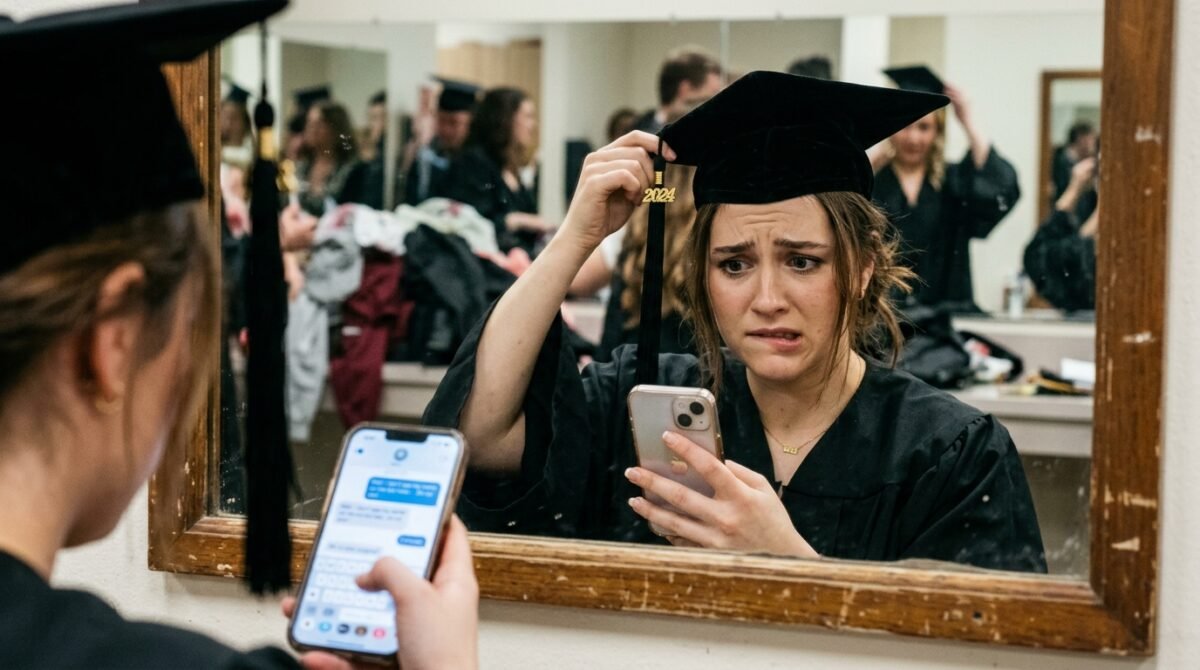
The weeks leading up to my graduation were filled with a strange, heavy silence. My mother had been blocked on my primary phone number for over two years, yet she managed to reach out through various social media channels and secondary numbers. She wasn’t asking for apologies; she was acting as if the last four years were merely a temporary lapse in our relationship. Her messages were filled with platitudes about ‘forgiveness’ and ‘pride,’ completely ignoring the reality of the bridge she burned when she emptied my college savings account to fund her own lifestyle.
I kept my head down, focusing on my final rotations. Every time a notification popped up, my pulse would spike. I had been careful not to post my graduation date or location on any public social media, yet somehow, she found out. It felt like she had been watching me from a distance, waiting for the one moment where I would be too busy and too public to turn her away. The anxiety was a physical weight, like lead in my stomach.
My friends were excited for me, planning dinners and brunches, but I felt like I was living in a suspense movie. I had even contacted the university’s event staff, giving them a vague heads-up that my mother might try to make a scene. They assured me they had protocols, but I didn’t truly believe them. How do you tell security to watch out for your own mother without sounding like a hysterical, ungrateful daughter?
“I just want to be there for your big day, sweetie. It’s a mother’s right to see her daughter succeed. Don’t be so cold-hearted. You know I love you.”
— A text from my mother, received three days before graduation.
I didn’t respond. I couldn’t. Any acknowledgment, even a firm ‘no,’ would be treated as an invitation to engage. I had learned through years of therapy that with her, silence was the only weapon I had. I spent the nights before the ceremony tossing and turning, wondering if I should just skip the event entirely to avoid the spectacle. But I had earned this. Why should she get to take this away from me too?
On the morning of the ceremony, I dressed in my regalia, trying to force a smile for the group photos. My friends were kind, oblivious to the fact that I was hyper-aware of every person in the crowd. I scanned the auditorium, my eyes darting from face to face. It felt like I was waiting for an ambush. I had worked too hard to let her presence contaminate the sanctity of this achievement, but the fear of a scene was paralyzing.
The Uninvited Guest in Row 12

The ceremony began with the usual pomp and circumstance. The dean spoke, the music swelled, and I found myself getting lost in the rhythm of the event. For a brief moment, I actually forgot about my mother. I was surrounded by people who had supported me—my mentors, my roommates, and the few family members who actually stood by me when things got dark. I felt a sense of relief, thinking that perhaps I had overreacted and she wouldn’t show up after all.
Then, I saw her. She wasn’t sitting in the back; she was sitting in the twelfth row, wearing a bright, ostentatious yellow dress that made her stand out like a flare in the night. She wasn’t looking at the stage; she was looking directly at me. Her expression wasn’t one of maternal pride, but of grim determination. My heart sank. The dread returned, sharper than before. She had found a way to get a ticket, likely buying one from a desperate student on a Facebook group.
I saw her reach for her phone. A moment later, my phone vibrated in my pocket. I knew exactly what it said without looking. She was signaling her presence, making sure I knew that she was watching, that she was here, and that she was ready to make her move. The air in the auditorium seemed to thin. I looked toward the security guards stationed near the aisles, my hands trembling as I held my program.
“I see you. I’m proud of you. I’m coming down when they call your name. We’re going to do this together, just like we planned.”
— A text sent by my mother from the audience.
The delusion was staggering. We had never planned anything. We hadn’t spoken in years. The audacity of her rewriting our history in real-time was enough to make me feel faint. I looked over at my friend, Sarah, who was sitting next to me. I leaned over, my voice barely a whisper, and told her what was happening. Her face went pale. She immediately understood the gravity of the situation.
We had to act fast. If my mother reached the stage, the disruption would be total. The ceremony was being live-streamed, and the university administration was notoriously strict about decorum. I felt a surge of adrenaline, the kind I only ever experienced in the ER during high-stakes trauma cases. I had to protect my boundaries, even if it meant causing the very scene I was trying to avoid.
The Descent into Chaos
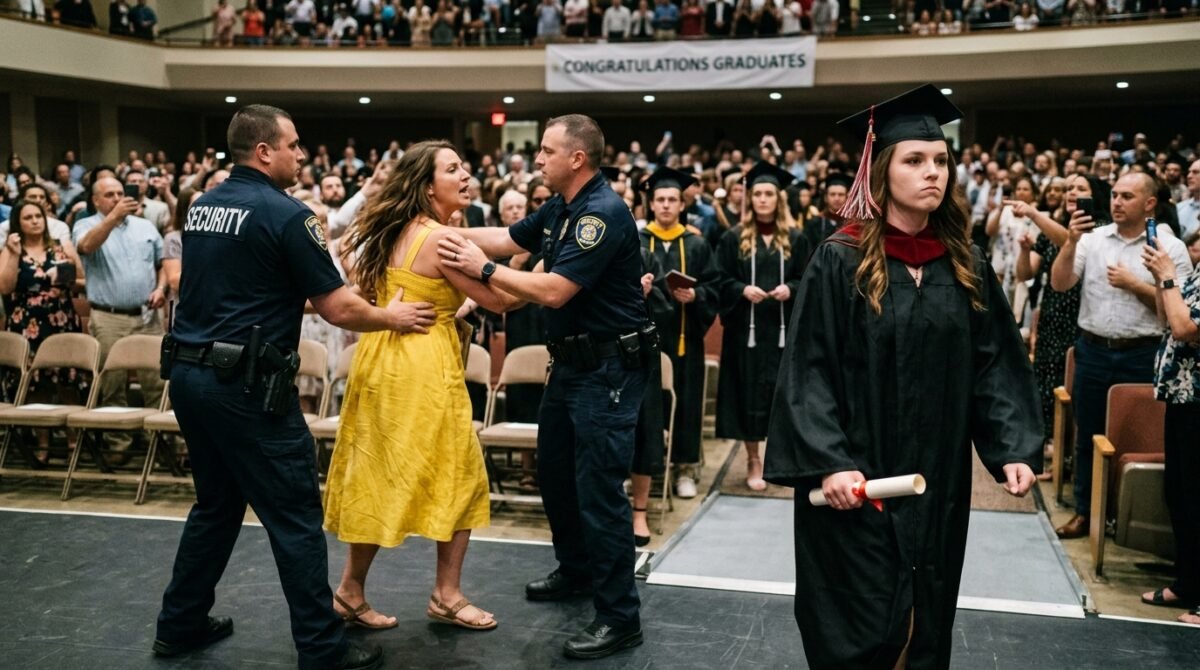
When they started calling names in alphabetical order, the panic truly set in. My last name starts with ‘B,’ so I was going to be up there early. I watched as the line of graduates moved forward. I looked back at the twelfth row. My mother was standing up. She was already pushing past people in her row, ignoring the glares and the whispers. She was intent on reaching the aisle.
I stood up and caught the eye of a security guard I had spoken to earlier. I didn’t say a word; I just pointed to her. The look on his face shifted from bored professional to alert. He started moving toward her, but she was fast. She had clearly been preparing for this moment. She bypassed the usher and began walking toward the stairs that led up to the stage. People were staring now, the collective hum of the crowd dying down into an uncomfortable silence.
I stepped out of the line, my heart pounding against my ribs like a trapped bird. I didn’t want to engage, but I had to intercept her. As I walked toward the edge of the stage, she saw me. A manic grin spread across her face, and she started waving. It was performative, a desperate grab for attention that completely invalidated the four years of work I had put in. It wasn’t about me; it was about her being seen.
“Look at you! My beautiful doctor! Come here, let’s go up together! Everyone needs to see what a great mother I am!”
— My mother, shouting across the aisle in the middle of the ceremony.
The dean stopped reading names, looking down at the commotion. The entire auditorium was now focused on us. I felt the heat rising in my cheeks, a mixture of shame, anger, and pure, unadulterated resolve. This was my moment, and I refused to let her hijack it. I signaled to the guards again, my voice shaking as I finally spoke to them, loud enough for those around us to hear.
‘She is not invited. Please get her out of here.’ The guards didn’t hesitate. They moved in, forming a wall between me and her. She started shrieking, claiming that I was being brainwashed, that I was a terrible daughter. The sound was shrill, echoing off the high ceilings of the auditorium. I turned my back on her and started walking back to the stage, my knees shaking, my vision blurred by unshed tears.
The Aftermath in the Parking Lot
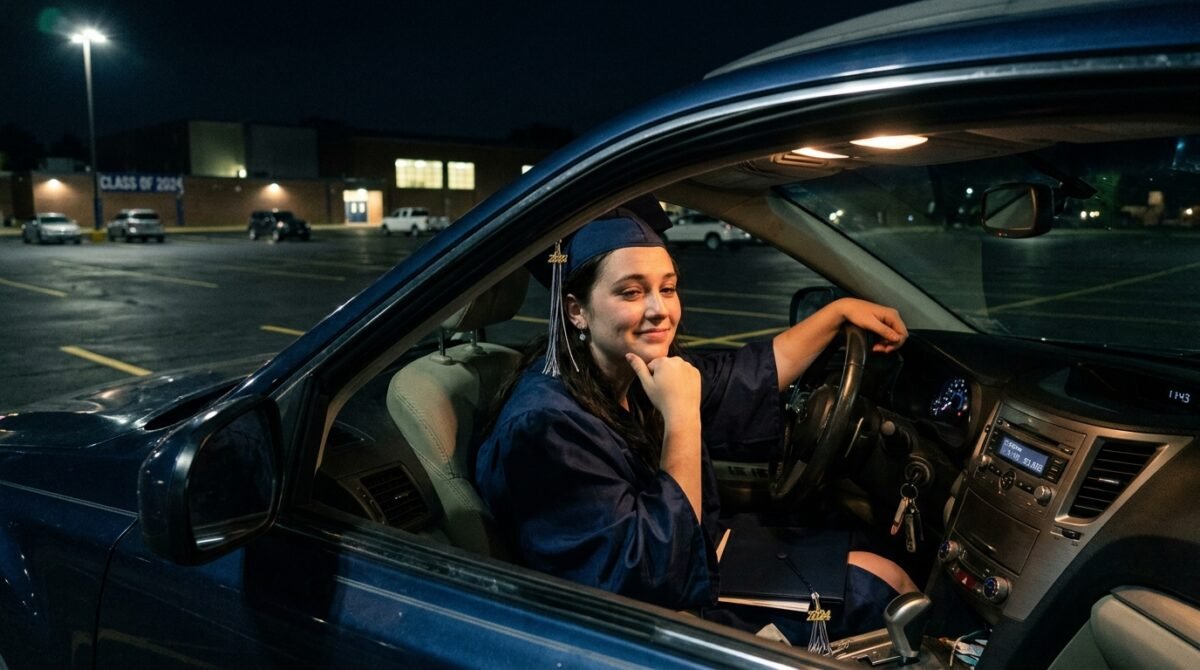
The rest of the ceremony was a blur. I stood on that stage, accepted my diploma, and smiled for the professional photographer, but I wasn’t really there. My mind was back in the aisle, replaying the scene over and over again. When the ceremony concluded, I didn’t wait for the festivities. I went straight to my car, my friends following me, guarding me like a phalanx. I was terrified she would be waiting for me.
She wasn’t in the parking lot, but her presence was felt in every text message that started flooding my phone. She had sent dozens of messages in the span of an hour. They were a mix of vitriolic insults and pathetic pleas for attention. She couldn’t understand why I had chosen to ‘humiliate’ her in front of everyone. She still didn’t grasp the concept that she had humiliated herself by acting like a deranged fan at a concert instead of a parent.
My phone was buzzing constantly. I finally sat in my car, took a deep breath, and started reading them. Each message was more deranged than the last. She was claiming I owed her for ‘raising me,’ conveniently forgetting that she had spent my childhood bouncing between boyfriends and jobs, leaving me to raise myself. It was the classic narcissist’s playbook: blame the victim, rewrite the history, and demand empathy for the pain you caused.
“I hope you are happy with yourself. Calling security on your own mother? You’re dead to me. You will regret this when you finally realize that I’m the only one who truly knows you.”
— A final text from my mother before I blocked her on every platform.
I didn’t reply. I couldn’t afford to. I knew that if I engaged, I would just be feeding the fire. I blocked her number, blocked her social media, and even reached out to my landlord to make sure she didn’t have my address. I was exhausted, but for the first time in years, I felt a sense of finality. The ties were officially severed, and there was no going back.
My friends tried to comfort me, taking me out for a celebratory dinner, but I couldn’t eat. I kept looking over my shoulder, expecting to see that yellow dress. The trauma of the day had left me hollowed out. I had my degree, I had my future, but the cost had been higher than I ever anticipated. I had to face the reality that my mother was a ghost I had finally finished exorcising, but the haunting wasn’t over.
The Digital Fallout and Public Scrutiny
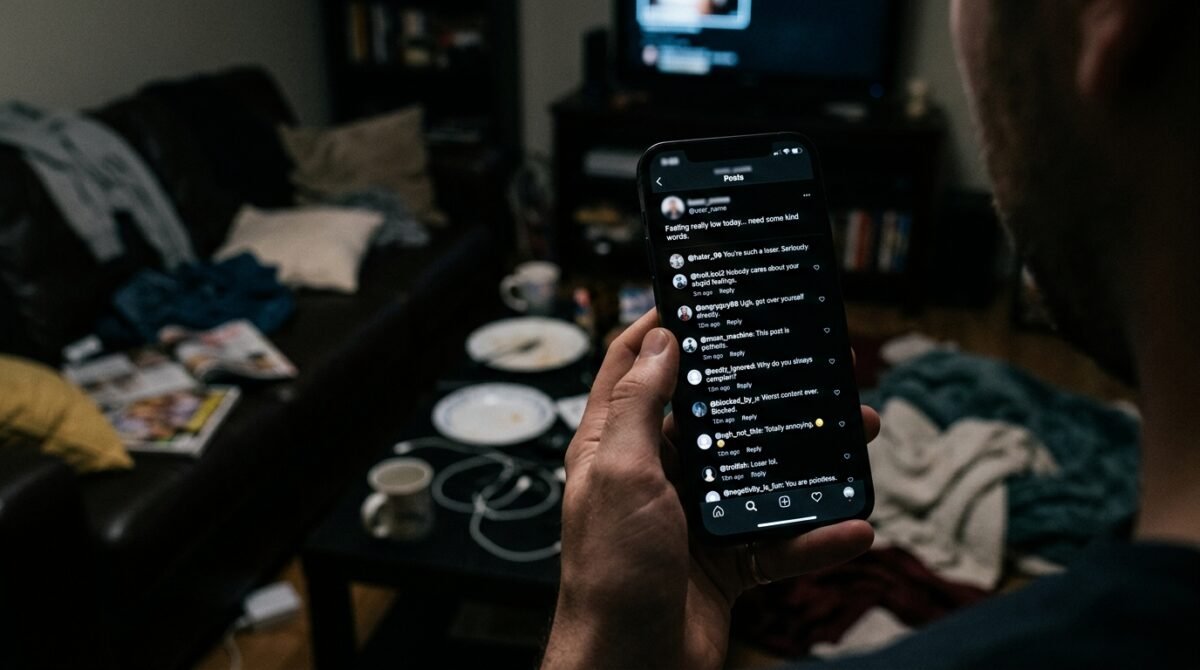
By the time I reached home, the story had already started circulating in my family’s private circles. My aunt, the only one who stayed in touch with my mother, called me in a panic. She didn’t ask if I was okay; she asked why I had to make such a scene. She suggested that I should have just let her walk with me to avoid the ‘bad blood.’ It was maddening how easily people justified toxic behavior in the name of ‘keeping the peace.’
I realized then that my mother had been calling everyone, spinning a narrative where she was the victim. She had posted about it on her own social media, using photos she took from the aisle before she was escorted out. She was getting sympathy from people who didn’t know the truth, people who saw a ‘heartbroken mother’ and not the reality of the situation. It was a classic smear campaign, and it was working.
I felt a deep urge to post my side of the story, to set the record straight, but I held back. I knew that the truth didn’t matter to people who wanted to believe the worst in me. I had to choose my peace over the need to be understood by strangers. I spent the next few days in a cocoon, only talking to my closest circle. I was effectively in hiding, waiting for the storm to pass.
“She is a monster. I gave her everything. I sacrificed my own dreams for her. And this is how she treats me on the biggest day of her life. She is ungrateful and cold.”
— My mother’s Facebook post, shared by family members.
It was painful to see people I once cared about liking and commenting on those posts. It felt like a betrayal, a second wave of abandonment. But it also provided clarity. I saw exactly who was in my corner and who was willing to dance to my mother’s tune. The list of people I needed to cut out of my life was growing, but it was necessary for my own health.
I started documenting everything—every text, every email, every incident. Not to post it, but for my own protection. If she tried to come after my job or my reputation, I would be ready. I was a doctor now. I had a responsibility to myself to be professional, but I also had the right to defend my boundaries with everything I had. The digital fallout was intense, but I was determined to weather it.
Community Perspectives: The Reddit Verdict
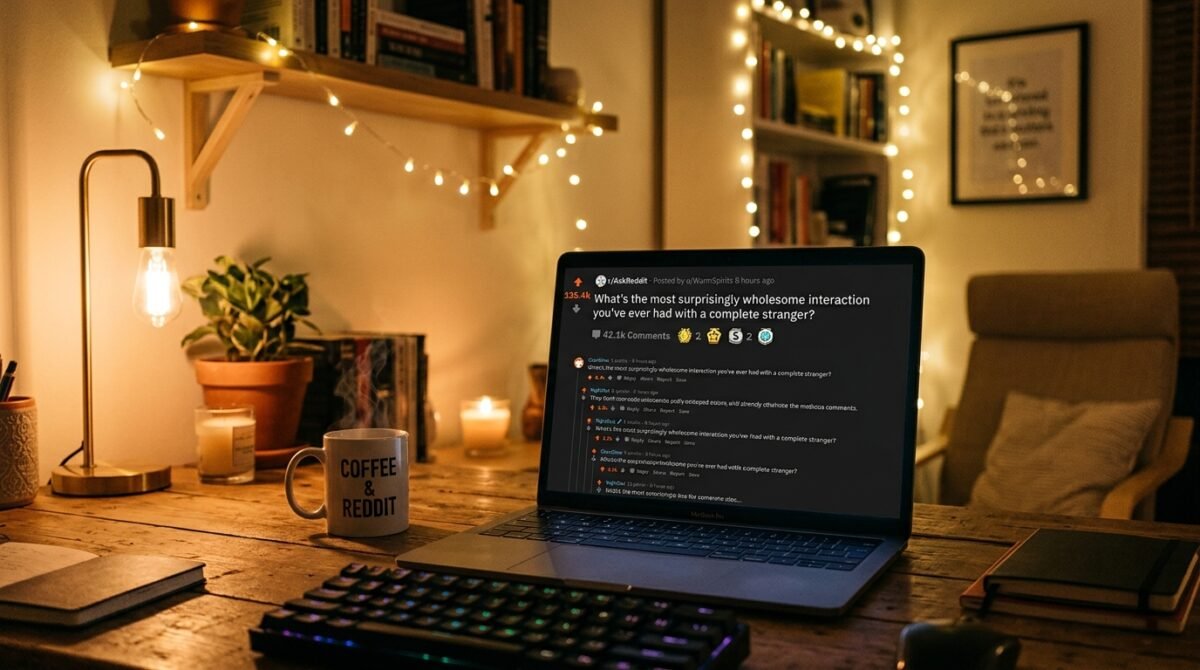
I eventually found myself on a popular subreddit, reading through threads about toxic parents. I didn’t post my story initially, but I started commenting on others, finding solidarity in the shared pain of so many people. When I finally decided to share a version of my own story, the reaction was overwhelming. It wasn’t just support; it was a validation of the choices I had made.
The community was largely in my corner. Many had similar experiences with parents who felt entitled to their children’s lives. There were people who had been in my position—the ones who had to call security on their parents at weddings or graduations. It was a bittersweet comfort to know I wasn’t alone. The anonymity of the platform allowed me to be raw, to admit that I was still hurting, that I was still scared.
Of course, there were the devil’s advocates, the people who insisted that ‘family is everything’ and that I should have just tolerated the intrusion. But they were quickly drowned out by the voices of those who understood that ‘family’ is a privilege, not a right. I found myself reading the comments for hours, finding the strength to keep going in the words of strangers who had no stake in my life other than a shared sense of humanity.
“You are not responsible for her feelings, especially not when she’s violating your boundaries. You earned that stage. You didn’t owe her a single step. NTA.”
— u/SupportiveSoul (Top Comment, 18.5k upvotes)
“My mother did the same thing at my wedding. I regret not calling security sooner. You did the right thing. Do not let her rewrite your history.”
— u/Survivor101 (12.2k upvotes)
The feedback was a turning point. It gave me the perspective I needed to stop doubting my decision. I realized that my guilt was a remnant of the conditioning she had instilled in me, a way for her to maintain control even when she wasn’t physically present. The internet, for all its toxicity, had provided a safe space for me to process this trauma and move toward healing.
I started taking the advice of the commenters—focusing on my own life, continuing therapy, and refusing to engage with the smear campaign. The validation from strangers was more powerful than the condemnation from my family. It showed me that I was building a new family, one based on mutual respect and genuine care, and that was the only thing that truly mattered.
The Hard Truth About Enablers
The most difficult part of the aftermath wasn’t my mother’s actions, but the reactions of my extended family. The ‘peacemakers,’ the ones who wanted me to just ‘get over it,’ were the ones who hurt the most. They were the silent enablers who had watched my mother neglect me for years and now expected me to play along as if nothing had happened. They were the ones who told me I was ‘ruining the family image’ by calling security.
I had a series of difficult conversations with them. I told them clearly: if they wanted to have a relationship with me, they had to respect my boundaries. They couldn’t be a bridge for my mother to reach me. If they passed information to her, or if they tried to convince me to ‘forgive and forget,’ I would stop talking to them. It was a hard line, and it cost me a few relationships, but it was necessary.
I learned that people often prefer a polite lie to an uncomfortable truth. They didn’t want to hear about the years of abuse; they wanted a happy family photo. But I wasn’t there to provide a facade for their comfort. I had spent my life being the ‘good girl,’ the one who kept quiet and made things easy for everyone else. That girl was gone. The woman standing in her place was a doctor, a survivor, and someone who would no longer tolerate disrespect.
“I don’t care how you feel about her. I care about how you feel about me. If you can’t support my need for safety, then you don’t need to be in my life. It’s that simple.”
— My response to my aunt during a heated phone call.
The fallout was isolating, but it was also liberating. I stopped trying to please people who didn’t care about my wellbeing. I started surrounding myself with friends who were proud of me, friends who celebrated my accomplishments without trying to attach their own agenda to them. The ‘family’ I chose was starting to look a lot more like a real family than the one I was born into.
I realized that the ‘family image’ was a hollow construct. It was a mask that people wore to hide the rot underneath. By refusing to wear it, I was forcing them to look at the reality of our dynamic. Most of them turned away, but a few—my cousins, a couple of aunts—started to understand. They started to see that my boundaries weren’t an attack on them, but a defense of my own sanity.
Finding Strength in the White Coat

The weeks after graduation were filled with the administrative grind of starting my residency. There was paperwork, housing, and the constant stress of the upcoming transition. It was a welcome distraction. The white coat hanging in my closet became a symbol of everything I had achieved on my own. Every time I looked at it, I felt a sense of pride that no one could take away, not even my mother.
I started working in the hospital, and the pace was unrelenting. It was the perfect environment for me. There was no room for emotional baggage when you were trying to stabilize a patient. The work was demanding, but it was honest. I felt useful, competent, and valued for the first time in my life. I was no longer the ‘troubled daughter’—I was Dr. [Last Name].
I continued to see my therapist, and we spent a lot of time processing the graduation incident. She helped me realize that my mother’s behavior was a symptom of her own deep-seated insecurity and the loss of her power over me. It wasn’t about me; it was about her inability to accept that I was a separate person, one who didn’t need her to be whole. That realization was the final piece of the puzzle.
“You are not her project. You are your own person. The fact that you are standing here, in this coat, is proof of your autonomy. She can’t touch that.”
— My therapist, during our weekly session.
I felt a shift in my perspective. The fear was subsiding, replaced by a steady, quiet confidence. I wasn’t just surviving anymore; I was thriving. I was building a life that was entirely mine, one where I had the final say on who was allowed in and who was kept out. It was a powerful feeling, one that I never thought I would experience.
I started mentoring some of the younger students, sharing my experiences with them. I told them about the importance of boundaries, not just in their professional lives but in their personal ones as well. I saw a lot of myself in them—the drive, the anxiety, the desire to succeed. I hope that in some way, my journey could help them navigate their own paths, even if they were filled with their own challenges.
Defining My Own Legacy

As I settled into my residency, I thought a lot about what kind of legacy I wanted to leave. For so long, my life had been defined by my mother’s actions, by her neglect, and by her drama. I didn’t want my story to be about ‘the girl whose mother ruined her graduation.’ I wanted it to be about the girl who became a doctor despite the odds.
I started to lean into my own identity, outside of the trauma. I took up hobbies I had long abandoned—painting, hiking, reading for pleasure. I reconnected with friends I had lost touch with. I was reclaiming the parts of myself that I had sacrificed on the altar of my mother’s expectations. It was slow work, but it was rewarding.
I also started to think about what I wanted from my future family. I wanted to create a home that was safe, a space where people could be themselves without fear of judgment or manipulation. I wanted to be the kind of parent I never had—one who celebrated their child’s achievements without making them about me, one who respected their boundaries and loved them unconditionally.
“I’m building something new. Something that doesn’t have a place for the chaos I grew up with. I’m the architect now.”
— A thought from my journal, written at the end of a long shift.
The journey had been long, and the path hadn’t been easy, but I was proud of where I stood. I was the master of my own life, and the decisions I had made—the hard ones, the ones that cost me relationships—were the ones that saved me. I had survived the worst, and I had come out stronger, wiser, and more determined than ever.
I realized that the graduation incident wasn’t an ending; it was a beginning. It was the moment I finally drew the line, the moment I decided that my happiness was worth more than the approval of a toxic parent. It was a painful, messy, and loud start, but it was mine. And in the end, that was all that ever really mattered.
Lessons from the Edge

Looking back, the biggest lesson I learned was that boundaries aren’t just for ‘difficult’ people; they are for everyone. They are the essential guardrails that keep us safe, healthy, and sane. I had spent years thinking I was being ‘mean’ or ‘selfish’ by setting boundaries, but I realized that I was simply respecting my own dignity.
I also learned the importance of surrounding myself with people who challenge me to grow, not people who want to keep me small. My friends were the ones who truly supported me, the ones who didn’t ask me to compromise my values for the sake of ‘family.’ They were the true reflection of the life I wanted to live, and I was so grateful for them.
Most importantly, I learned to trust myself. I had spent my life doubting my perceptions, wondering if I was the crazy one, if I was the problem. But when I was standing in that auditorium, facing the reality of my mother’s behavior, I knew I was right. I knew what I had to do, and I did it. That trust is something I will never lose again.
“The most important relationship you will ever have is the one you have with yourself. Guard it with your life.”
— A piece of advice I now give to my medical students.
I know that my mother will always be a part of my story, but she no longer controls the narrative. I am the one writing it now, chapter by chapter, in the work I do, the relationships I cultivate, and the life I lead. The trauma is a part of my history, but it is not my future.
If you are in a similar situation, if you are struggling with a toxic parent or a relationship that feels like it is draining the life out of you, know that you have the right to set boundaries. You have the right to protect your peace. And you have the right to choose who shares in your accomplishments. You are worth it.
Conclusion
The story of my graduation is not one I tell often, but when I do, I see the recognition in people’s eyes. It is a universal struggle—the fight to become our own person when the people who were supposed to guide us are the ones who try to keep us from flying. But I hope this story serves as a reminder that we are not defined by our parents’ failures. We are defined by our own resilience, our own choices, and our own commitment to a better life.
As I continue my journey in medicine, I carry that day with me. It reminds me of the strength I have, the boundaries I can enforce, and the life I am capable of building. I am no longer that terrified student in the auditorium. I am a doctor, and I am finally, truly, free.
What about you? Have you ever had to draw a hard line with a family member during a major life milestone? Share your stories below, and let’s create a space where we can support each other in the often difficult, but necessary, work of self-preservation. Is blood really thicker than water, or is that just a lie we are told to keep us trapped?
What's your verdict on this dilemma?
Vote below to contribute to the official community consensus.

Have a Dilemma Keeping You Up at Night?
Share your real-life feud, wedding chaos, or relationship crossroads anonymously with our editorial team.
What do you think ?
0 Comments🛡️ Comments are moderated to protect community integrity. Your comment will appear once approved by the editorial team.