
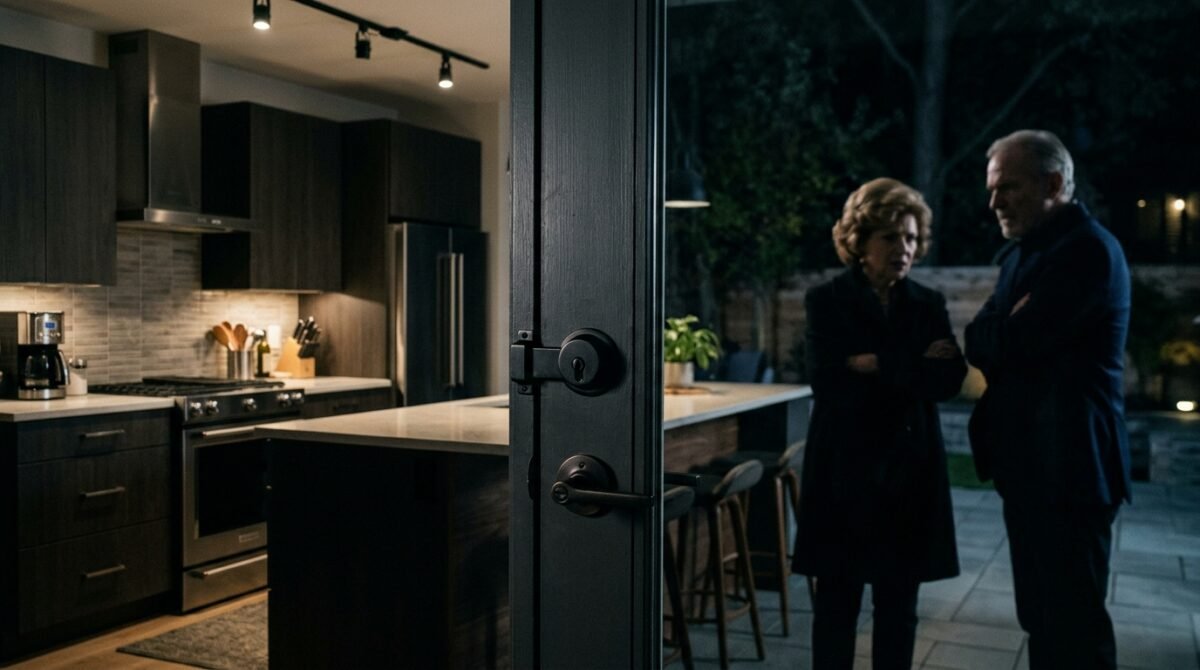
For most, Thanksgiving is a season of gratitude and shared labor. For me, it has always been a labor of love—a three-day process of brining, roasting, and perfecting family recipes that have been passed down through generations. My husband, Mark, has always been supportive of these traditions, even when my in-laws, Eleanor and Richard, would offer backhanded compliments about my ‘rustic’ cooking style. But this year, the tension reached a boiling point that I never saw coming.
It started innocently enough. Eleanor texted me two weeks before the holiday, asking if she could ‘bring a little extra help’ to make sure the meal was perfect. I assumed she meant she was bringing a side dish or perhaps an extra set of hands for chopping vegetables. I was wrong. She wasn’t talking about extra hands; she was talking about a professional culinary team she had hired behind my back to ‘upgrade’ my menu.
The morning of Thanksgiving, my kitchen—the sanctuary where I prepare my heart and soul for my family—was invaded by a man in a crisp white chef’s coat, carrying crates of artisanal ingredients that looked nothing like the comfort food I had planned. My turkey, which had been perfectly brined for 48 hours, was being pushed aside for a sous-vide contraption I didn’t recognize. The violation was visceral, physical, and immediate.
Standing in my entryway, Eleanor beamed, completely oblivious to the heat rising in my chest. ‘I thought you could use a break this year, dear,’ she said, as if she were doing me a favor by erasing my presence from my own kitchen. I looked at Mark, expecting him to defend our home, but he simply shrugged, clearly intimidated by his mother’s overbearing nature. That was the moment I realized that if I didn’t take control, I would be a ghost at my own table.
I didn’t yell. I didn’t scream. I simply turned on my heel, walked into the kitchen, grabbed the heavy deadbolt key from the side of the doorframe, and walked out, locking the professional chef inside with his expensive gadgets and my ruined, brine-soaked turkey. The silence that followed was heavy, breathless, and utterly glorious. Little did I know, the battle for my home had only just begun.
The Unannounced 8:00 AM Kitchen Intrusion
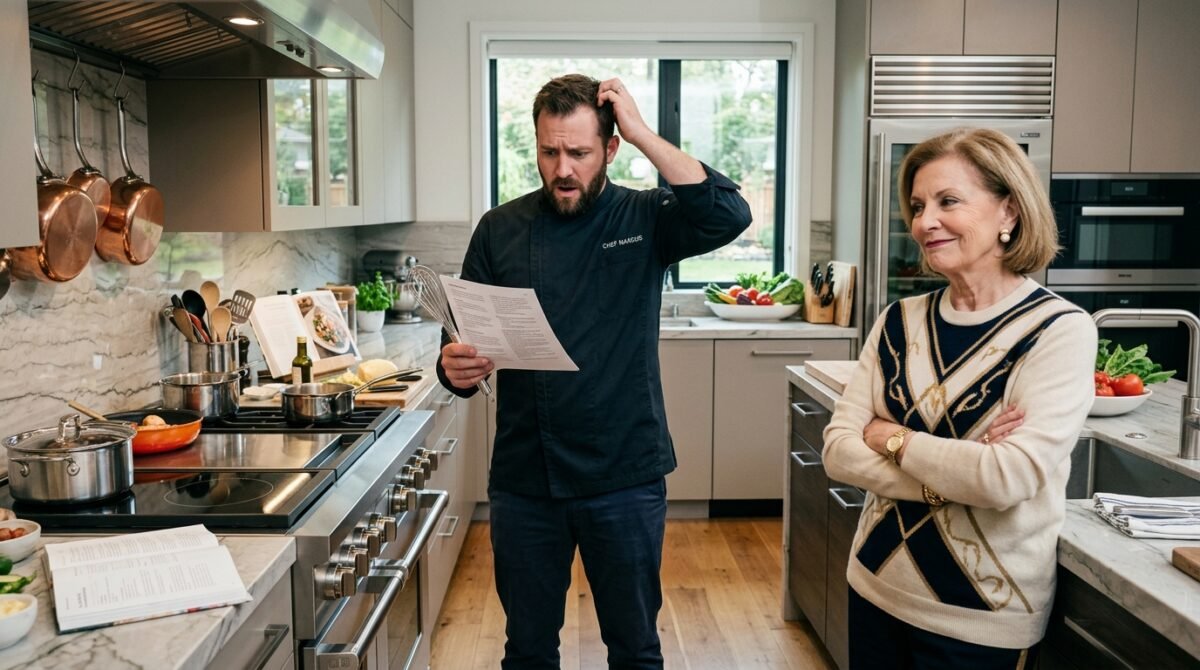
The morning of Thanksgiving began with the rhythmic thudding of a heavy crate being set down on my hardwood floor. I was still in my robe, coffee in hand, when the sight of a stranger in a chef’s uniform greeted me in my kitchen. He wasn’t a family friend or a relative; he was a culinary professional, and he was currently rearranging my refrigerator shelves with ruthless efficiency.
I felt a cold sweat wash over me as I realized the scale of the disruption. My carefully labeled containers, the prep work for the stuffing, and the slow-cooked cranberry sauce I’d started the night before were being pushed to the back to make room for imported truffles and delicate garnish flowers. The man didn’t even look up as he started unpackaging high-end equipment.
“Excuse me, but who authorized you to move my things? This is a private residence, not a catering hall. You need to leave immediately.”
The chef, looking flustered, pointed toward the hallway where Eleanor was standing, arms crossed, looking smugly at her phone. She stepped into the kitchen with the air of a woman who had just solved a problem I didn’t know I had. ‘Don’t be dramatic, Sarah,’ she chirped, looking at my messy prep station with disdain. ‘I told you, I wanted this year to be special. You’re clearly overwhelmed, and frankly, we all deserve a meal that doesn’t taste like a home-ec project.’
I stared at her, feeling my blood pressure spike to dangerous levels. My home, my sanctuary, had been violated in the most personal way imaginable. I looked at Mark, who had followed his mother into the room. He looked at the floor, clearly hoping to avoid the inevitable confrontation. He had known, hadn’t he? He had let them bring a stranger into our home to override my authority without saying a word to me.
The sheer arrogance of it was suffocating. I thought about the hours I had spent planning this meal, the memories I had hoped to build, and how quickly it was being dismantled by a woman who wouldn’t even eat a piece of bread unless it was artisanal sourdough. I realized then that my feelings—my boundaries—meant absolutely nothing to them. They viewed my kitchen as a public space they could purchase influence over.
I didn’t say another word to Eleanor. I looked at the chef, who was now starting to look deeply uncomfortable, and then back at the door. I knew I couldn’t win this by arguing over the merits of my cooking. I had to remove the variable entirely. I walked to the pantry, grabbed the spare set of keys I kept for security, and moved toward the kitchen exit, my hands steady for the first time that morning.
The Sound of the Deadbolt Turning
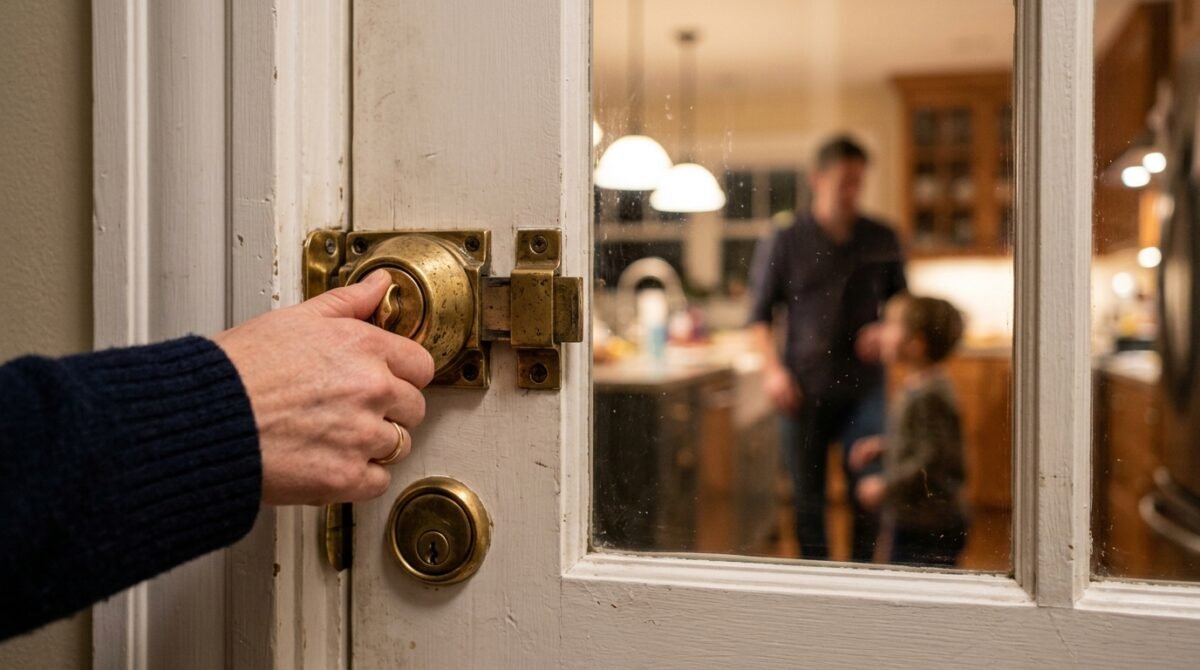
As I reached the threshold of the kitchen, I caught Mark’s eye. He finally looked up, his expression shifting from embarrassment to confusion. He didn’t understand yet. He thought I was just going to pout in the other room. He didn’t realize that I had reached my absolute limit. I pulled the heavy door shut, hearing the satisfying ‘click’ of the latch, and then turned the deadbolt with a sharp, final sound.
The reaction was instantaneous. Eleanor shrieked, hitting the glass pane of the door with her manicured fingernails. The chef, now trapped inside, looked at the locked door with wide, panicked eyes. He started tapping on the glass, clearly worried about his reputation and his expensive gear. I stood on the other side, leaning against the hallway wall, finally feeling a sense of calm wash over me for the first time all day.
“Open this door right now, Sarah! Have you lost your mind? We have guests coming in three hours! You are acting like a petulant child!”
I leaned in close to the glass, meeting her frantic gaze with a steady, unblinking stare. ‘You wanted a private chef, Eleanor? Great. You have one. He’s in your private kitchen. But you aren’t getting into mine. My home, my turkey, my rules. You can enjoy your Thanksgiving inside that room, or you can leave. But the kitchen stays locked until I decide otherwise.’
Mark was now standing behind his mother, his face pale. He finally stepped forward, his voice cracking slightly. ‘Sarah, babe, just unlock the door. This is insane. They’re just trying to help, and you’re causing a scene. Don’t do this to my family.’ He reached for the handle, but I stepped in front of him, my posture firm. The power dynamic of the entire marriage was shifting in that hallway.
I looked at my husband, the man who had promised to stand by me, and saw only his mother’s son. ‘They aren’t helping, Mark. They are staging a hostile takeover. If you want to eat their food, you can go in there with them. But you are not allowed to override me in my own house. You chose your side when you let them bring this man here behind my back.’
The house fell into an eerie silence. The other guests, who had started arriving in the driveway, were beginning to knock on the front door, unaware of the chaos unfolding in the kitchen. I turned and walked toward the front door to welcome our guests, leaving Eleanor, the chef, and my husband to contemplate their next move. I was host-ready, but I was done being a doormat.
The Group Chat Explosion
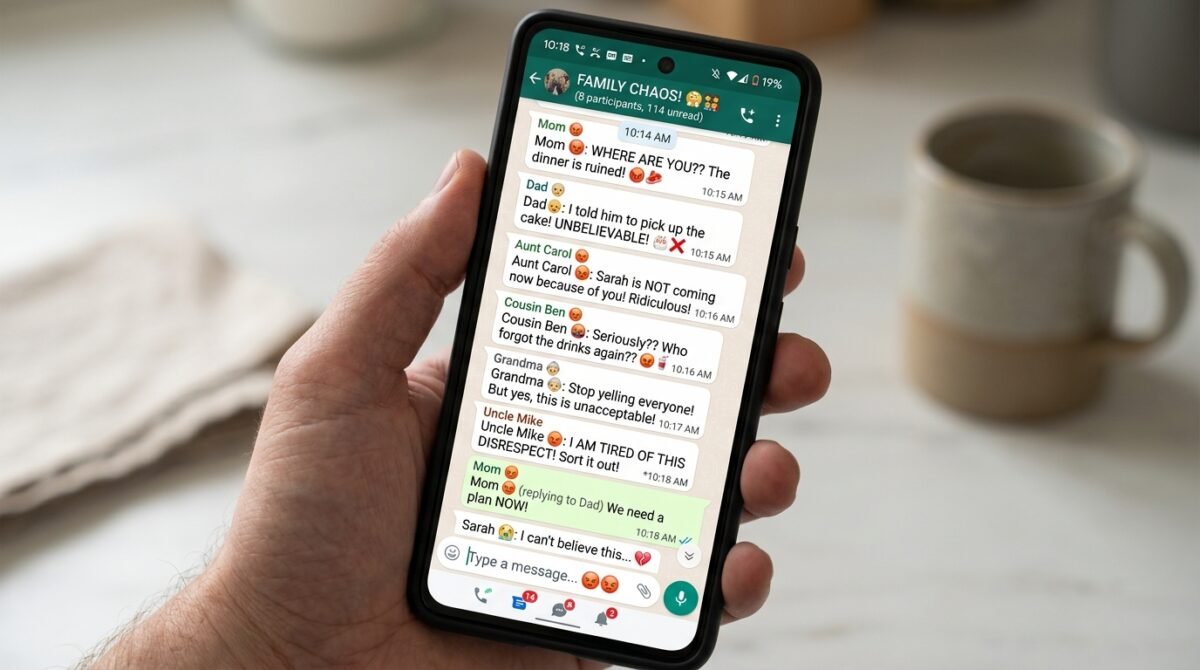
By the time the third group of cousins arrived, my phone was vibrating off the table. It was the family group chat, and it was blowing up. Eleanor hadn’t just been angry; she had been busy. She had screenshotted my ‘outrageous’ behavior and sent it to every aunt, uncle, and cousin in the extended family. My phone was flooded with messages ranging from utter confusion to outright hostility.
“I don’t care what you think you’re proving, Sarah. You’ve embarrassed us all. Unlock the door and apologize to Eleanor immediately. This is supposed to be a day of family, not a hostage situation.”
— Uncle Robert, Family Group Chat
I didn’t respond. I kept serving appetizers in the living room, acting as if nothing was wrong. I was playing the part of the perfect hostess, even as the walls around me felt like they were closing in. I could hear Eleanor still shouting from the kitchen, though it was muffled now. The chef had apparently given up and was sitting on the floor of my pantry, waiting for a resolution that wasn’t coming.
Then came the message from my sister-in-law, who had always been on the fence about me. She wasn’t aggressive, just confused. ‘Sarah, what is going on? Mom says you’ve lost your mind and there’s a chef locked in the kitchen. Is this a joke? Please, just open the door before this gets worse.’
“It’s not a joke. Eleanor brought a catering team into my home without asking. I’m reclaiming the space. I’m happy to serve appetizers, but the kitchen is strictly off-limits for the rest of the day. If people want to eat, they can order delivery or leave.”
— My reply to the family group chat
The chat went dead silent for a full minute. Then, a few of the more distant cousins started chiming in. Some were actually taking my side, shocked that Eleanor would go to such lengths to undermine me. The divide in the family was deepening in real-time, and I felt the weight of it. I was no longer the ‘quiet daughter-in-law’; I was the ‘unhinged host’ who had officially burned the bridge.
I looked at the notifications and felt a strange sense of vindication. For years, I had bent over backwards to accommodate Eleanor’s critiques of my life, my home, and my marriage. I had allowed her to slowly encroach upon every aspect of my identity. Today, I had simply said ‘no,’ and the result was chaos. It was the most honest day I had ever spent with my in-laws.
Mark finally entered the room, looking utterly drained. He walked up to me and whispered, ‘Mom is calling the police, Sarah. You need to unlock that door before this becomes a legal issue. You can’t hold someone against their will in your house.’ I looked him in the eye, my voice low and steady. ‘Let her call them. Let’s see what the police say about a guest who refuses to leave your private residence after being asked to stop trespassing in your kitchen.’
The Police Arrival and the Legal Reality Check
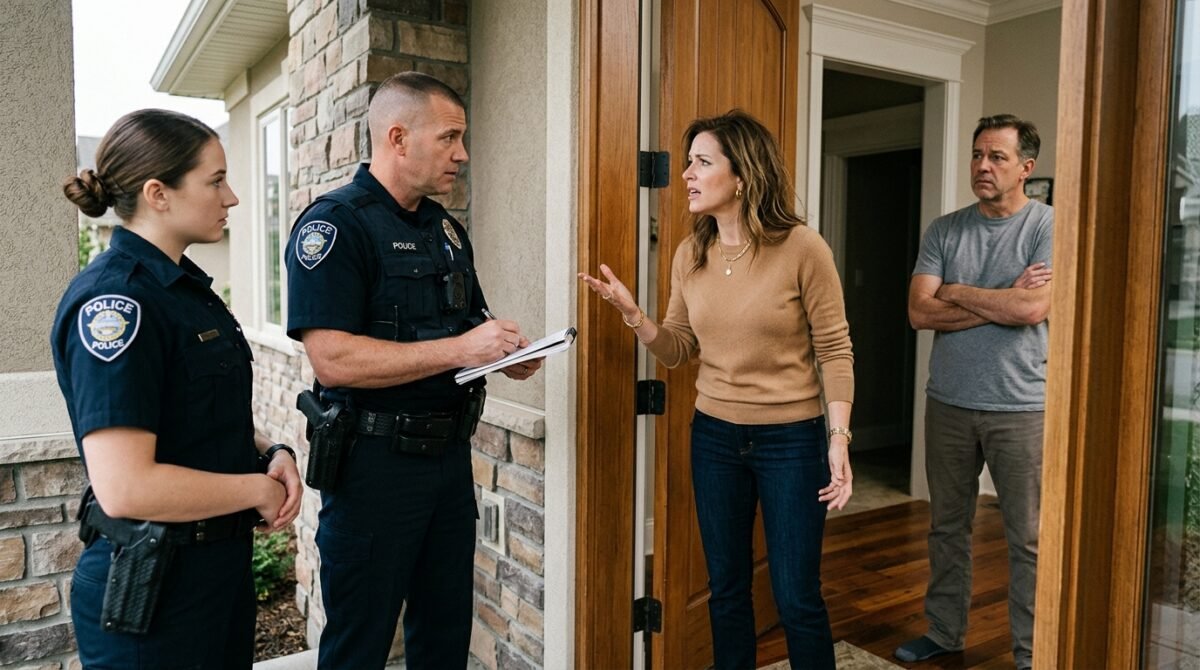
When the patrol car pulled into the driveway, the entire atmosphere of the house changed. The guests in the living room went silent, all eyes shifting to the window. I walked to the door, my heart pounding, but my resolve remained unbroken. I was prepared for this. I had lived in this house for five years; my name was on the deed, and my rights as a homeowner were clear.
Two officers walked up the path. They looked like they had seen plenty of Thanksgiving dramas before, but this one was clearly unique. I opened the door before they could knock. I greeted them calmly, showing them my ID and explaining the situation with as much poise as I could muster. I explained that an uninvited person was currently in my home causing a disturbance and that the guest of honor was refusing to respect my boundaries.
Eleanor came storming out of the kitchen hallway just as the officers stepped inside. She looked disheveled, her expensive blouse wrinkled from her time in the kitchen. She began shouting immediately, pointing a finger at me. ‘She’s holding that man hostage! He’s a professional chef I hired, and she’s locked him in there! Arrest her for kidnapping!’
“Ma’am, please calm down. We’re here to mediate, not arrest anyone for a kitchen dispute. Is there a disagreement regarding the property or the guests?”
— Officer Miller
The officer’s calm demeanor only made Eleanor more furious. She realized quickly that the police weren’t going to drag me out in handcuffs because she wanted an upgrade to her Thanksgiving dinner. They listened as I explained the boundary violation: the chef wasn’t a guest, he was an employee brought in against my direct refusal. The officers turned to the chef, who was now sheepishly walking out of the kitchen with his gear, looking to escape the situation as quickly as possible.
The interaction was brief but humiliating for my in-laws. The police advised them that since I was the homeowner, I had the right to determine who entered my kitchen and what services were provided. They suggested that Eleanor and her party might want to relocate to a restaurant if they weren’t happy with the hosting situation. The look on Eleanor’s face was one of pure, unadulterated shock.
She looked at Mark, expecting him to fight for her, but he just stood there, defeated. The reality was that he had no legal standing to override my decision, and the police had confirmed it. My in-laws had tried to use the law as a weapon to force their will upon me, and it had backfired spectacularly. The officers left, and the house was quiet once more, but the air was thick with the wreckage of our family dynamic.
I turned to Eleanor, who was now trembling with rage. ‘You have two choices,’ I said, my voice cold and firm. ‘You can apologize for this intrusion and sit down to have a normal meal with the rest of the family, or you can leave. But the chef is gone, and the kitchen is mine again. Choose now.’
The Table of Silence
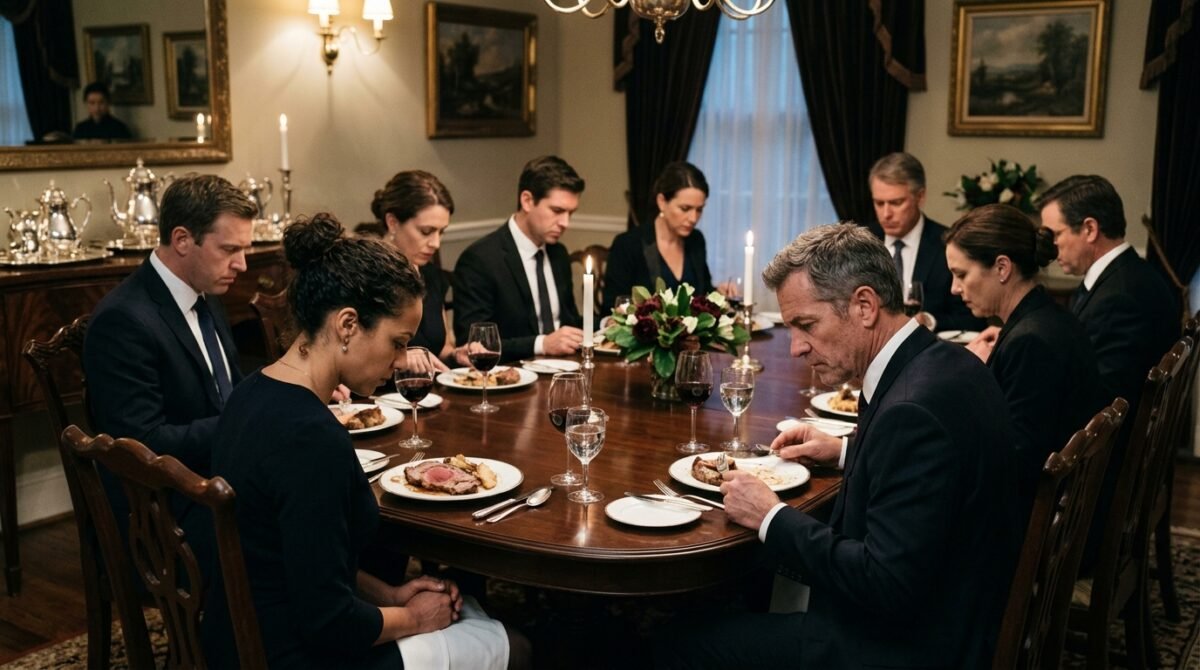
The dinner that followed was the most awkward in the history of the holiday. We sat at the long dining table, the turkey I had roasted in the now-reclaimed oven served in the center. I had prepared the meal exactly as I had planned, and while the atmosphere was tense enough to cut with a knife, the food was excellent. Eleanor sat at the far end of the table, staring at her plate with a look of profound bitterness.
The rest of the guests, clearly shaken by the earlier events, barely spoke. Conversation was limited to mundane topics—the weather, the football game, the price of gasoline. Every time a silence stretched too long, I would fill it with a mundane question about the stuffing or the salad, maintaining a veneer of normalcy that was as fragile as glass. I was holding the line, and everyone knew it.
“This is delicious, Sarah. I’m glad you stuck to your guns. This is much better than whatever that chef would have made.”
— My cousin, attempting to break the tension
I smiled, a genuine, small smile. It was the first sign of support I had received all day. Eleanor snapped her head toward my cousin, her eyes flashing. ‘It’s perfectly adequate, I suppose. If you like rustic, home-style cooking. Some of us prefer a higher standard of living, but clearly, we’ve learned our place in this house today.’
Mark finally spoke up, his voice low. ‘Mom, please. Can we just have one peaceful meal? You started this. You brought the chef. Sarah was just hosting her own home. Let’s just move past this.’
Eleanor didn’t back down. ‘I was trying to make it better for everyone! I thought you wanted a nice experience, Mark. It’s not my fault your wife is so insecure that she feels threatened by a professional.’ The room went cold again. I looked at Mark, waiting for him to shut her down, to tell her that my ‘insecurity’ had nothing to do with it. He hesitated, looking between his mother and me, and in that hesitation, the final crack in my trust for him appeared.
I stood up, clearing the first set of plates. ‘I’m happy everyone is enjoying the meal,’ I said, my voice steady. ‘And I’m glad we’re all here, regardless of how we got to this point. But let’s be clear: this is a home, not a hotel. If anyone here feels that my standard of living isn’t up to their preference, they are more than welcome to make other plans for future holidays.’
The table went silent again. The gauntlet had been thrown. I wasn’t just defending my kitchen; I was setting the terms for the rest of my life. I walked into the kitchen, the room I had fought for, and began to prep dessert. I didn’t care if they were uncomfortable. For the first time in my marriage, I felt like I truly lived in my own house.
The Aftermath and the Public Verdict

By the next morning, the story of my ‘Thanksgiving Hostage Crisis’ had hit the internet. A cousin had posted a vague, dramatic summary of the events on Reddit, and the community response was immediate and overwhelming. I found myself reading through thousands of comments, some calling me a hero, others calling me a toxic partner. The divide in my digital life mirrored the divide in my family.
“NTA. Your home is your sanctuary. The audacity to bring a stranger into someone else’s kitchen to override them is absolutely unhinged. You held the line. Don’t apologize for having boundaries.”
— u/CulinaryQueen, 45k upvotes
I found comfort in the validation, but it didn’t solve the problem of my marriage. Mark had spent the night on the couch, refusing to talk to me about what had happened. He kept repeating that I had ‘ruined’ his mother’s holiday and that I needed to call and apologize for the ‘scene’ I had caused. He couldn’t understand that the scene was caused by the intrusion, not the defense of the home.
“ESH. You overreacted by locking the door, but she definitely crossed a huge line. You two need serious marriage counseling before you even think about the next holiday.”
— u/BalancedOpinion, 12k upvotes
I read those comments and felt a pang of doubt. Did I overreact? Could I have handled it differently? I thought about the hours of prep, the disregard for my feelings, and the way Mark had let it happen. No, I decided. I hadn’t overreacted. I had simply reached a breaking point that had been building for years. If I hadn’t locked that door, the precedent would have been set: my home was theirs to command.
The internet community, while divided, mostly focused on the boundary violation. The sheer audacity of the in-laws was the headline. It wasn’t about the food; it was about the power. People shared their own stories of overbearing in-laws, and I realized I wasn’t alone. Thousands of others had faced similar challenges where their efforts were dismissed and their authority undermined by family members who thought they knew best.
I started a note on my phone, listing the boundaries I needed to enforce moving forward. No more unannounced visits. No more ‘surprise’ help that wasn’t requested. No more allowing my husband to sacrifice my comfort for his mother’s approval. The ‘Thanksgiving Incident’ had become a catalyst for a total reset of my personal boundaries.
I shared some of the comments with Mark, hoping he would see the perspective of others. He skimmed them, dismissing the Reddit thread as ‘a bunch of strangers who don’t know my family.’ He still didn’t get it. He saw the world through the lens of his mother’s approval, and until that changed, our marriage was going to be an uphill battle. The drama wasn’t over; it was just entering a new, more difficult phase.
The $1,400 Restaurant Bill Left on the Table
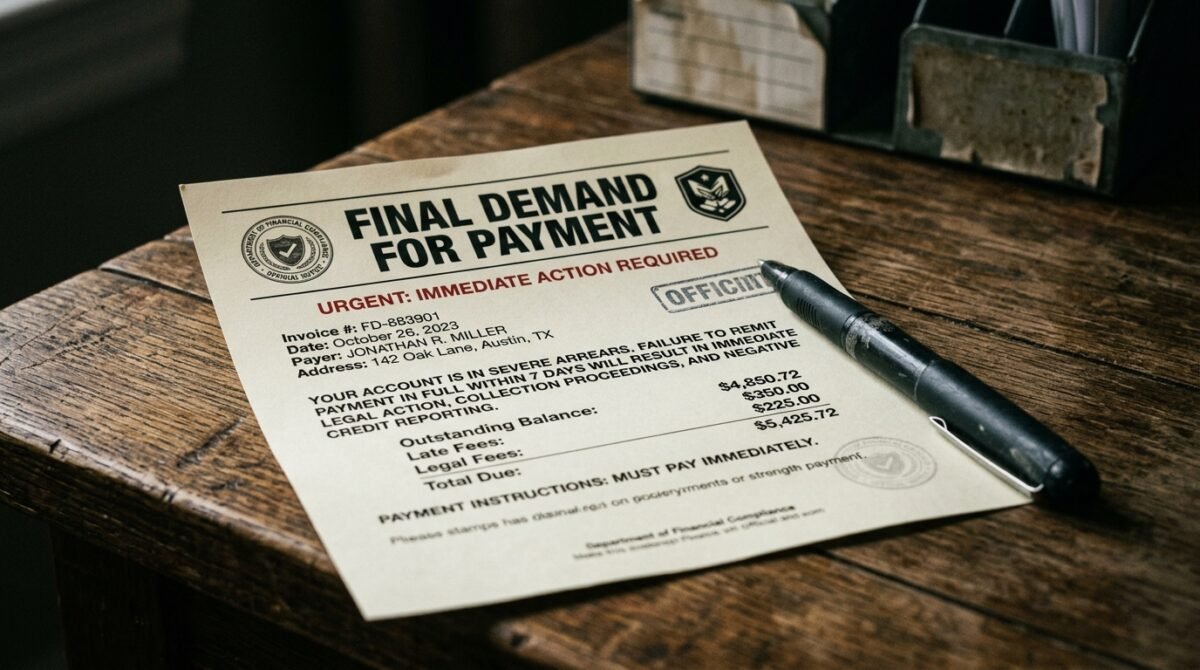
Three days after the holiday, an envelope arrived in the mail. It was a bill from the private chef service, addressed to me. They were charging for the full day’s service, including the cancellation fee, the premium ingredients that had been left in my pantry, and the ‘inconvenience’ of being locked in my kitchen for forty minutes. The total came to exactly $1,400. It was a bold move, and I knew exactly who had orchestrated it.
I called Mark into the room and handed him the bill. He looked at the total and blanched. ‘Are you kidding me? They expect us to pay for this?’ he said, his voice rising. ‘I’m not paying a cent for this disaster. This is between them and the chef.’
I didn’t say a word. I just pointed to the bottom of the invoice, where Eleanor had handwritten a note: ‘Since you ruined the professional meal I hired, I think it’s only fair that you cover the cost of the disruption. We’ll be expecting this to be settled by the end of the week. Consider it a thank-you for the lesson in etiquette.’
“She is literally billing me for the audacity of me not letting her take over my home. I am not paying this, and if you even think about it, we’re going to have a major problem.”
— Me to Mark, during our final argument about the bill
Mark tried to argue that it would just be easier to pay it and ‘make it go away,’ but I was done making things go away. I scanned the invoice, wrote a firm email to the catering company explaining that I never authorized their services and that they were trespassing on my property, and CC’d a lawyer. The bill was effectively dead, but the message from Eleanor was clear: she was still trying to exert control.
The audacity was staggering. She wasn’t just entitled; she was delusional. She felt that because she had money, she could rewrite the reality of what happened in my house. I felt a surge of anger, but beneath it, a sense of clarity. This wasn’t about Thanksgiving anymore; it was about whether I would allow myself to be treated as a subordinate in my own life.
I decided then that I would not be seeing Eleanor for a very long time. I needed space to breathe, to heal, and to build a life that didn’t revolve around her constant, suffocating interference. I told Mark that I was going low-contact with his parents and that I expected him to respect that boundary. He struggled with it, but he knew that the alternative was losing me entirely.
It was a turning point. I had stopped the intrusion, defeated the legal threat, and rejected the financial manipulation. I had done it all on my own terms. The ‘Thanksgiving Incident’ would be remembered as the moment I finally reclaimed my autonomy, and the cost—a broken relationship with my in-laws—was one I was more than willing to pay.
The Shift in the Power Dynamic

The weeks following Thanksgiving were quiet, but it was a heavy, expectant silence. I was no longer the person who accommodated, who apologized, or who shrunk herself to fit into Eleanor’s vision of what a daughter-in-law should be. I had reclaimed my kitchen, yes, but more importantly, I had reclaimed my voice. When Eleanor called, I didn’t answer. When she texted, I waited hours—or days—to reply, and when I did, it was short, professional, and devoid of emotion.
Mark was struggling to adjust to the new reality. He had spent his whole life navigating his mother’s volatile emotions, and now he was caught in the middle of a war of attrition. He wanted things to go back to ‘normal,’ but I kept reminding him that ‘normal’ was the problem. ‘Normal’ was the expectation that I would accept whatever his mother threw at me, including a stranger in my kitchen on a holiday I had planned for weeks.
“I love you, Mark, but I will not be a prop in your mother’s play. If she wants to be part of our lives, she needs to respect the boundaries we set together. If she can’t do that, she doesn’t get access to our home.”
— Me to Mark, after a particularly difficult conversation
The change was visible in the way we interacted. I was more confident, less likely to compromise on things that mattered to me. I stopped asking for permission to do things in my own house, and I stopped apologizing for being myself. The shift was uncomfortable for both of us, but it was necessary. The ‘Thanksgiving Incident’ had revealed that our marriage was fundamentally unbalanced, and we were now forced to confront that imbalance.
I started taking more time for myself, focusing on my hobbies and my own friends. I stopped being the one who reached out to his family to plan events or manage the social calendar. If Mark wanted to see them, he could manage it. I was no longer the bridge between them. It was a liberating feeling, to realize that I didn’t have to carry the burden of their relationship on my shoulders.
Eleanor, for her part, was not taking the low-contact well. She would call Mark and cry, telling him how ‘heartbroken’ she was, how she only wanted the best for us. Mark would come to me, looking exhausted, and I would just listen. I wouldn’t budge. I wouldn’t provide the validation she was looking for. I had learned that my silence was a more powerful tool than my arguments.
It was a slow process of deprogramming. I had to unlearn the habits of a lifetime—the need to be liked, the need to keep the peace at all costs. Every time I held a boundary, it got a little bit easier. Every time I said ‘no’ to something that didn’t align with my values, I felt a little bit more like myself. The kitchen door was locked for a reason, and the reason was that I finally realized I deserved to be the master of my own domain.
The Unspoken Apology That Never Came
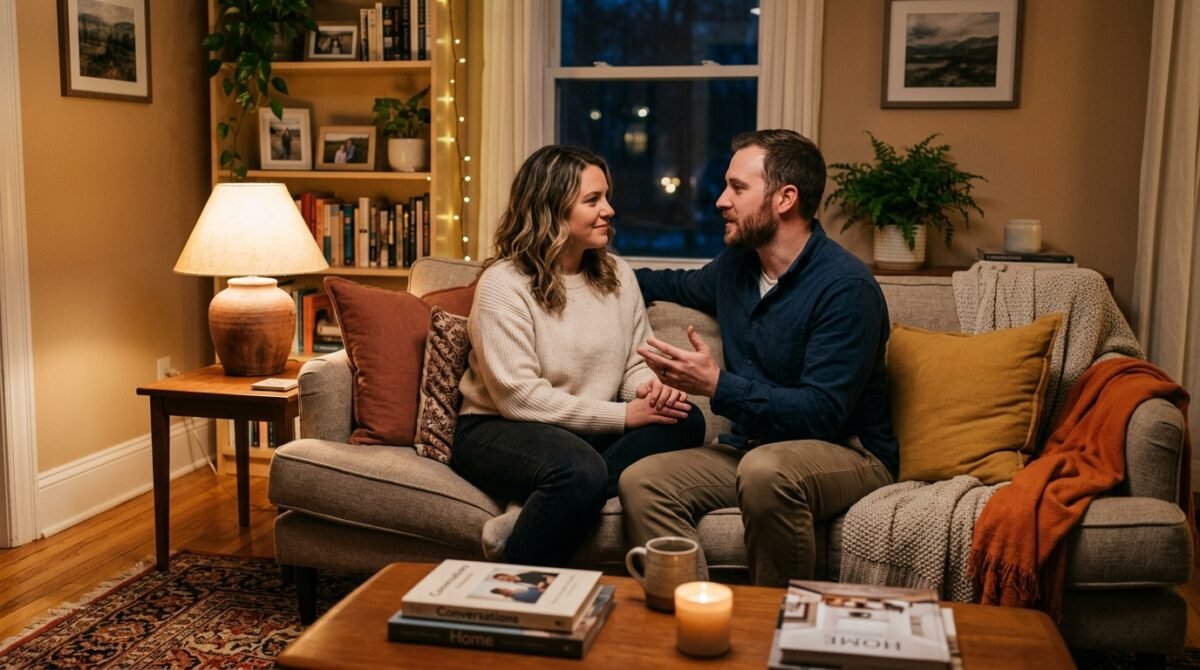
Months passed, and the holiday season came and went. There was no ‘heartfelt’ apology from Eleanor. There was no realization of her overstep, no admission that she had behaved like an entitled guest. Instead, there was a cold, distant standoff. She treated me like a stranger, and I treated her with the same polite, distant respect. It was the only way we could coexist, and honestly, it was a relief.
Mark eventually started to see it too. He began to notice the ways his mother would manipulate conversations, the subtle jabs she would take, and the way she expected him to defend her actions, even when they were clearly wrong. It was a slow awakening, but it was happening. He wasn’t the same man who had stood in the hallway on Thanksgiving, hoping I would just open the door and fix everything.
“I’m sorry, Sarah. I see it now. I see how she treated you, and I see how I let it happen. I shouldn’t have expected you to just take it.”
— Mark, during a quiet evening months later
That apology meant more to me than a thousand apologies from Eleanor ever could. It was the moment I knew that our marriage had a chance. He had finally stepped out of the shadow of his mother’s expectations and seen me as an equal partner. We were finally on the same team, and that was the most important thing. We had moved past the crisis, but we were stronger for it.
We decided to go to therapy together, not because our marriage was ending, but because we wanted to ensure that it was built on a foundation of mutual respect and clear communication. We talked about the Thanksgiving incident, about the years of tension that had led up to it, and about how we wanted to build our future. It wasn’t always easy, but it was productive.
I still think about that locked kitchen door sometimes. I think about the sound of the deadbolt clicking and the look on Eleanor’s face when she realized the game was over. It was a moment of pure, raw defiance, but it was also a moment of self-discovery. I had learned that I was capable of standing up for myself, even when it was difficult, even when it meant facing the wrath of people I was ‘supposed’ to respect.
I am a better person for that experience. I am more aware of my needs, more firm in my boundaries, and more confident in my ability to handle whatever life throws at me. I still love to cook, but now, I cook for myself, for Mark, and for the people who truly respect the time and effort I put into my home. The kitchen is always open to them, but the door is firmly locked to anyone who thinks they can just walk in and take over.
Reflections on Boundary Setting and Family

The story of my Thanksgiving ‘hostage crisis’ taught me that boundaries are not just suggestions; they are the bedrock of self-respect. When we allow others to trample over our wishes, we are effectively telling them that our feelings don’t matter. For years, I had believed that ‘keeping the peace’ was the most important part of a family relationship, but I learned that true peace only exists when everyone’s boundaries are honored.
Looking back, I see how the tension had been building for years. Small slights, backhanded compliments, and unsolicited ‘help’ were all indicators that Eleanor viewed my life as an extension of her own. She didn’t see me as a partner to her son; she saw me as a student who needed her guidance. By standing my ground, I wasn’t just defending my turkey; I was defending my right to exist as an independent adult.
“Boundaries aren’t about being mean. They’re about being honest. When you set a boundary, you are telling the world how you expect to be treated. And if someone can’t respect that, they don’t deserve access to your time or your space.”
— A piece of advice from my therapist
I hope that anyone reading this realizes that they are never obligated to accept abuse, intrusion, or disrespect, regardless of who it comes from. Family is important, but your dignity is paramount. You can love your family and still hold them accountable. You can be a good host and still say ‘no’ to people who don’t appreciate your efforts.
My relationship with my in-laws may never be perfect, and that’s okay. I’ve accepted that I cannot control how they feel or how they treat me. I can only control how I respond. I have chosen to live my life on my own terms, with the people who respect my boundaries and value my presence. It’s a much smaller world, but it’s a much happier one.
I am grateful for that Thanksgiving, as strange as it sounds. It was the catalyst for the rest of my life. I went from being a person who allowed others to define my reality to a person who defines it for herself. And honestly, that’s a transformation worth every single stressful, chaotic, and loud moment of that day. I am stronger, I am clearer, and I am finally, truly at home.
Conclusion
The events of that Thanksgiving taught me that the most important space you inhabit isn’t just your kitchen—it’s the boundaries around your autonomy and your self-worth. If you found yourself nodding along to this story, it’s likely because you’ve felt that same pressure to be the ‘perfect’ person at the cost of your own sanity. Whether it’s an overbearing in-law, a demanding workplace, or a partner who doesn’t see your value, remember that your ‘no’ is just as valid as anyone else’s ‘yes’.
I’m curious to hear your take on this. Did I go too far by locking the door, or was that the only way to send a message that could actually be heard? Would you have handled the situation differently, or would you have walked out the front door and left them to their own devices? Let’s talk about it in the comments below—have you ever had to draw a line in the sand with family, and how did they react?
What's your verdict on this dilemma?
Vote below to contribute to the official community consensus.

Have a Dilemma Keeping You Up at Night?
Share your real-life feud, wedding chaos, or relationship crossroads anonymously with our editorial team.
What do you think ?
0 Comments🛡️ Comments are moderated to protect community integrity. Your comment will appear once approved by the editorial team.