

We all have that specific vision of the ‘perfect’ family holiday. It is built on a foundation of carefully curated nostalgia, table settings that cost more than a monthly car payment, and the unspoken expectation that everyone will play their assigned roles with a smile. For my husband, Mark, his family home is a sanctuary of tradition. For me, after three years of marriage, it has become a theater of the absurd where the script was written in 1954 and never updated.
The trouble with traditions that rely on gender roles is that they rarely survive a reality check. In the Miller household, the men are the ‘providers’ and ‘thinkers,’ which apparently means their only contribution to a gathering is to provide commentary on the Sunday football game. The women? We are the support staff, the silent chore-doers, the invisible engines keeping the machine of the family dinner running smoothly.
I had spent years biting my tongue, playing the role of the dutiful daughter-in-law. I’d rinse the plates while the men laughed at commercials, I’d fetch more drinks, and I’d nod along to comments about how ‘lucky’ I was to have such a traditional husband. But that day, the air felt different. The humidity of the kitchen, the clatter of the massive mountain of dishes, and the booming cheers from the living room created a pressure cooker of resentment that finally reached its boiling point.
When my mother-in-law, Susan, pointed at the towering pile of grease-stained platters and told me, ‘The ladies need to get started on the cleanup so the men don’t have to worry about it,’ something inside me just snapped. I didn’t scream. I didn’t throw a plate. I simply realized that I was an adult, I had a functioning bank account, and I was under absolutely no obligation to be anyone’s maid.
What followed wasn’t just a walk to an Uber; it was the start of a seismic shift in my marriage. The fallout was immediate, the family group chat became a war zone, and the internet—well, the internet had a lot to say about whether I was a hero or a villain. This is the story of that Sunday, the silence that preceded the storm, and the lesson I learned about what happens when you finally stop playing the game.
The Prelude to the Proclamation

The day began with the familiar frantic energy of the Miller household. We had arrived at 11:00 AM, and from the moment we crossed the threshold, the gender divide was as clear as the division of property lines. The men were ushered into the den to ‘discuss business,’ which mostly involved scrolling through fantasy football stats, while the women were immediately tasked with prepping side dishes.
I found myself peeling potatoes for what felt like hours, listening to my sister-in-law, Sarah, talk about her promotion at work while Susan periodically interrupted to remind her that she needed to ‘leave some energy for her husband’s evening.’ It was patronizing, archaic, and exhausting. Every time I tried to interject with a topic of substance, the conversation was steered back to the menu or the state of the house.
Mark, meanwhile, was in his element. He loved these gatherings because he didn’t have to make a single decision. He could float through the day on a tide of beer and snacks, his presence celebrated simply because he was a Miller male. I watched him from the kitchen window, leaning back in an armchair, laughing as his father patted his shoulder. He looked entirely comfortable, and for a moment, I felt a deep, piercing loneliness.
I realized then that I wasn’t there as a partner or a guest. I was there as an accessory to Mark’s heritage. The food we prepared was meant to be consumed and forgotten, much like the labor we were expected to provide. As the dinner hour approached, the kitchen grew warmer, the smell of roasting meat thick and suffocating, and the sound of the game grew louder, signaling the transition from prep work to the final act: the inevitable post-meal servitude.
I looked at the stack of fine china that had been brought out specifically for this occasion. It was heavy, delicate, and required hand-washing. Susan had already made it clear earlier that no one was allowed to use the dishwasher because it ‘ruins the finish’ of her grandmother’s plates. The sheer volume of labor ahead of us was daunting, and for the first time, I looked at the task and felt not duty, but a cold, hard refusal.
The Command from the Head of the Table
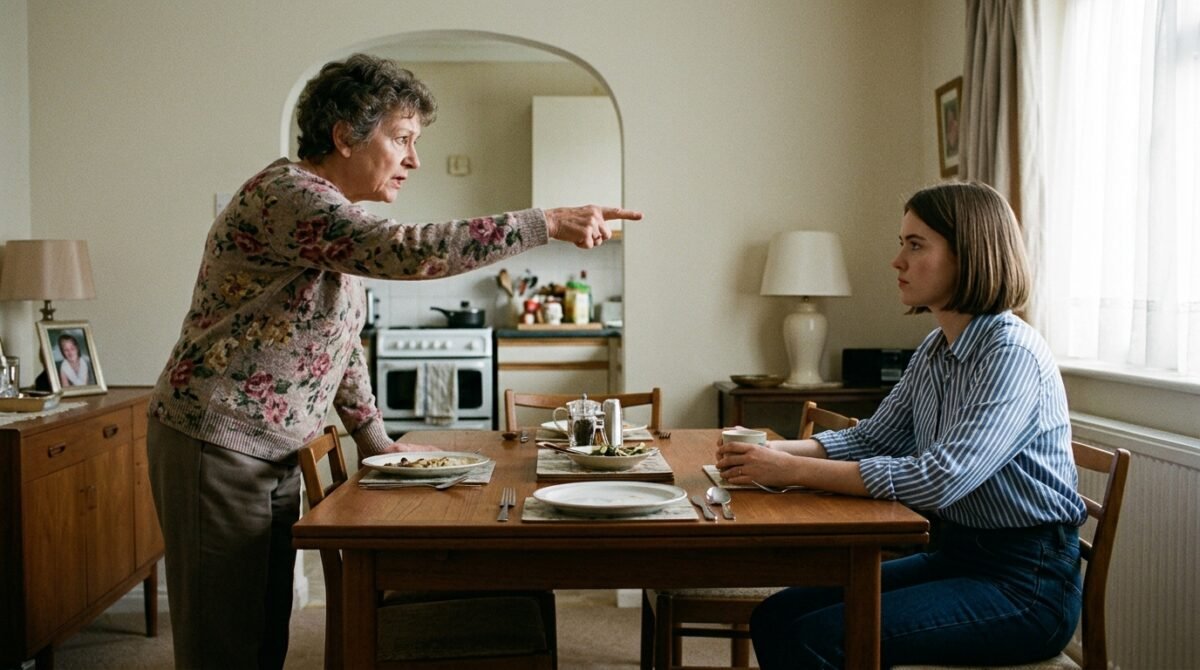
The meal itself was a masterpiece of passive-aggression. Susan kept pointing out how much ‘the boys’ loved her gravy, and how ‘the girls’ were so lucky to have such hard-working men. Mark ate with gusto, never once glancing over at me, never once asking if I needed help or if I was enjoying the conversation. He was in his bubble, fueled by football and comfort.
As the final dessert plates were cleared, the men began their migration back to the living room. The game was entering the fourth quarter, and the atmosphere was electric. Susan cleared her throat—a sound I had come to dread. It was the signal. She stood at the head of the table, clutching a dish towel like a scepter. ‘Alright,’ she announced to the room, her voice dripping with a forced sweetness that didn’t reach her eyes.
‘The boys have had a long day of watching the game. The ladies, let’s get into the kitchen. We need to tackle this before we all get too tired.’ She looked directly at me, her gaze lingering just a second too long, as if waiting for me to jump up and start scrubbing. It was a command disguised as a communal suggestion, a test of my compliance.
My sister-in-law, Sarah, sighed and began stacking the plates, her face a mask of resignation. I watched her, feeling a surge of protective anger. She had worked a sixty-hour week, she had brought a side dish, and yet here she was, ready to act as a servant because that was the ‘way things were done.’ The silence in the dining room was thick, waiting for me to follow suit.
I looked at the men. My father-in-law had already popped open another beer. Mark was deep in a conversation about a touchdown play. None of them acknowledged us. To them, we had effectively ceased to exist the moment the food left the table. I felt the heat rising in my neck, not from the kitchen, but from the sheer audacity of the assumption that my time was worth nothing.
“Susan, I’m not doing the dishes today. I’m actually quite tired, and I think everyone here is capable of cleaning up after themselves.”
— Me, responding to the ‘command’
The Sound of Silence and the Uber Alert
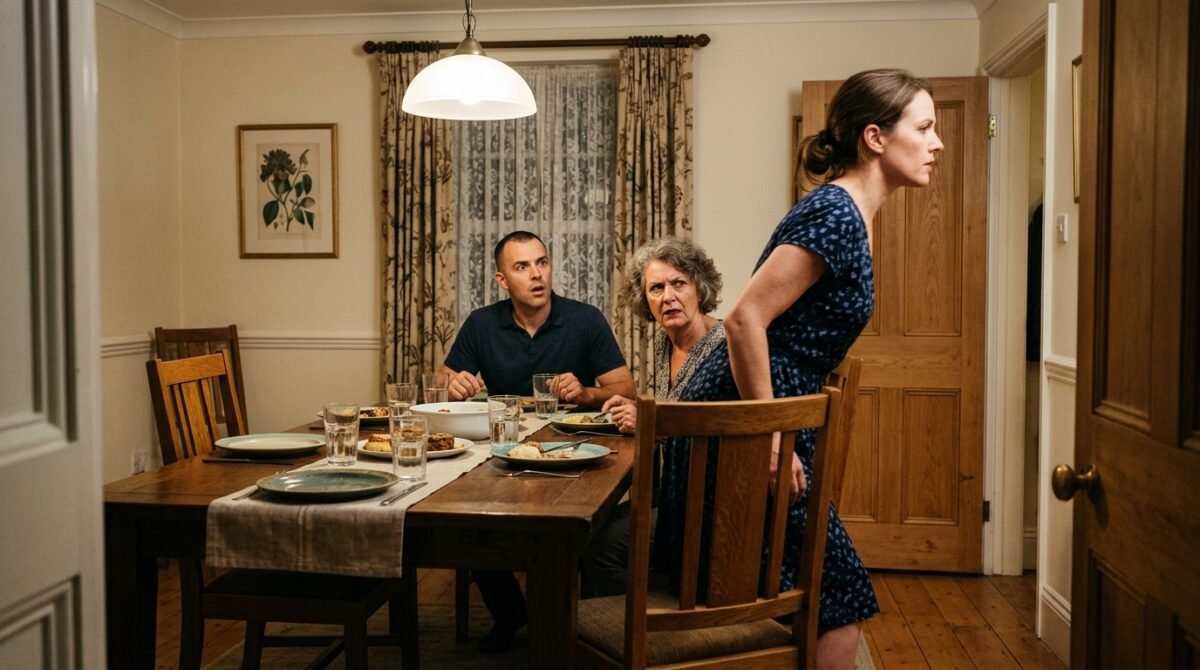
The room went absolutely silent. It was the kind of quiet that you could feel in your teeth. Susan’s hand dropped from the air. Mark finally looked up from the television, his expression shifting from amusement to pure confusion. He didn’t know what was happening; he had missed the context because he hadn’t been paying attention to anything but the game.
I didn’t argue. I didn’t explain. I simply reached into my pocket, pulled out my phone, and opened the Uber app. The app showed a driver nearby—a four-minute wait. I watched the little car icon move along the street on the map, a tiny, glowing beacon of my impending freedom. The silence stretched, filled only by the muffled roar of the stadium crowd from the living room television.
Mark finally stood up, his face reddening. ‘What are you doing? We’re not leaving yet, the game is still on.’ He sounded like a child whose favorite toy had been snatched away. He still didn’t understand that this wasn’t about the game, or the chores, or even the dishes. It was about the fundamental lack of respect that had been simmering for years.
I stood up, smoothed out my dress, and picked up my purse. I felt a strange, detached calm. ‘I’m going home, Mark,’ I said, my voice steady. ‘You’re welcome to stay as long as you like. There’s an Uber arriving in three minutes. If you want to ride back with me, you’re welcome to come now. If not, I’ll see you at home later.’ The look on his face was one of absolute shock; he had never seen me defy his mother in public before.
Susan found her voice, a sharp, indignant sound. ‘You are being incredibly rude! We are a family! We work together!’ She was visibly shaking, the social order she had curated so carefully beginning to crumble. I didn’t stop to debate the definition of family. I just turned and walked toward the front door. The sound of my heels on the hardwood floor seemed to echo through the entire house, a rhythmic beat of departure.
The Digital Firestorm

I was halfway home when my phone started buzzing incessantly. It was the family group chat—a place usually reserved for holiday photos and passive-aggressive birthday wishes. Now, it was a waterfall of condemnation. My phone was lighting up so fast I had to mute the notifications just to keep from being distracted while the Uber driver navigated the city.
The messages ranged from genuinely confused to outright hostile. Susan had wasted no time framing the narrative. She had painted my departure as a ‘hissy fit’ and a ‘disrespectful display’ that had ruined the day. Sarah, interestingly, had stayed silent, but other relatives were jumping in, echoing Susan’s outrage. It was a classic case of family gaslighting, where the one who breaks the cycle is labeled the enemy.
“You have embarrassed us all. This is not how we treat family. Apologize to your mother-in-law immediately.”
— My Father-in-Law, in the family group chat
“I don’t think you realize how much work Susan does for everyone. You owe her an apology for walking out.”
— Aunt Linda, in the family group chat
I didn’t respond to any of them. I watched the messages pile up, each one a testament to why I had left. They weren’t angry that I had left; they were angry that I had broken the illusion that they were all perfectly happy servants of the status quo. By leaving, I had forced them to look at the work they were doing and realize, perhaps for a fleeting second, that they didn’t have to do it.
When I finally got home, the house was dark and quiet. I made myself a cup of tea and sat on the couch, the silence of my own home feeling like a luxury I had been starved of. I was terrified, of course—I knew there would be a massive confrontation when Mark got home—but the fear was eclipsed by a sense of profound relief. I had set a boundary, and for the first time in my life, I had not backpedaled when the pressure hit.
Mark didn’t come home for another three hours. I heard him fumbling with his keys, the sound of his frustrated sigh as he entered the house. He walked into the living room, ready for an argument, his face flushed with the kind of defensive anger that comes from being told you’re wrong by someone you think you own.
The Midnight Confrontation

Mark didn’t even take off his coat. He stood in the center of the living room, gesturing wildly. ‘Do you have any idea what you did? My mother is in tears. My father thinks you’re insane. You made me look like an idiot in front of everyone!’ He was breathless, his energy still spiked from the tension at his parents’ house.
I didn’t flinch. I sat there, sipping my tea, and looked at him. ‘I didn’t make you look like anything, Mark. You looked like what you were—a man sitting on the couch while his partner was treated like hired help. If you felt embarrassed, it’s because you know that what happened there wasn’t right.’
He paced the room, his frustration clearly stems from the fact that I wasn’t playing my part. ‘It’s just dishes! It’s one day! Why are you so sensitive? We’ve done this for years. You’ve never complained before. Why today?’ His question was genuine, and it highlighted the core of the problem: he had never considered my comfort because he had never had to. He had been trained to believe that my labor was a given.
I stood up and faced him. ‘It’s not just about the dishes, Mark. It’s about the fact that you didn’t even notice I was gone until I was out the door. It’s about the fact that your mother thinks she has the right to assign me chores like I’m a child. I am your wife, not your mother’s employee, and I am certainly not here to subsidize your father’s leisure time.’
“You’re being dramatic. It’s a family gathering. You’re supposed to help. That’s what family does.”
— Mark, during our argument
“If family means me cleaning up your messes while you ignore me, then I don’t want to be that kind of family.”
— My response to Mark
The argument lasted for hours. We tore through years of suppressed resentment, every small, forgotten grievance coming to the surface. He tried to pivot, he tried to minimize, and he tried to make it about the ‘tradition’ of the Miller family. But I held my ground. I told him that if he wanted to go to his parents’ house and play house, he could do it alone from now on. I was done with the theater.
The Reddit Trial

I didn’t tell anyone in real life what had happened, but I needed to know if I was losing my mind. I wrote a post on Reddit, laying out the timeline, the expectations, and the confrontation. I expected a mix of feedback, maybe some criticism for ‘ruining the holiday,’ but what I got was a deluge of support that left me sobbing in front of my laptop.
The community response was overwhelming. It wasn’t just ‘NTA’ (Not The Asshole); it was a deep, analytical breakdown of the gender roles, the emotional labor, and the entitlement that the Miller family exhibited. People shared their own stories of similar ‘kitchen traps’ and how they had eventually broken free. I felt a sense of validation I hadn’t realized I was starving for.
“The audacity of your mother-in-law to ‘assign’ chores is the real issue. You aren’t a guest in her home; you’re a prop. The fact that she expects the men to do nothing while the women labor is a power move, not a tradition.”
— u/ReasonableHuman (18.4k upvotes)
“I love the part where you just left. No drama, no screaming, just an Uber ride to peace. That’s the most powerful thing you could have done. It denies them the satisfaction of the fight they were looking for.”
— u/TruthTeller88 (12.1k upvotes)
Reading through these comments, I realized that I wasn’t ‘crazy’ or ‘sensitive.’ I was a person who had finally decided to opt-out of a system that didn’t value me. The sheer number of people who identified with my situation made me feel less alone. It also made me realize that my situation was a systemic issue, one that many women face every holiday season under the guise of ‘togetherness.’
One comment stood out to me, from a user who pointed out that by staying, I was actually enabling the behavior. They argued that my departure was a gift to my sister-in-law, because it forced the family to at least acknowledge that the labor wasn’t automatically ‘free.’ It shifted the perspective, and though I wasn’t there to see it, the thought gave me comfort.
I spent the whole night reading, clicking through threads, and learning about boundaries. I realized that the conflict hadn’t started that day; it had been building for years, and my silence had been interpreted as consent. The Reddit community didn’t just give me advice; they gave me a roadmap for how to handle the inevitable fallout that was going to come when the sun rose the next day.
The Fallout at the Office

Monday morning came with a heavy, leaden feeling. I walked into my office, dreading the inevitable text from Susan or a call from Mark’s father. My phone was still muted, but I could see the missed calls—five from Susan, three from my father-in-law. It was as if they couldn’t conceive of a world where I didn’t immediately answer to them.
Mark was distant. We hadn’t spoken since our fight late the previous night. He had slept on the couch, and when I left for work, he was still there, staring at the ceiling. I felt a wave of sadness wash over me. I loved him, but I was beginning to realize that the ‘him’ I loved was conditioned to view me in a way that I could no longer accept. The distance between us wasn’t just physical anymore; it was philosophical.
My sister-in-law, Sarah, reached out to me on a private platform. It was the first message I had received that wasn’t an attack. She was hesitant, almost scared to be seen talking to me. She told me that after I left, things got incredibly awkward. The men were forced to ‘help’ because there weren’t enough women to cover the mountain of dishes, and they complained the entire time about how ‘out of place’ they felt.
“I just wanted to say… I think you were brave. I stayed because I was too afraid to leave, but watching you walk out… it made me realize I have a choice too. I’m sorry I didn’t stand with you.”
— Text message from Sarah
That text changed everything for me. It wasn’t about winning or losing; it was about the ripple effect of setting a boundary. Even if I was the only one who left that day, I had changed the atmosphere of the room. I had forced the issue into the light, and for the first time, someone else had seen it for what it was. I felt a sudden surge of strength.
I decided then that I would not apologize. I would not reach out to Susan, and I would not grovel to my father-in-law. If they wanted a relationship with me, it would have to be on terms that respected my time and my labor. I was no longer interested in being the ‘good’ daughter-in-law; I was interested in being a healthy, respected adult.
The rest of the day was a blur. I focused on my work, but my mind kept drifting back to the conversation I knew I would have with Mark that evening. It was going to be the most important conversation of our marriage. I had to make it clear that this wasn’t an isolated incident—it was the baseline for our future. If he couldn’t stand up to his family, he couldn’t be my partner.
The Sit-Down Conversation

When I got home, Mark was actually home early. He had made dinner—pasta, nothing fancy—but it was an attempt at something. He didn’t say much when I walked in, just greeted me with a nod. We ate in a silence that was less tense than the night before, but still thick with unspoken expectations. I knew he was waiting for me to ‘come to my senses’ and apologize.
I waited until the plates were cleared—which, to his credit, he did himself—and then I sat him down. I told him that I wasn’t trying to destroy his relationship with his family, but that I could no longer participate in a dynamic that treated me like an outsider. I explained the emotional labor, the exhaustion, and the feeling of being invisible.
Mark was quiet for a long time. He admitted that he had never noticed the chores, because he had never been taught to. He said that his mother had always just ‘handled it,’ and he assumed it was just what people did. It was the classic ‘I didn’t know because I never looked’ defense. But for the first time, he seemed to be actually listening to my words instead of just waiting for his turn to argue.
“I never thought about it like that. I just saw it as a day off for me, and I didn’t think about what you were doing. I’m sorry I made you feel like you were invisible.”
— Mark, during our serious conversation
It wasn’t a perfect apology, and it didn’t solve everything instantly, but it was a crack in the armor. We talked about how we would handle future holidays. I told him that if I went to his parents’ house, I would be a guest, not a servant. If the expectation was that I would work, then I would stay home. He agreed, though he was still clearly nervous about how his mother would react to that boundary.
I told him that his mother’s reaction was his to manage, not mine. I would not be the shield he hid behind. If she had a problem with us establishing healthy boundaries, he would have to be the one to tell her. This was the hardest part for him; he had been the ‘good son’ his whole life, and the thought of disappointing her was terrifying. But he knew, deep down, that losing me was a much bigger risk.
We spent the night making a plan. We talked about how to politely decline requests, how to leave early if the environment became toxic, and how to support each other when the pressure mounted. It was the first time we had truly acted as a unit, a partnership against the outside world, rather than me trying to fit into his world. It was a small win, but it felt like a foundation.
The Inevitable Mother-in-Law Phone Call

Two days later, the inevitable happened. My phone rang, and it was Susan. I debated for a long time whether or not to answer. My instinct was to ignore it, to protect my peace. But I knew that if I didn’t handle it, she would just keep coming, and she would drag Mark into the middle of it. I took a deep breath and hit the green button.
She didn’t start with pleasantries. She launched directly into an attack. ‘I don’t know what you’ve done to Mark, but he’s acting very strangely, and I expect you to fix this immediately. We are a family, and you don’t just leave during a celebration. It’s disrespectful.’ Her voice was tight, thin with rage. She was trying to exert control, and it was clearly failing.
I stayed calm. I had rehearsed this. ‘Susan, I left because I felt that my presence was only valued for the labor I could provide. If you want a relationship with me, it needs to be based on mutual respect, not on chores. I am not an employee, and I won’t be treated like one. If you want to have a conversation about that, I’m happy to have it. If you’re just calling to berate me, then I’m hanging up.’
“You are being incredibly ungrateful. I have done so much for this family, and this is how you treat me?”
— Susan, during our heated phone call
She tried to talk over me, to guilt-trip me, to bring up everything she had ever done for us. It was classic deflection. I stood firm. I didn’t yell; I just repeated my point. I told her that I loved Mark and I wanted to be a part of the family, but not at the cost of my self-respect. When she refused to listen and started making personal digs, I did exactly what I promised: I hung up.
The silence that followed was heavy. I looked at my phone, my hands shaking slightly. I had stood up to the matriarch of the family. It was a terrifying moment, but it was also empowering. I realized that she had no real power over me, only the power I allowed her to have. She couldn’t fire me, she couldn’t evict me, and she couldn’t force me to do anything I didn’t want to do.
Mark came home shortly after. I told him what happened. He was worried, but he didn’t tell me I was wrong. He didn’t ask me to apologize. He just hugged me and said, ‘Thank you for handling it.’ It was the validation I needed. He was finally on the same page, and that was the only thing that mattered to me in that moment.
Reflecting on the New Normal

A few months have passed since that Sunday. Things are different, and in some ways, they are harder. We see his parents much less, and when we do, the air is thick with tension. Susan hasn’t apologized, and frankly, I don’t expect her to. But she has changed her behavior. When we visit, there is no ‘kitchen assignment.’ The work is done by everyone, or it isn’t done at all, and no one dares to point a finger at me.
Mark has grown in ways I didn’t think possible. He’s started noticing the labor he previously ignored in our own home, too. He steps up without being asked, and he’s become much more protective of our time together. We’ve had to set boundaries with other family members as well, realizing that this wasn’t just about his parents—it was about our autonomy as a couple.
I’ve learned that setting boundaries isn’t a one-time event. It’s a practice. It’s something you have to do every day, in every situation where your comfort or your dignity is at stake. It’s not about being ‘difficult’; it’s about being an equal participant in your own life. It’s a lesson I wish I had learned years ago, but I’m grateful I learned it now.
Looking back, I don’t regret walking out. It was the most honest thing I’ve ever done. It forced the issue, it exposed the rot in the dynamic, and it pushed us to build something healthier. I’m not saying it was easy—losing the approval of people you want to be close to is painful—but it was necessary. The peace I’ve gained is worth more than any holiday tradition.
If you find yourself in a similar position, know that you aren’t alone. You aren’t obligated to follow traditions that make you feel like a guest in your own life. You have the right to leave, to say no, and to demand respect. Your labor is not an infinite resource, and your time is your own. Never be afraid to prioritize your peace, even if it means walking out of the room.
Conclusion
The experience changed my life in ways I never anticipated. It wasn’t just about dishes or holidays; it was about reclaiming my agency. The pushback I received was intense, but it served as a litmus test for the relationships in my life. Those who truly cared about me were able to adjust and respect my boundaries, while those who only valued me as a servant eventually drifted away.
We are still working through the dynamics, and there are days when the tension is palpable. But we are doing it together, as a team. I’ve realized that true intimacy is built on honesty, not on pretending that everything is fine while you’re secretly drowning in resentment. We are forging a new path, one that doesn’t rely on archaic roles or the silent sacrifice of our happiness.
This story isn’t just mine; it’s shared by countless people who feel the weight of unspoken expectations every single day. The community debate on this issue highlights a deep generational and cultural shift in how we view family, labor, and respect. It is a conversation that is long overdue, and one I am proud to have sparked in my own small way.
What about you? Have you ever had to walk out of a situation to reclaim your dignity? Or have you found a way to set boundaries without the drama? Share your experiences in the comments below—let’s talk about how to protect our peace in a world that constantly demands our labor.
What's your verdict on this dilemma?
Vote below to contribute to the official community consensus.

Have a Dilemma Keeping You Up at Night?
Share your real-life feud, wedding chaos, or relationship crossroads anonymously with our editorial team.
What do you think ?
0 Comments🛡️ Comments are moderated to protect community integrity. Your comment will appear once approved by the editorial team.