

For three years, the rhythmic creaking of our floorboards served as a constant reminder of the project we were saving for. We had been living in a charming, yet structurally compromised fixer-upper that needed a serious foundation overhaul. We called it the ‘Foundation Fund.’ Every month, like clockwork, we deposited a portion of our combined income into a high-yield savings account. It wasn’t just money; it was the promise of a safe, stable future for our family. By the time we hit our goal of $45,000, I felt a sense of relief I hadn’t experienced in years. We were finally ready to call the contractors.
Then came the Tuesday evening that shattered my reality. I was sitting at the kitchen table, finalizing the quotes we’d received from three different structural engineering firms, when I decided to log into our joint bank account to double-check the available balance for the initial down payment. My heart didn’t just skip a beat; it plummeted into my stomach. The balance was $142.18. My breath caught in my throat as I refreshed the page, assuming it was a banking glitch. It wasn’t.
I spent the next hour scrolling through months of transfers, each one more bewildering than the last. They were all directed toward a brokerage account my husband, Mark, had opened in secret. I sat there in the silence of our home, watching the realization dawn on me: every cent of the money we had sacrificed for, skipped vacations for, and argued over for years, was gone. It had been poured into a series of high-risk, speculative biotech stocks that had bottomed out.
When Mark walked through the door at 6:30 PM, whistling a tune and carrying a bag of takeout, he had no idea he was walking into a war zone. I didn’t scream. I didn’t throw anything. I simply turned the laptop screen toward him and asked one question: ‘Where is the foundation money, Mark?’ The way his face drained of color told me everything I needed to know before he even opened his mouth to lie.
This wasn’t just a financial mistake. It was a calculated, long-term betrayal of trust. In the following days, as the dust settled and the sheer magnitude of his gambling addiction—and his talent for deception—came to light, I was forced to confront the fact that the person I had shared my bed with for five years was a stranger. This is the story of how our foundation fell, and why I’m still digging myself out of the rubble.
The Tuesday Night That Changed Everything
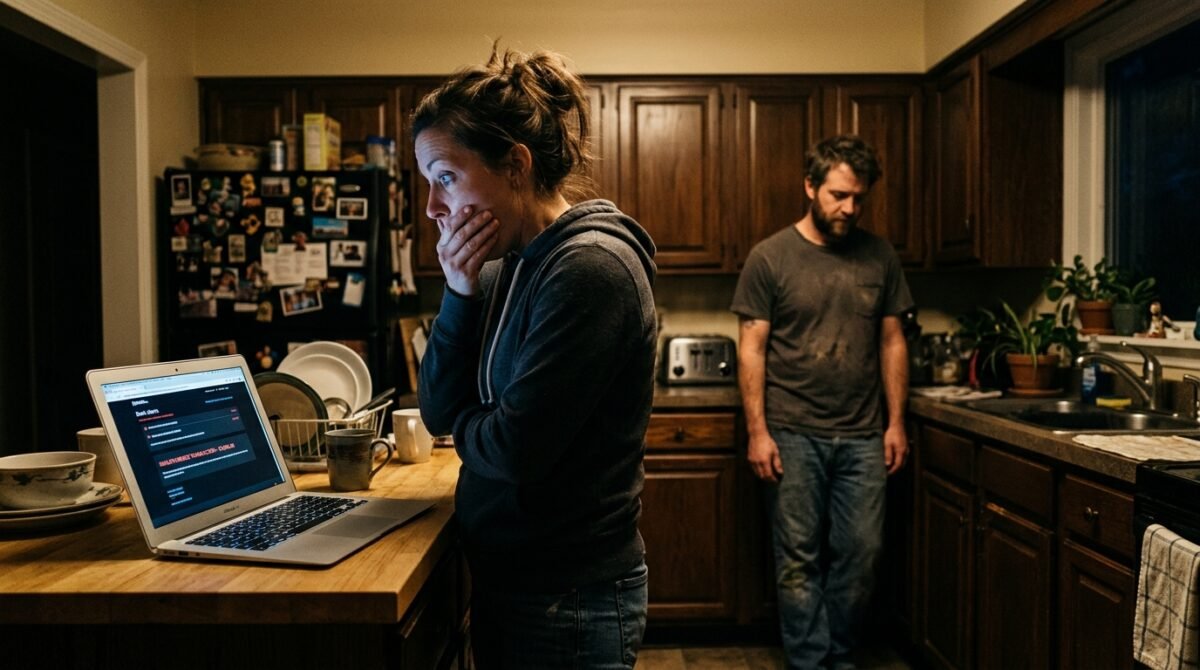
The silence in the kitchen was absolute, save for the hum of the refrigerator. When Mark finally set the takeout bag on the counter, his eyes darted to the laptop screen, and the whistling stopped instantly. He knew. He knew exactly what was on that screen, and he knew that his months of meticulous scrubbing and hiding were officially over.
“I can explain everything, Sarah. It wasn’t gambling. It was an investment. I was trying to double it so we could afford the luxury kitchen renovation you wanted. I did this for us.”
— Mark, in the immediate aftermath of the discovery.
I felt a cold rage settle into my bones. ‘You didn’t ask me,’ I replied, my voice shaking with a tremor I couldn’t control. ‘You didn’t even consult me. You took money that was meant to keep this house from sinking into the dirt and you bet it on a company that hasn’t even cleared Phase II clinical trials. That isn’t an investment, Mark. That is high-stakes gambling with our security.’
He tried to move toward me, to put a hand on my shoulder, but I recoiled. The touch felt like a violation. For months, he had been coming home late, appearing exhausted, and I had coddled him, thinking he was working overtime for our dream. All that time, he was staring at red and green candles on a trading platform, watching our future evaporate into thin air.
The audacity of his justification was what stung the most. He was framing his betrayal as a selfless act of love. He wasn’t just a gambler; he was a gaslighter who believed that if he spun the narrative correctly, I would eventually forgive him. I stared at him, really seeing him for the first time—the nervous tic in his jaw, the way he couldn’t hold my gaze—and realized I didn’t know who this man was.
I grabbed my keys, my phone, and my coat. I needed to breathe. I couldn’t be in the same house that was quite literally falling apart, knowing that the money to fix it had been traded for digital numbers on a screen. I left him standing in the kitchen, surrounded by the smell of cold takeout and the ghosts of our financial security.
The Digital Trail of Deception

I spent the next three days at my mother’s house, fueled by adrenaline and a desperate need for the truth. I demanded his login credentials for the brokerage account, threatening that if he didn’t provide them, I would call his father—a man who prided himself on financial integrity—and tell him everything. It was a low blow, but I was past the point of fighting fair.
The trade history was a nauseating read. It wasn’t just one bad day. It was a slow, agonizing bleed. He had been ‘day-trading’ on margin, borrowing money from the brokerage to buy even more stock. As the stocks dipped, he kept doubling down, hoping for a ‘moon shot’ that would miraculously restore the fund and hide his tracks. He had treated our life savings like a playground.
I found the text messages between him and his ‘trading mentor,’ a guy he’d met on an obscure forum. They were filled with jargon—’diamond hands,’ ‘to the moon,’ ‘buy the dip’—and an alarming level of detachment from reality. They talked about money as if it were play-doh, never acknowledging that this was the roof over our heads.
“Just need a quick 20% pop on $BIOTECH and I’m back in the clear. Sarah doesn’t need to know yet. I’ll replace it before the contractors start in July.”
— Leaked text message from Mark to his online trading group.
The dates on the messages spanned six months. Six months of dinner conversations where he asked me about my day, knowing full well he had lost another $5,000 that morning. Six months of sleeping beside him, oblivious to the fact that he was actively dismantling our life. The sheer effort required to maintain that level of deceit was exhausting just to read about.
I started printing every statement, every trade, and every message. I needed to see it in black and white because my brain refused to process the scale of the destruction. It wasn’t just the $45,000; it was the loss of the two years we had spent working extra shifts and cutting coupons to save every dollar. It was the stolen time.
The Confrontation in the Living Room
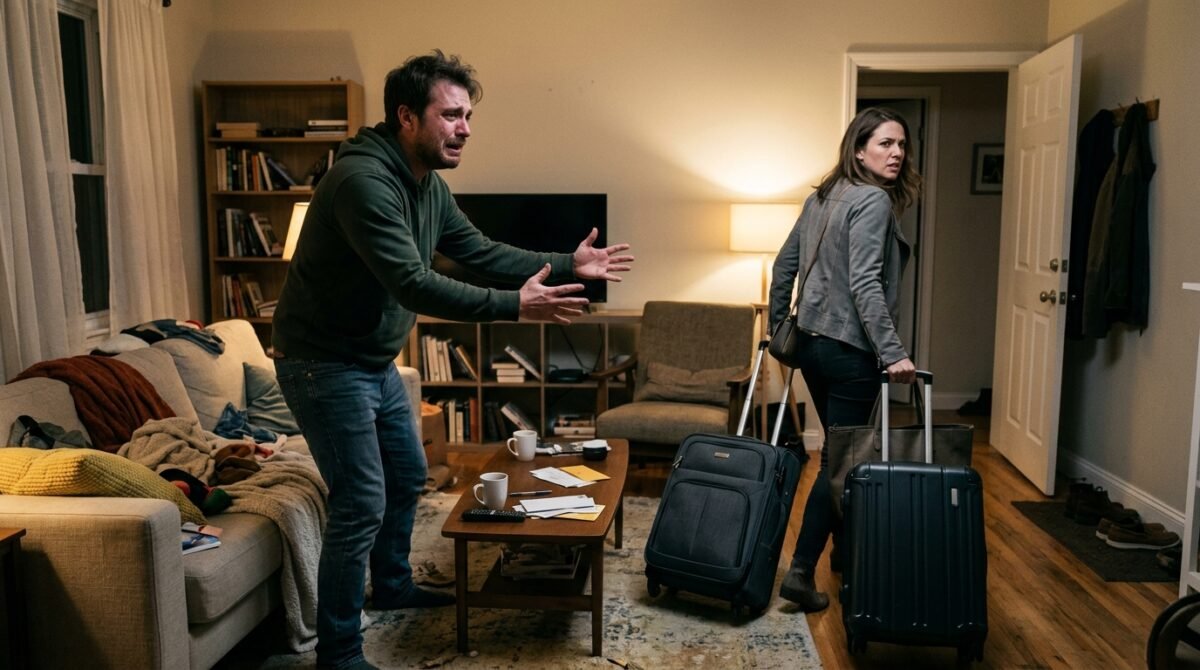
When I returned to the house to gather my things, Mark had clearly been spiraling. The house was a mess, empty beer bottles littered the coffee table, and he looked as though he hadn’t slept since I left. He stood up when I entered, his eyes bloodshot, his posture desperate. He was ready to play the victim, or perhaps the repentant sinner, depending on what he thought would get him the best result.
He started with the apologies, the ‘I didn’t mean for this to happen,’ and the classic ‘I’m a victim of a bad market.’ I let him talk for a full five minutes, watching the desperation drip off him like sweat. Then, I dropped the thick folder of printed trade logs onto the coffee table with a thud that seemed to echo through the empty room.
“You didn’t have bad luck, Mark. You had a bad strategy and a complete lack of respect for this marriage. Don’t you dare talk to me about the market. Talk to me about why you thought your greed was worth more than our home.”
— My response to his excuses.
He tried to argue that I was being ‘cold’ and ‘unsupportive.’ He tried to invoke the ‘for better or worse’ clause of our wedding vows, as if those vows were a blank check for him to gamble our future away. I stopped him right there. I told him that ‘for worse’ didn’t include intentional, secretive destruction of a spouse’s security.
The conversation devolved into an ugly spectacle. He started yelling about how I was ‘always controlling the money’ and that he ‘felt suffocated’ by our financial goals. It was the final straw. He was blaming me for his own lack of impulse control and his decision to lie. I realized then that I wasn’t just angry; I was finished.
I didn’t stay to hear the rest. I packed two suitcases and told him that if I saw him at my mother’s house, I would call the police. The look on his face—a mixture of genuine shock and pathetic realization—was the last thing I saw before I locked the front door behind me. I knew, without a shadow of a doubt, that I wouldn’t be walking back through that door as his wife.
The Fallout: When the Community Speaks

I didn’t tell anyone at first. The shame was too heavy to carry. But after a week of isolation, I reached out to a subreddit dedicated to financial and relationship advice. I needed to know if I was crazy. Was I really being too harsh? Was this something that could be ‘worked through’ with enough counseling and patience? I laid the situation out, raw and unfiltered.
The response was overwhelming. Within hours, the post had thousands of views and hundreds of comments. The collective wisdom of the internet was a jarring contrast to the desperate excuses Mark had been feeding me. People didn’t see a ‘mistake’; they saw financial infidelity, which is just as damaging as sexual infidelity in many marriages.
“This isn’t a stock market problem; it’s a character problem. He didn’t just lose money; he systematically lied to you for months while looking you in the eye. That kind of betrayal doesn’t just go away because he ‘learned his lesson.’ Run, OP.”
— u/FinanceExpert_Real (Top Comment, 32.4k upvotes)
Others shared their own stories, stories of partners who had secret debts, secret credit cards, and secret gambling addictions. The patterns were identical: the gaslighting, the shifting of blame, the promise that ‘this is the last time,’ and the eventual second, third, or fourth relapse. It was a terrifying mirror to my own life.
There were a few voices who suggested marriage counseling, who talked about the ‘sickness of addiction’ and the importance of supporting a spouse through a crisis. I read those comments too, but they felt hollow. Maybe in a different world, with a different man, I could have been the supportive wife. But here, with the foundation of my house and my trust in ruins, I knew there was no room left for empathy.
The consensus was clear: the financial infidelity was the symptom, but the lack of integrity was the disease. People pointed out that he hadn’t even confessed voluntarily—I had discovered it. If I hadn’t looked at the account, he would have kept lying until the very last cent was gone, and likely would have started borrowing against our future in other ways.
The Legal Reality Check

When I finally spoke to a divorce attorney, the conversation was sobering. Because we had a joint account, and because we were married, the money was technically ‘marital assets.’ Proving that he had essentially embezzled it to fund a gambling habit wasn’t going to make it magically reappear, but it would have a massive impact on the division of assets.
The attorney was blunt. ‘The money is gone, Sarah. You need to focus on protecting what’s left. If there are other assets, you need to freeze them immediately. You need to ensure he can’t take out loans in your name. Have you checked your credit report lately?’ I hadn’t. That was my next terrifying task.
I pulled my credit report and found a credit card I didn’t recognize. He had opened a line of credit in my name without my knowledge, using my social security number, to fund his trading when the savings account ran dry. I sat in the attorney’s office, feeling the tears start to fall, not out of sadness, but out of pure, unadulterated fury.
“Financial infidelity is often the precursor to complete household collapse. He didn’t just break your trust; he committed fraud. You are no longer dealing with a marriage issue; you are dealing with a legal liability.”
— Advice from my divorce attorney during our second consultation.
The realization that he had committed identity theft was the final nail in the coffin. There was no ‘working through’ this. There was no ‘rebuilding’ after fraud. My attorney walked me through the process of filing a police report for identity theft, which was necessary to dispute the charges and protect my future. It felt like I was destroying my husband, but I reminded myself: he had already destroyed himself.
I walked out of the office into the bright afternoon sun, feeling lighter. I wasn’t the victim anymore. I was a person taking control of their own survival. I had a long road ahead of me, but for the first time in months, I could see the path clearly. The foundation was gone, but I was going to build a new one, brick by brick, entirely on my own terms.
The Final Confrontation and Departure

I went back to the house one last time, with my brother in tow. Mark was waiting, looking disheveled and frantic. He had clearly been calling me, and the tone of his messages had shifted from apologetic to aggressive, demanding to know why I wasn’t answering. When he saw my brother standing in the doorway, his demeanor shifted again, back to the wounded, misunderstood husband.
He tried to start the same conversation as before, the one about ‘us’ and ‘our future.’ I didn’t let him finish a single sentence. I handed him the paperwork for the divorce, which my attorney had prepared. It was a cold, clinical document, but it was the most honest thing that had ever been in that house.
“I’m not here to talk, Mark. I’m here to tell you that the locks are being changed tomorrow, and you will be served with these papers by a process server. Do not contact me again unless it is through my lawyer.”
— My final words to my husband.
The look of utter disbelief on his face was almost comical. He truly believed that this was something that could be patched up with a few ‘I’m sorry’s’ and a promise to do better. He started to laugh, a dry, humorless sound, and then he started to cry. It was a desperate, ugly performance, but I was immune to it. The person I loved had been replaced by a man who valued his own ego and his ‘get rich quick’ schemes over the woman he had promised to cherish.
As I walked out of the house for the last time, I didn’t look back. I didn’t care about the foundation, or the peeling paint, or the leaky roof. Those were just things. They could be replaced or left behind. What mattered was that I was leaving behind a toxic, parasitic situation that had been rotting from the inside out for years. I felt a profound sense of peace as I drove away.
My brother didn’t say a word until we were miles away. He just reached over and squeezed my hand. I knew I had a long road of financial recovery, legal battles, and emotional healing ahead of me. I had lost $45,000, and I had lost five years of my life. But I hadn’t lost myself. And that, I realized, was worth more than any foundation.
The Long Road to Recovery

The months that followed were a blur of bank statements, divorce hearings, and endless calls to credit bureaus. I had to dispute every charge on the unauthorized credit card, provide proof of my identity, and testify about the fraud. It was grueling, but with each victory, I felt a little more of my agency return. I had to learn how to manage a budget, how to handle my own investments, and how to trust my own judgment again.
I moved into a small apartment, one that didn’t need a foundation repair and didn’t have any hidden surprises. It was modest, but it was mine. I started focusing on my career, taking on extra projects that I had previously avoided because they might ‘interfere with our life plans.’ I was finally building a life that was truly my own, without the weight of someone else’s secrets.
I also started therapy. It was essential for processing the anger, the betrayal, and the lingering sense of inadequacy I felt for not seeing the signs earlier. My therapist helped me understand that I wasn’t responsible for Mark’s actions. I was responsible for my own choices, and my choice to leave was the best thing I could have done for my mental health.
“You didn’t fail the marriage. The marriage failed you the moment your partner chose his own selfishness over your shared future. That is not on you, Sarah.”
— My therapist, during one of our breakthrough sessions.
I started reaching out to friends I hadn’t seen in years. I realized how much I had isolated myself to accommodate Mark’s moods and his ‘financial stress.’ Being back in the world, connecting with people who valued me for me, was a revelation. I was more than just a partner in a failing relationship; I was a person with dreams, ambitions, and a life that was worth living.
I still think about the $45,000 sometimes. It was a lot of money, and losing it hurt. But then I remember the feeling of walking out of that house, and I realize that the cost of my freedom was actually a bargain. I had paid $45,000 to find out that I was stronger than I ever imagined, and that I could handle whatever life threw at me.
Rebuilding the Foundation

A year later, I found myself looking at a new house. Not a fixer-upper, but a place that was move-in ready. I had saved up, not through extreme deprivation, but through steady, honest work. I was looking at the inspection report, feeling a sense of confidence that I had never felt before. The house was solid, and more importantly, so was I.
I ran into a mutual acquaintance recently who told me that Mark had lost his job and was moving back in with his parents. He was still talking about ‘the next big trade’ and how he just needed one ‘lucky break’ to get back on top. Hearing that, I didn’t feel pity or anger. I just felt a profound sense of relief that I was no longer part of his narrative.
I have learned so much from this experience. I’ve learned that trust is a fragile thing, and it must be earned and maintained, not just assumed. I’ve learned that financial transparency is the bedrock of any healthy partnership, and that secrets in a relationship are like termites: they eat away at the structure until everything comes crashing down.
“The most expensive lesson I ever learned was that a house is just a building, but a life is a work of art. Never let anyone paint over your masterpiece with their own insecurities.”
— Reflecting on my journey.
I am now more careful with my money, but I am also more careful with my heart. I value honesty above everything else. I know that if I ever find myself in another relationship, the first thing I will do is lay out our financial expectations clearly and transparently. No more secrets, no more ‘investments’ without consultation, and no more guessing games.
My new home is small, but it is filled with light and laughter. I’ve started a garden, something I always wanted to do but never felt I had the ‘stability’ for. It’s a slow process, watching things grow, but it’s a beautiful one. I’m building a foundation that can’t be shaken by bad stocks or bad partners. I’m building it on truth, on self-respect, and on the knowledge that I am enough.
A Note to Anyone Struggling with Financial Infidelity

If you are reading this and feeling the same sinking sensation I felt that Tuesday night, please know that you are not alone. Financial infidelity is a silent, devastating problem that affects countless relationships. It’s not just about the money; it’s about the erosion of trust and the violation of the partnership you built together.
Don’t wait for your partner to come clean. If your intuition is telling you something is wrong, trust it. Check your accounts, look at your credit reports, and be prepared for the possibility that the truth might be even worse than you imagined. And most importantly, know that you have the right to protect yourself. Your financial security is a part of your self-respect.
“You are not responsible for the lies of others. You are only responsible for how you respond to them. Choose yourself.”
— My advice to anyone facing a similar betrayal.
Don’t be afraid to reach out for help. Talk to a therapist, consult with a financial advisor, and speak to an attorney if necessary. You don’t have to carry the burden of someone else’s secrets alone. There are people who can help you navigate the legal and emotional complexities of the situation, and there is life after the collapse.
You are strong enough to get through this. It will be painful, it will be hard, and it will take time, but you will emerge from the rubble. You will be different, yes, but you will also be more resilient, more aware, and more capable of building a life that is truly your own. The foundation you build for yourself will never, ever be drained by someone else’s greed.
The Final Verdict

Looking back, the biggest takeaway from this entire nightmare wasn’t about the $45,000 or even the betrayal. It was the realization that I had given away my power. I had let someone else control my future, my security, and my happiness. I had assumed that we were a team, but a team requires two people to play by the same rules. Mark wasn’t playing on the same team; he was playing his own game, and I was just the financier.
I’ve realized that the most important investment I can ever make is in myself. Whether it’s education, personal development, or simply building my own financial independence, that is the only investment that is guaranteed to pay off. I am no longer waiting for someone else to build my house; I am the architect of my own life now.
“When your foundations are built on someone else’s promises, they will always be at risk. When they are built on your own integrity, they are unbreakable.”
— Closing thoughts on my journey.
I often get comments from people who ask if I regret not being ‘more involved’ in his finances earlier. And my answer is always the same: No. I shouldn’t have had to play detective. I shouldn’t have had to monitor my husband like a child. In a healthy relationship, trust is a given. If you have to monitor your partner’s every move to ensure they aren’t committing fraud, then the relationship is already over.
So, to those who are still in the middle of it: get out. Do it carefully, do it legally, and do it with your head held high. You deserve better than a life of uncertainty and betrayal. You deserve a future that you can trust, and a life that you can be proud of. And trust me, when you finally reach the other side, the view is absolutely magnificent.
Conclusion
The story of my ruined foundation is ultimately a story of rebirth. While the financial loss was a heavy blow, it served as a catalyst for a profound personal transformation. I learned that my value is not tied to a bank account or a home’s structural integrity, but to the strength of my own character and the resilience I discovered within myself when everything fell apart.
We often talk about the ‘sunk cost fallacy’ in relationships—staying in a bad situation because we’ve already invested so much time and effort. But that is the biggest trap of all. Your life is not a sinking ship you must go down with; it is a vessel you are steering. When you realize that the person you’re sailing with is sabotaging the engine, you don’t keep trying to fix the leaks—you get into the lifeboat.
I am grateful for the lessons I’ve learned, as hard-won as they were. I am a different person now—more cautious, yes, but also more authentic and deeply connected to my own needs. I hope my story encourages others to prioritize transparency, set firm boundaries, and never, ever compromise their own future for someone else’s reckless choices.
Discussion Poll: If you discovered your spouse had secretly gambled away your savings, would you try to save the marriage, or is financial infidelity an automatic deal-breaker for you? Share your thoughts below.
What's your verdict on this dilemma?
Vote below to contribute to the official community consensus.

Have a Dilemma Keeping You Up at Night?
Share your real-life feud, wedding chaos, or relationship crossroads anonymously with our editorial team.
What do you think ?
0 Comments🛡️ Comments are moderated to protect community integrity. Your comment will appear once approved by the editorial team.