

I have never considered myself a person who enjoys conflict. I spent most of my twenties trying to smooth over the jagged edges of my family dynamic, usually by being the quiet sibling who didn’t ask for much. My sister, Sarah, has always been the center of the orbit. She is charismatic, volatile, and deeply accustomed to getting exactly what she wants, usually by making everyone else feel guilty for standing in her way. When her husband finally filed for divorce last month, the entire family went into crisis mode, treating her disaster like a national emergency that required all of our assets—emotional, financial, and apparently, canine.
My dog, Jasper, is not just a pet. He is a certified psychiatric service animal who has been by my side through my own struggle with severe generalized anxiety. He is a constant, steady heartbeat in a world that often feels like it is spinning too fast. When Sarah and her two children moved back to her parents’ house, she didn’t call to talk about her feelings; she called to announce that she was ‘borrowing’ Jasper indefinitely because her kids were ‘bored and sad’ and needed his ‘therapeutic presence’ to cope with the transition. The entitlement was so staggering that for a moment, I actually laughed, assuming it was some kind of sick, sleep-deprived joke.
It wasn’t a joke. Within forty-eight hours, the polite requests turned into aggressive demands, followed by a campaign of emotional manipulation involving my parents, my aunt, and even my childhood friends. They argued that because I was ‘single and didn’t have kids,’ I had no right to prioritize a dog over my nieces and nephews during a time of crisis. The way they spoke about Jasper—like he was a piece of furniture to be redistributed to whoever was suffering most—made me realize that they have never once respected my boundaries or my mental health.
I held my ground, and in doing so, I became the family pariah. My mother called me ‘heartless,’ my father sent me a lecture about ‘familial duty,’ and Sarah has blocked me on every platform after a final, venomous text message. This story isn’t just about a dog; it is about the moment I realized that my family doesn’t see me as an equal, but as a resource to be tapped. I am sharing this now because I need to know: am I truly the monster in this narrative, or is this the final breaking point I should have triggered years ago?
The 3:00 AM Ultimatum
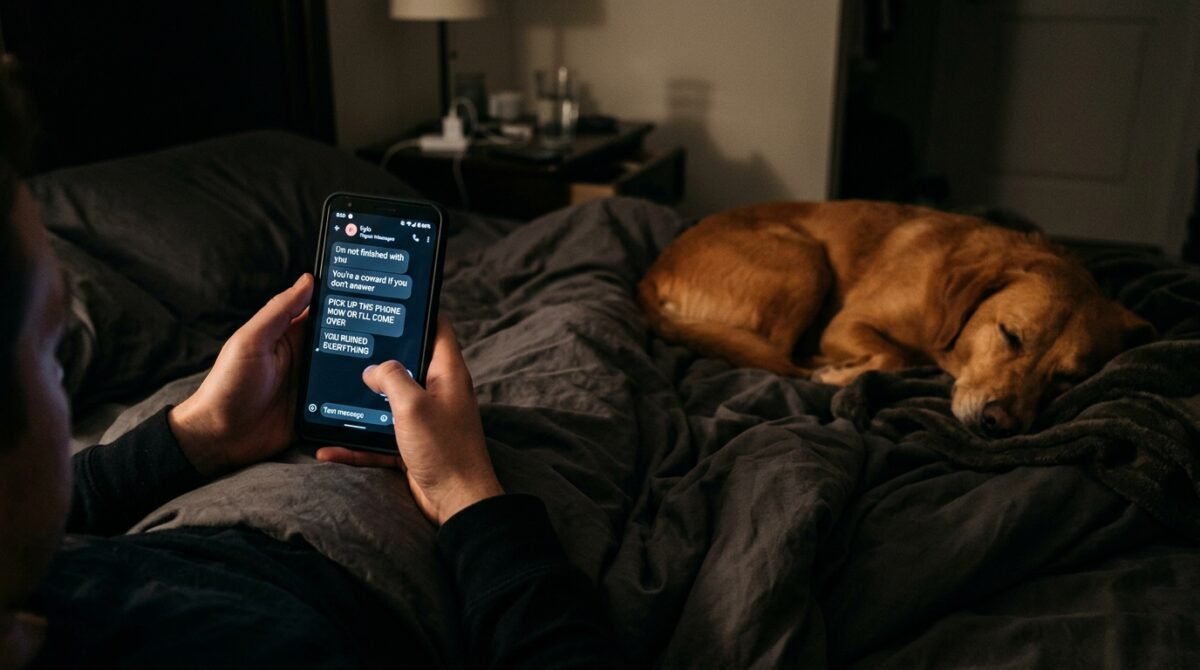
The first sign that things were going to spiral out of control wasn’t a formal request or a family meeting; it was a series of rapid-fire text messages at three in the morning. I woke up to my phone buzzing incessantly, the glow of the screen illuminating the dark bedroom. Sarah had been drinking, or so I assumed, given the frantic nature of the messages. She wasn’t asking how I was; she was telling me how my life was going to change starting the following Monday morning.
I remember reading the first message and feeling a cold pit open in my stomach. She didn’t lead with ‘I’m struggling’ or ‘I need help.’ She went straight to the logistics of removing Jasper from my home. She had already decided that my apartment was too small for me anyway, and that Jasper would be better off in the large, fenced-in yard at our parents’ house where her kids were now staying. It was as if she had already written me out of the equation entirely.
“You need to have Jasper ready by 9 AM tomorrow. The kids are crying non-stop, and he’s the only thing they’ve been asking for. It’s not like you have a job that keeps you busy all day. You’re lucky I’m giving you a chance to do something good for the family for once.”
— Sarah, via Text Message
I sat up in bed, my heart racing, the familiar tightness in my chest beginning to manifest. I didn’t respond immediately, not because I was considering it, but because I was in shock. How do you respond to someone who views your lifeline as a toy for their children? I typed out a response, deleted it, and typed another, trying to find a way to be firm without escalating. Little did I know, the escalation was already baked into her plan.
By the time I finally replied, she was already calling my mother. The narrative had already shifted. To Sarah, my hesitation wasn’t a boundary; it was an act of extreme selfishness. I wasn’t just withholding a dog; I was actively hurting her children. The transformation from ‘sister’ to ‘villain’ took less than an hour, and I was caught completely off guard by the speed and the cruelty of the transition.
I spent the rest of the night walking with Jasper, his steady pace beside me providing the only grounding force in my life. I knew then that if I gave in, I would be setting a precedent that my life, my health, and my companions were all negotiable under the right amount of family pressure. I decided that night that no matter what happened, Jasper would stay with me. I just didn’t realize how much of a war that decision would ignite.
The Sunday Dinner Ambush
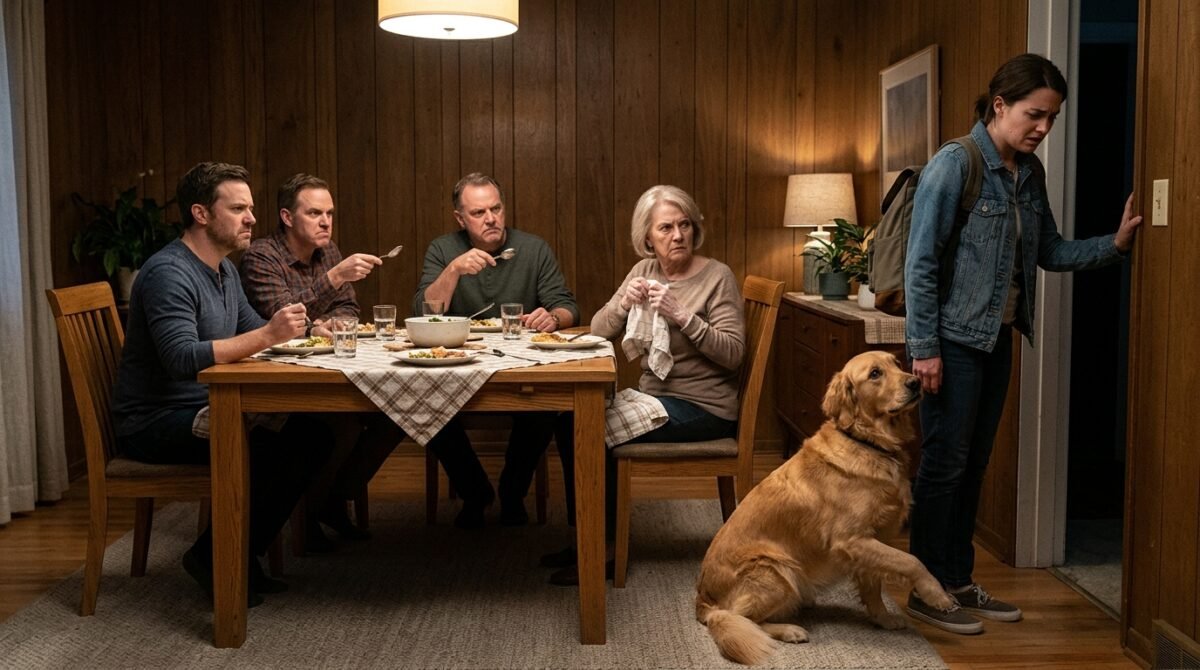
Sunday dinner at my parents’ house was supposed to be a low-stakes affair. I was naive enough to think that after a few days of silence, the issue would have blown over. I arrived with Jasper, expecting to stay for an hour and then head back to my own space. Instead, I walked into a courtroom. Sarah was sitting at the head of the table, her eyes red-rimmed, while my parents exchanged glances that were heavy with expectation.
The atmosphere was thick enough to cut with a knife. As soon as I set my keys down, my father cleared his throat, his face set in a mask of grim disappointment. He didn’t ask me how my week was. He went straight to the point, treating the topic as if it had already been decided by a council of elders. The entitlement was visceral; they weren’t asking for my permission, they were informing me of my obligation.
“We’ve discussed it, and it’s for the best. Sarah needs this, and the kids need stability. You have no reason to say no except for your own stubbornness. It’s just a dog, and you’re an adult who can move on. Don’t make this harder than it has to be.”
— My Father, at the dinner table
I looked at Sarah, who was staring at her plate, playing the martyr with practiced perfection. My mother was already reaching for Jasper, her voice dripping with artificial sweetness as she tried to lure him away from my side. The betrayal was staggering. These were the people who raised me, who knew exactly how much Jasper had helped me through my darkest phases, and yet they were willing to strip that away from me to soothe a temporary family crisis.
I stood my ground, my voice shaking but firm. I told them that Jasper was a service animal, not a comfort object, and that his presence was medically necessary for my stability. My mother scoffed, dismissing my anxiety as something I ‘grew out of’ years ago. The gaslighting was so blatant it felt like physical abuse. They weren’t just asking for the dog; they were asking for me to admit that my mental health didn’t matter as much as Sarah’s comfort.
The tension exploded when I refused to leave Jasper behind. My father stood up, his face turning a shade of red I hadn’t seen since my teenage years. The accusations started flying—I was selfish, I was cold, I was a disgrace to the family. I watched as my sister, the person who had orchestrated this entire event, looked up and shed a single, perfectly timed tear, cementing her position as the victim. I left that house knowing I had just burned a bridge that might never be rebuilt.
The Digital Campaign of Guilt
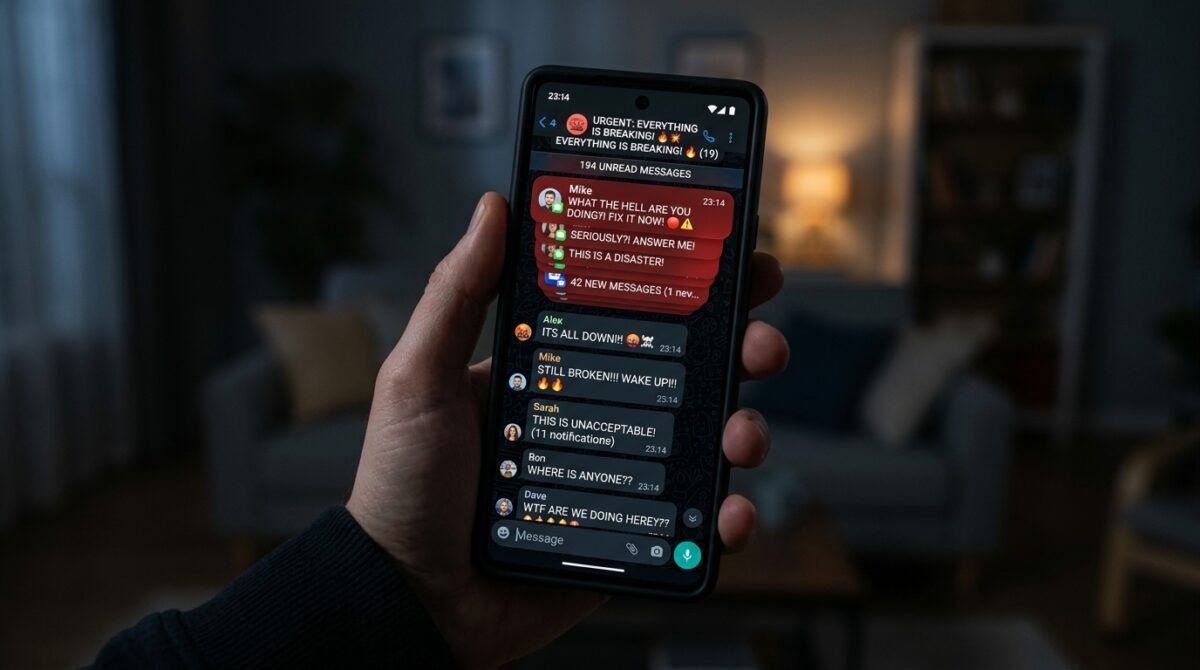
The aftermath of the dinner was a barrage of digital warfare. My family didn’t just let the argument die; they weaponized it. Within hours, I was added to a group chat that I didn’t want to be a part of. The participants included my parents, Sarah, and my aunt, who has always been a staunch defender of ‘family unity’ at all costs. The messages were relentless, ranging from pleading to outright insults.
They started posting pictures of my nieces looking sad in their bedrooms, tagging me, and adding captions about how a ‘simple act of kindness’ could heal their hearts. It was manipulative in the most grotesque way possible. They were trying to make me feel responsible for the emotional well-being of two children who were clearly being used as pawns in their mother’s game. Every notification I received sent a fresh wave of panic through me, exactly what they were trying to trigger.
“Look at them. They’ve been crying for hours. You are the only person who can help them, and you’re choosing a dog. What kind of person does that? I thought I raised a daughter with a heart, but clearly, I was wrong.”
— My Mother, via Group Chat
I tried to set boundaries. I replied once, stating clearly that using children as emotional leverage was unacceptable and that I would not be participating in this harassment. They didn’t listen. They doubled down. My aunt started calling me, leaving long, rambling voicemails about how ‘family is forever’ and how my behavior was ‘un-Christian.’ They were creating a narrative where I was the villain, and they were the noble defenders of the innocent.
I eventually had to mute the chat, then block them one by one. The silence that followed was heavy, but it was also a relief. I realized that if I allowed them to talk to me this way, I would be giving them permission to treat me like this forever. The digital guilt trip was their final attempt to break my resolve, and while it hurt—it hurt deeply—it also confirmed that I was making the right decision by distancing myself.
The hardest part was knowing that I was effectively cutting myself off from my parents. But I had to ask myself: what kind of relationship is it where your value is determined by what you can give up for someone else? If they couldn’t respect my boundaries, then they weren’t really family in the way I needed them to be. The digital barrage was the final straw, a clear signal that the family I grew up with no longer existed.
The Anatomy of a Service Animal
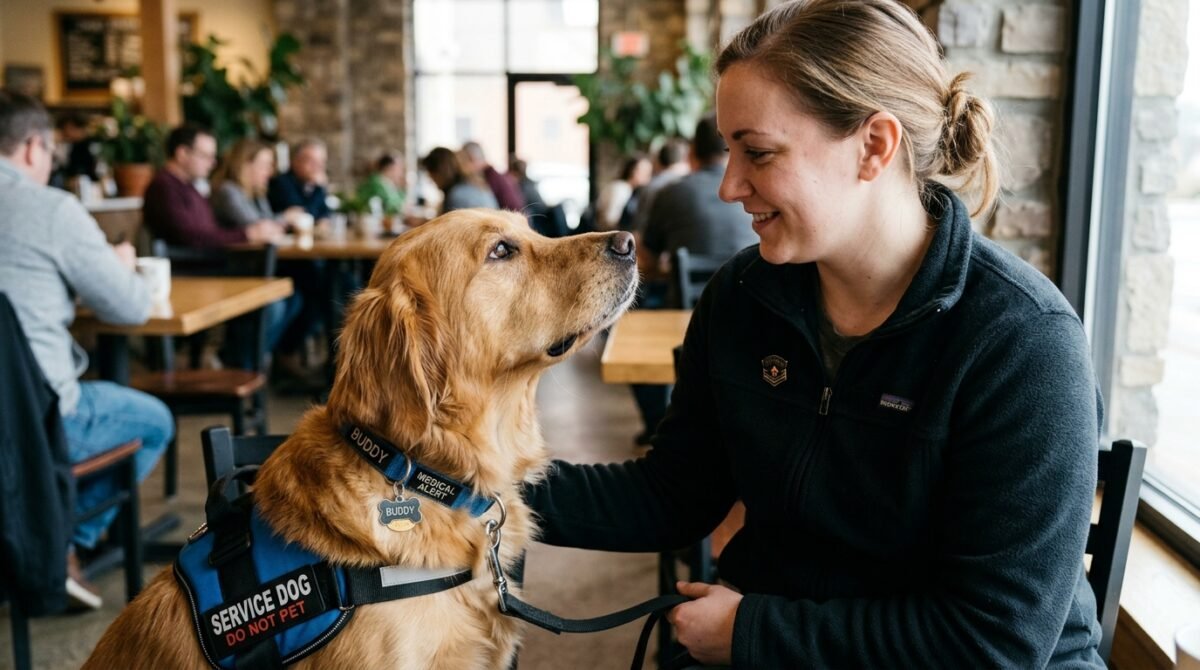
I think the most frustrating part of this entire ordeal was the constant trivialization of Jasper’s role in my life. My family seemed to believe that he was just a pet, a ‘dog’ that could be swapped out for a different one or kept at a kennel without any impact on my health. They couldn’t—or refused to—understand the science, the training, and the bond that makes a service animal so essential. To them, he was a commodity.
I tried to explain it, once, before the yelling started. I explained that Jasper is trained to perform specific tasks, like interrupting panic attacks and providing deep pressure therapy. I told them that without him, I wouldn’t be able to hold down my job or leave my apartment on bad days. My sister just rolled her eyes and said, ‘Oh, please, you’re just anxious, not disabled.’ That one sentence hurt more than any of the shouting.
The ignorance was staggering, but it was also deliberate. By labeling my needs as ‘anxiety’ rather than a legitimate health condition, they were able to frame my refusal to give up Jasper as a moral failing rather than a health necessity. They were essentially saying that my health doesn’t matter, and that I should just suck it up for the sake of the family. It’s a common tactic in families like mine: minimize the individual’s needs to prioritize the ‘collective’ drama.
I felt a strange sense of shame for a few days, wondering if maybe they were right. Maybe I was being ‘heartless.’ But then I would look at Jasper, and he would nudge my hand, sensing the spike in my cortisol levels, and I would be brought back to reality. My health is not a debate. My needs are not up for a vote. I realized that if I gave up Jasper, I would be sacrificing my own ability to function just so my sister wouldn’t have to deal with the messy reality of her own life choices.
This wasn’t about the kids. It was about Sarah wanting a quick fix for her own guilt and unhappiness. By demanding my dog, she was trying to outsource the heavy lifting of parenting and emotional healing. When I said no, she wasn’t mad that I didn’t care about the kids; she was mad that I wasn’t willing to be the emotional crutch she needed. And that is a boundary I will defend until my last breath.
The Reddit Trial

I didn’t want to post about this, but I felt like I was losing my mind. I needed an objective perspective, so I turned to the only place that gives it to you straight: Reddit. I wrote the story out, trying to be as neutral as possible, and braced myself for the impact. I expected people to call me out for being selfish, for not ‘helping family’ in a time of need. Instead, the response was overwhelming.
Within an hour, the post had thousands of views. The comments were a mix of outrage, solidarity, and practical advice. People weren’t just defending me; they were identifying the exact patterns of emotional manipulation that my family had been using for years. It was validation on a level I hadn’t expected. I read through comment after comment, crying for the first time since the ordeal began.
“NTA (Not The Asshole). A service animal is not a comfort pet for your sister’s kids. It is medical equipment. You wouldn’t expect someone to give up their wheelchair or their insulin pump to ‘cheer someone up.’ Your family is showing their true colors by prioritizing their drama over your health.”
— u/ReasonableObserver, 15.2k upvotes
There were people who had been through the exact same thing—families demanding their pets, their savings, or their time under the guise of ‘family duty.’ Their stories were like mirrors, reflecting my own situation and confirming that I wasn’t the crazy one. The community support gave me the courage to stick to my decision. I wasn’t just some heartless sibling; I was someone protecting their health against a toxic environment.
One comment in particular hit home. It talked about the difference between ‘family’ and ‘relatives.’ Relatives are the people you are born into, but family is the group of people who actually respect you and look out for your well-being. It was a simple distinction, but it changed how I viewed my parents and my sister. They were definitely relatives, but they certainly weren’t acting like family.
I kept the thread open for a week, reading every new comment, learning from the advice of people who had been through far worse. The collective wisdom of strangers ended up being the most important support network I had. It taught me that my struggle was universal, and that setting boundaries with toxic people is not just acceptable—it is necessary for survival.
The Legal Threat
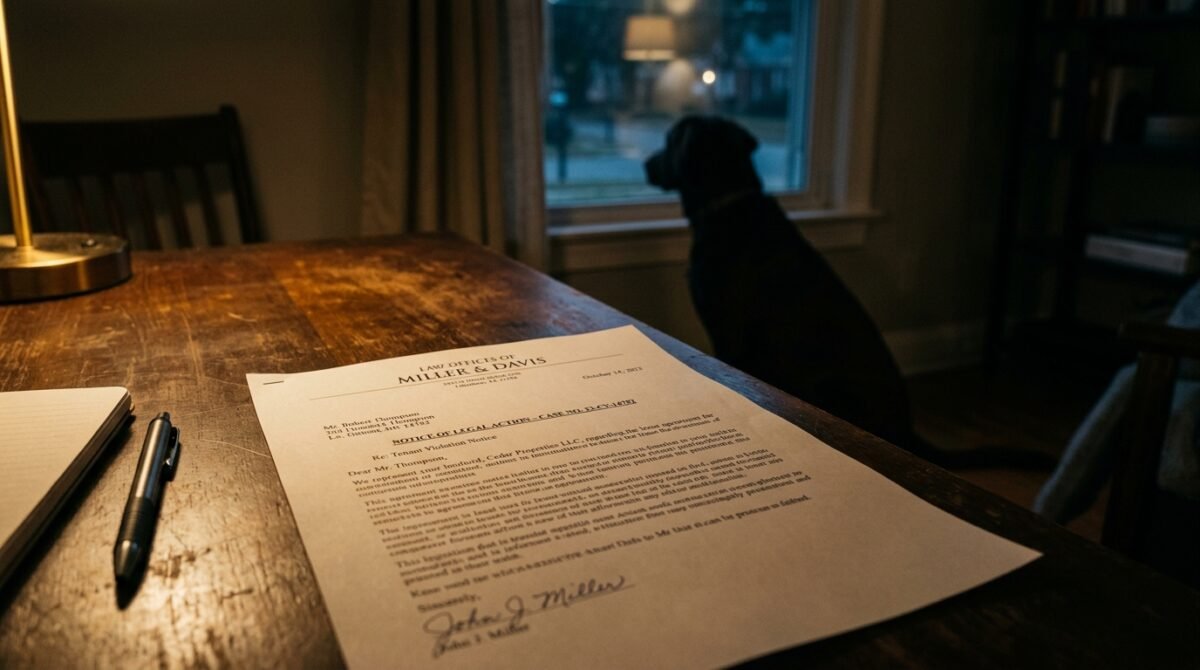
Just when I thought it was over, I received a certified letter in the mail. My heart stopped. I opened it with shaking hands, expecting a lawsuit or some kind of formal demand for custody of the dog. It was from my parents’ lawyer—an old family friend who had handled their estate planning for years. It was a strongly worded letter, suggesting that since my parents had ‘contributed’ to the cost of Jasper’s training as a gift, they had a ‘claim’ to his ownership.
The sheer audacity of it left me reeling. They were trying to use legal threats to intimidate me into submission. It was a classic escalation tactic. They knew that if they couldn’t guilt me, they would try to scare me. I spent the next forty-eight hours in a state of high anxiety, researching pet law and consulting with my own lawyer. As it turns out, the ‘contribution’ argument was absolute nonsense. A gift is a gift, and I had all the documentation to prove that Jasper was legally mine.
“We are prepared to take legal action to recover the animal in question, as it was a gift provided by your parents with the understanding of shared family benefit. Please surrender the animal immediately to avoid further costly litigation.”
— Letter from Family Attorney
I didn’t answer the letter directly. I had my lawyer draft a brief, firm response stating that any further attempts to harass me or claim ownership of my service animal would be met with a countersuit for harassment. The silence from their side after that was deafening. They realized they had overplayed their hand, and that I was actually prepared to fight them in a court of law.
It was a terrifying experience, but it also solidified my resolve. I realized that my family was willing to threaten me legally just to get their way. It was the final nail in the coffin of our relationship. There is no coming back from that level of hostility. I kept the letter in a file, a permanent reminder of how far they were willing to go to control me.
I felt a strange sense of freedom after that. The fear of being a ‘bad daughter’ or a ‘bad sister’ evaporated. If they were willing to treat me this way, I owed them absolutely nothing. The legal threat was a gift in disguise, because it stripped away the last shred of doubt I had about whether I should keep the doors open or shut them tight.
The Confrontation of Truth

A month after the legal threat, my sister showed up at my apartment. She didn’t call. She just knocked on the door, and when I opened it, there she was—looking tired, messy, and furious. She pushed past me into my living room before I could even say a word. The confrontation was inevitable, and for the first time, I felt ready for it.
She started screaming immediately, blaming me for everything. She said her kids were failing school, that she was losing her mind, and that all of it was my fault because I wouldn’t give her the dog. She wasn’t making sense, but she didn’t have to. She was venting, and I was the target. I stood there, listening, watching her unravel, and I realized that she was just a broken person trying to fix her life by breaking mine.
“You’ve ruined everything! You could have been the one person who helped me, but you’re just as selfish as everyone else. I’m suffering here, and you’re sitting here playing house with a dog. You’re the reason this family is falling apart!”
— Sarah, during the final argument
I didn’t yell back. I didn’t defend myself. I just told her, calmly and clearly, that she was responsible for her own happiness and that I was not her servant. I told her that if she wanted to help her kids, she needed to go to therapy, not kidnap my service animal. I told her that she had lost the right to be in my life the moment she sent that lawyer’s letter.
She started crying, trying to pivot to the ‘I’m your sister’ argument, but it didn’t land. I walked to the door and opened it. I told her that if she didn’t leave, I would call the police. That was the moment she realized I wasn’t the quiet, compliant sister anymore. The look on her face was one of pure shock, not just at what I said, but at the fact that I actually meant it.
She left, slamming the door so hard the pictures on the wall shook. I sat down on the floor with Jasper, and we just breathed. It was the hardest conversation of my life, but it was also the most liberating. I had finally set a boundary, held it, and enforced it. I wasn’t the villain; I was the survivor.
The Ripple Effect of Boundaries

Once the dust settled, the impact of the incident rippled through the rest of the family. My extended relatives, who had previously been on the fence, started to see the fallout for what it was. A few cousins reached out, not to take sides, but to check on me. They had heard the whispers, and they weren’t all in agreement with Sarah’s version of the events. It turns out that when you stop playing the game, others start to notice the rules you were being forced to follow.
I had a long talk with my aunt—not the one who left the voicemails, but a different one who had been quiet throughout the whole thing. She told me that she had always seen how Sarah was treated differently, and how I was always the one expected to sacrifice. It was validating to hear someone else acknowledge the dynamic I had spent years trying to ignore. She didn’t choose a side, but she acknowledged that my boundaries were mine to set.
The family gatherings—the ones I stopped attending—were reportedly disasters. My parents were apparently struggling to keep the peace between Sarah and the rest of the family. It’s almost satisfying, in a dark way, to know that the house of cards they built is finally collapsing. When you remove the person who was propping up the whole structure, the rest of it falls down. I was that person, and I’m glad I’m not anymore.
I’ve started to build my own life now, one that doesn’t involve constant crises and demands. I go to work, I come home, I take long walks with Jasper, and I actually have time to think. I’ve realized that the ‘family drama’ I was always embroiled in wasn’t my life; it was a distraction from it. Now that the distraction is gone, I can finally start to see who I am when I’m not being forced into a role.
It’s not all sunshine and rainbows. I still feel guilty sometimes, and I still miss the idea of a supportive family. But then I remind myself that the ‘family’ I miss never actually existed—it was just an image they projected, and one that required me to be their sacrificial lamb. I’m much happier being the ‘heartless’ one who finally has a life of their own.
Finding the New Normal

Building a new normal has been a slow process. At first, I felt like a ghost in my own life, waiting for the other shoe to drop. I would check my phone, expecting a new threat or a new guilt-filled message, but there was nothing. The silence was the hardest part to get used to. But gradually, the silence turned into peace. I started filling my time with things I actually enjoy—hobbies I had abandoned, friends I had neglected because I was always too tired from family drama.
Jasper and I have a routine now, one that is entirely our own. We have our favorite trails, our favorite parks, and our favorite spots to sit and watch the world go by. I’ve realized that my anxiety is much more manageable when I’m not constantly being pushed to the brink by people who don’t care about my well-being. It turns out, most of my ‘anxiety’ was actually just a normal reaction to being treated like garbage.
I’ve learned that saying ‘no’ is a superpower. It’s the most important word in my vocabulary now. If someone asks for something that crosses a boundary, I don’t feel the need to explain, justify, or argue. I just say ‘no.’ It’s surprisingly effective, and it’s allowed me to filter out the people in my life who were only there for what they could get from me.
I’ve also started therapy for myself, not for the ‘anxiety’ my family loved to talk about, but to undo the damage of growing up in that household. It’s been an eye-opening journey. I’m learning how to recognize my own worth, and how to stop seeking approval from people who are incapable of giving it. I’m not the same person I was six months ago, and I’m very happy about that.
The most surprising outcome of all of this is that my nieces and I have actually reconnected, in a way. Not through their mother, but through a separate, small channel that doesn’t involve her. They are doing better now, and they aren’t the monsters their mother made them out to be. I’m hopeful that one day, when they are older, they will understand why I had to do what I did. For now, I’m just happy to be in a place where I can be a healthy influence for them, from a distance.
The Final Verdict

Looking back, I don’t regret a single thing. I know the label ‘heartless’ is still being thrown around in my family’s circles, but it doesn’t sting anymore. It’s a badge of honor now. If being ‘heartless’ means protecting your health, your autonomy, and the loyal dog who saved your life, then I am perfectly happy to wear that label until the end of time.
I’ve learned that you can’t save people who don’t want to be saved, and you certainly can’t save them by destroying yourself. The price of admission for my family’s love was my own sanity, and that is a price I will never pay again. I’ve found my own tribe, my own peace, and my own purpose. It wasn’t the path I expected to take, but it’s the only one that led to a real life.
I’m sharing this story not for sympathy, but for anyone who is currently in the middle of their own family crisis. If you are being asked to sacrifice your health, your boundaries, or your own well-being for the sake of ‘family,’ please know that you don’t have to do it. You are not a resource. You are a person, and you have the right to say no. Even when it’s hard, even when they call you names, even when the pressure is unbearable—say no.
There is a life waiting for you on the other side of that ‘no.’ It’s a life where you are respected, where you are safe, and where you are surrounded by people who love you for who you are, not for what you can give them. It’s worth the fight, and it’s worth the loneliness you might feel for a while. Trust yourself. You are stronger than they think.
Thank you to everyone who supported me through this. Your words helped me reclaim my life, one step at a time. I hope this helps even one person realize that they are not obligated to be a martyr. Stay strong, keep your boundaries firm, and cherish the ones who truly love you back.
Conclusion
The story of Jasper and my journey to independence has been one of the most transformative experiences of my life. I have moved from a place of chronic guilt and enmeshment to a space of clarity and self-respect. My family still believes I am the villain, but their opinion no longer defines my reality. I am free, I am healthy, and most importantly, I am still with my best friend.
This dilemma raises a critical question for all of us: when does the concept of ‘family duty’ cross the line into abuse? Are we, as individuals, ever required to sacrifice our own mental and physical health to prop up the lives of our relatives? The debate in the comments has been fierce, and I would love to hear your perspective.
What do you think? Did I do the right thing by putting my boundaries first, or is there a ‘moral’ obligation to help family in crisis, even at the cost of one’s own well-being? Share your thoughts below and let’s keep the conversation going.
What's your verdict on this dilemma?
Vote below to contribute to the official community consensus.

Have a Dilemma Keeping You Up at Night?
Share your real-life feud, wedding chaos, or relationship crossroads anonymously with our editorial team.
What do you think ?
0 Comments🛡️ Comments are moderated to protect community integrity. Your comment will appear once approved by the editorial team.