

We grow up being told that family is the bedrock of our existence, the safety net that catches us when the world gets too heavy. My brother, Mark, and I were always close, or so I thought. We navigated childhood together, survived our parents’ messy divorce, and entered adulthood with the promise that we would always look out for one another. However, that promise has a shelf life when one person views the other not as a sibling, but as a resource to be tapped.
Three years ago, I purchased a property with a detached guesthouse. It was a fixer-upper, a project that drained my savings, my weekends, and my sanity. I spent eighteen months sanding floorboards, installing plumbing, and meticulously designing a space that could provide me with passive income. It wasn’t just a building; it was my financial cushion. It was the security I needed to eventually move toward a life of less professional stress.
When Mark approached me asking to rent the guesthouse at a significant discount, I felt for him. He claimed his startup was struggling, that he was living on ramen and sheer willpower, and that he needed a stable environment to focus. Against my better judgment, I drafted a lease. I offered him a ‘family rate’ that was already twenty percent below market value, believing I was helping a brother in need get back on his feet.
The moral dilemma didn’t start with a bang; it started with a whisper. It was the small things—missed payments, unannounced guests at 2:00 AM, and a persistent refusal to treat the guesthouse as a rental property rather than a college dorm. But as the months passed, the dynamic shifted from ‘struggling sibling’ to ‘entitled occupant.’ The final straw wasn’t a missed check, but a shiny, metallic reminder of where his priorities actually lay.
This is not just a story about a guesthouse. It is a story about the intersection of blood ties and financial reality, about the moment you realize that your kindness has been weaponized against you. It is the story of why I finally decided to lock the gates, turn off the utilities, and face the fallout of saying ‘no’ to family who treats you like an ATM.
The Fabricated Financial Crisis

The story began on a Tuesday evening over a lackluster dinner at a local bistro. Mark looked disheveled, wearing a faded hoodie that looked like it hadn’t seen a washing machine in weeks. He spoke about his business with a frantic energy, describing how his ‘revolutionary’ app was just one investor meeting away from global success. He looked at me with those wide, earnest eyes—the same ones he used to charm our mother when he broke a vase.
I felt a pang of guilt. I was doing well, and he was clearly struggling. When he asked, ‘Can I crash in the guesthouse? Just until the Q3 funding comes in?’ I didn’t see the trap. I saw a brother who needed a roof. I figured it would be a six-month arrangement, enough time for him to stabilize his company and find his footing.
“I just need a space to breathe, sis. If I can cut out the rent overhead, I can put every cent into the developers. It’s for the future of the company, and by extension, our family’s security. Please, don’t say no.”
I agreed, but I insisted on a formal lease. I wasn’t naive enough to hand over the keys without a contract. I made the terms clear: discounted rent, utilities paid by him, and a strict no-subletting policy. He signed it with a flourish, thanking me profusely and calling me his hero. For the first two months, everything seemed fine. He was quiet, kept to himself, and seemed to be working hard.
Then, the excuses started to trickle in. ‘The bank transfer is delayed,’ he’d say. ‘The client paid late,’ he’d add. I let it slide the first time. Then the second. By the fourth month, he was consistently two weeks late on rent, and the utilities were being paid by me. I started to notice a strange discrepancy between his ‘broke’ persona and his lifestyle. He was always out, always at the gym, always wearing expensive sneakers that certainly didn’t look like they came from a clearance rack.
I began to wonder if his business was actually struggling, or if he was simply funneling his income into his own vanity. The narrative of the ‘starving entrepreneur’ started to feel performative. I found myself checking his social media, not because I was paranoid, but because the numbers weren’t adding up. I was subsidizing his lifestyle, and my patience was wearing thin. I wasn’t just losing money; I was losing the peace of mind that my guesthouse was supposed to provide.
The Instagram Notification That Changed Everything

It was a Saturday morning, the kind where the sun streams through the window and makes you want to ignore the world. My phone buzzed with an Instagram notification. It was a post from a local luxury car dealership. The caption read: ‘Another happy client in their new ride! Congrats to Mark on the 911.’ My heart stopped. I clicked on the photo, and there he was—leaning against a pristine, silver Porsche, grinning like he had just won the lottery.
The rage didn’t hit me all at once; it was a cold, creeping realization of how foolish I had been. He hadn’t paid rent in two months, citing ‘liquidity issues,’ yet he had enough liquid cash for a down payment on a high-performance luxury car. I sat on my sofa, staring at the screen, feeling the blood drain from my face. I had been paying his electric bill while he was out shopping for a vehicle that cost more than my first home.
“I am genuinely shaking right now. You told me you couldn’t make rent, yet I see you bought a Porsche? Explain this to me right now.”
— My text to Mark at 9:15 AM
The response didn’t come for six hours. When it did, it wasn’t an apology. It was a justification, a masterclass in gaslighting. He told me that the car was a ‘necessary business investment’ to look successful for his clients. He said I was being ‘petty’ and ‘jealous’ of his growth. He even had the gall to suggest that my reaction was proof that I didn’t support his dreams.
I walked out to the guesthouse. The door was locked, but I had the spare key. I didn’t go in, but I stood on the porch, listening to the silence. I realized then that I wasn’t a brother to him; I was an enabler. I had created a vacuum of responsibility, and he had filled it with his own selfish desires. The guesthouse was no longer a place of support; it was a sanctuary for his deception. I knew that I couldn’t keep this arrangement going a second longer.
I spent the rest of the day looking through my records. The missed rent, the utility bills, the maintenance costs I had covered—it totaled over eight thousand dollars in unpaid expenses. I was subsidizing a lifestyle I didn’t even agree with. I felt disgusted with myself for letting it go this far. I sat down at my laptop and started drafting an eviction notice, my hands trembling with a mixture of anger and cold, calculated resolve.
The Confrontation in the Kitchen
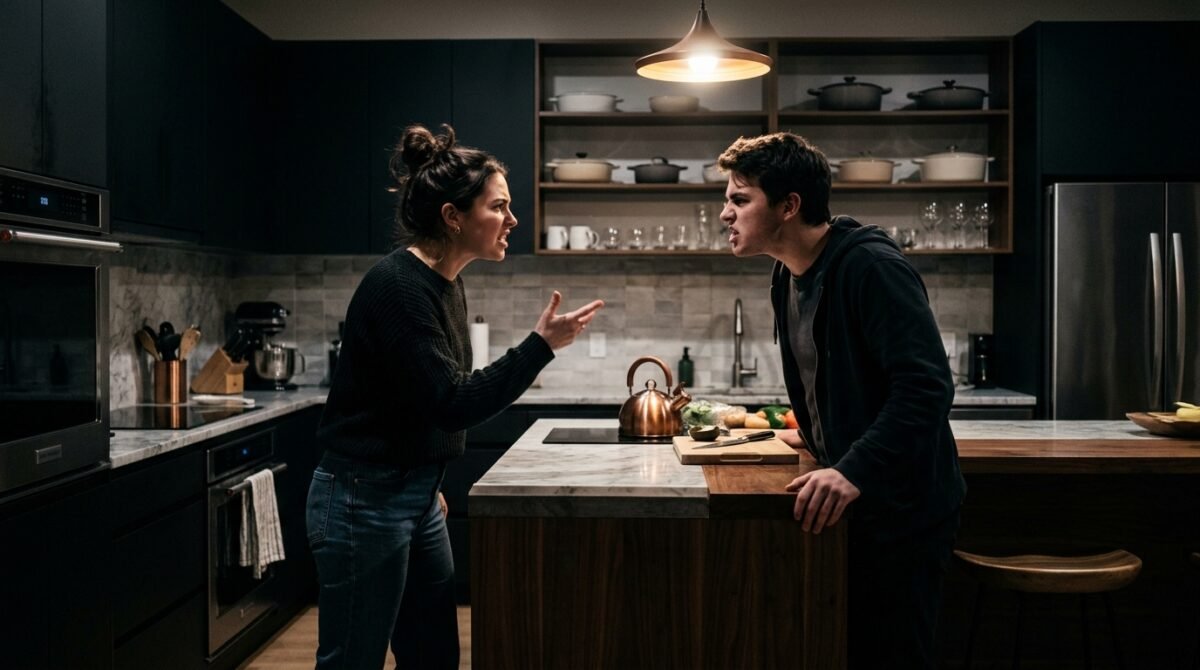
I didn’t wait for him to come to me. I marched over to the guesthouse the following evening, the printed eviction notice tucked firmly into my jacket pocket. He was inside, the lights dimmed, likely editing another social media post about his ‘grind.’ When he saw me, his expression went from relaxed to defensive in a heartbeat. He didn’t even get up from his chair.
“I thought we agreed on some space,” he said, his voice dripping with condescension. I didn’t waste time on pleasantries. I dropped the printed notice onto the coffee table, right next to a pile of unopened mail. He didn’t even look at it at first, assuming it was just another complaint about the rent. Then he read the top line, and his eyes widened.
“You’re evicting me? Over a car? Do you have any idea how much damage you’re doing to my reputation? This is insane, even for you.”
I laughed, a dry, humorless sound. “Your reputation? Mark, you owe me eight thousand dollars. You lied to me about your finances while buying a luxury vehicle. This isn’t about the car; it’s about the fact that you’ve been treating me like a fool.” He started to stand up, his face turning a shade of red that signaled he was about to lose his temper. I didn’t blink. I stood my ground, my posture rigid, my voice steady.
He tried to argue that the ‘family discount’ was a gift, that he didn’t really ‘owe’ me the back rent because I was ‘doing fine.’ The entitlement was breathtaking. He actually believed that my success was a communal pot that he was entitled to dip into whenever he wanted. It was the moment I realized that he had never respected me as an independent person; he only respected what he could take from me.
“You have thirty days,” I said. “And if I don’t see the back rent by the end of the week, I’m filing a formal claim in small claims court. Do not test me on this, Mark. I am done.” I turned and walked out, not waiting for his rebuttal. The air outside felt crisp and clean, like I had finally exhaled after holding my breath for months. I knew the war was just beginning, but for the first time in a long time, I felt like I was in control of my own life.
The Family Group Chat Explosion

By the next morning, the nuclear bomb had gone off in the family group chat. Mark had messaged our parents, spinning a narrative of ‘sibling cruelty’ and ‘unreasonable expectations.’ My phone wouldn’t stop buzzing. My mother was calling, my father was texting, and an aunt I hadn’t spoken to in years was sending me ‘concerned’ emojis. They were all taking his side, assuming I was the one being petty over money.
“Why are you kicking your brother out? He’s clearly trying to make something of himself. Can’t you just be the bigger person and let this slide?”
— Mom, via text
I took a deep breath and drafted a single, comprehensive response. I didn’t defend myself; I presented the facts. I sent screenshots of the unpaid rent notices, the utility bills, and the link to the car dealership’s post. I kept the tone clinical and detached. I wasn’t going to get into an emotional debate. I was providing documentation for why my decision was final and justified.
The silence that followed was deafening. Even my mother, who usually couldn’t resist a chance to weigh in, didn’t have an immediate response. When she finally did text back, it was a half-hearted, ‘Well, that’s unfortunate, but you should still talk to him.’ It was clear that the truth, while inconvenient, wasn’t going to stop them from trying to force a reconciliation. I muted the chat and put my phone in a drawer.
I realized then that my family was more comfortable with me being the ‘bad guy’ than they were with holding Mark accountable. They preferred the status quo, even if it was built on a foundation of lies. It was a painful realization, but it was also freeing. I didn’t need their permission to draw a boundary. I didn’t need them to understand my logic to know that I was right. I was done being the family peacekeeper at the expense of my own sanity.
The Reddit Community Weighs In

That night, I opened Reddit. I didn’t want advice from people who knew us; I wanted the brutal honesty of strangers. I posted the story on a popular subreddit, omitting names but detailing the financial betrayal. The response was overwhelming. Within an hour, the thread had hundreds of comments. The consensus was shockingly unanimous: I was not the asshole. The validation was almost overwhelming.
“This is classic financial abuse. He used your kindness to fund his own ego. Do not feel guilty for a second. Get the law involved if you have to. NTA.”
— u/FinanceExpert99 (Top Comment, 18.2k upvotes)
Reading through the comments, I saw so many stories like mine—people who had been taken advantage of by ‘struggling’ siblings who somehow always had money for luxuries. It made me feel less isolated, less like I was the villain in my own life. Some users provided practical advice on how to legally secure the eviction and protect my assets. It was the reality check I needed.
One comment in particular hit home. It talked about how ‘family’ is often used as a lever to bypass boundaries. If someone uses the word ‘family’ to justify taking advantage of you, they aren’t acting like family. That really resonated. I wasn’t being a bad sister; I was being an adult who demanded respect. The internet, in all its chaotic glory, had provided me with the clarity that my actual family refused to offer.
I started replying to some of the comments, clarifying details and thanking people for their support. It became a therapeutic process, organizing my thoughts and seeing the situation from an objective perspective. I wasn’t just venting; I was reclaiming my narrative. I was no longer the ‘petty sister’ in the family group chat; I was a person who had stood up for herself. It was a massive psychological shift.
The Final Move-Out Day

The move-out day was as awkward as one would expect. Mark didn’t speak a word to me. He packed his things with a sullen, performative aggression, slamming drawers and throwing boxes into his car. I stayed inside my main house, watching from the window, making sure everything was being taken and nothing was being destroyed. It was a quiet, pathetic end to a relationship that had spanned thirty years.
When he finally finished, he walked up to my front door. I opened it, ready for a final confrontation. He didn’t have much to say. He looked at me with a mix of resentment and genuine confusion, as if he still couldn’t comprehend why I would choose a lease agreement over our ‘bond.’ He muttered something about how I would regret this, that I had burned a bridge that I would eventually need.
“You think this is over? You’re making a huge mistake, and you’re going to be the one reaching out when things get tough. I hope you’re happy in your empty guesthouse.”
I didn’t answer. I just watched him get into his Porsche and drive away. As the engine roared down the driveway, I felt a weight lift off my shoulders. The guesthouse was empty, yes, but it was *my* empty space. It was no longer a place of conflict or deception. I walked over to the guesthouse and unlocked the door. It was messy, but it was repairable. I felt a sense of peace I hadn’t felt in months.
I started the cleanup process immediately. I repainted the walls, scrubbed the floors, and changed the locks. Every action was a symbolic reclaiming of my property. I wasn’t just cleaning a room; I was erasing the traces of his entitlement. I knew there would be future drama with the family, but that was a problem for another day. For now, I had my space back, and I had my self-respect.
The Lingering Family Fallout

The weeks following the eviction were a minefield. My parents kept trying to orchestrate ‘mediations,’ which really meant they wanted me to apologize to Mark to ‘keep the peace.’ I remained firm. I refused to attend any dinner where he was present, and I made it clear that my financial relationship with him was closed permanently. The fallout was messy, with accusations of ‘holding a grudge’ and being ‘unforgiving.’
I found myself having to set firm boundaries with my parents, too. Every time they brought up Mark, I would calmly change the subject or end the conversation. It was exhausting, but it was necessary. I had to teach them how to treat me if they wanted a relationship with me. It was a steep learning curve for everyone, and some relationships in the family were permanently altered by the friction.
“I love you both, but Mark’s financial choices are his own. I am not his bank, and I am not his landlord anymore. Please respect my decision to move on.”
Some of my cousins reached out to me privately, admitting that they were actually proud of me for standing up to him. It turned out I wasn’t the only one who had been on the receiving end of Mark’s ‘charm.’ Hearing their stories made me realize that this was a pattern of behavior that had been excused for years. I wasn’t the outlier; I was simply the first one to finally say ‘no.’
I stopped checking the family group chat altogether. I realized that the stress of seeing their messages was more damaging than the silence of missing out on family updates. I started focusing on my own life, my own goals, and my own circle of friends—people who respected boundaries and didn’t see me as a resource. It was a lonely transition, but a necessary one for my own growth.
The Reality of Financial Recovery

Getting the guesthouse ready for a new tenant was a journey in itself. I had to fix the plumbing issues he had ignored and replace the carpet he had stained. Every repair was a reminder of why I had made the right decision. I wasn’t just losing money; I was investing in the future of my property. I eventually found a tenant—a quiet, professional woman who paid on time and actually appreciated the space.
The financial recovery was slow but steady. I didn’t see a dime of the back rent Mark owed me—he claimed he was ‘broke’ again and couldn’t pay—but the loss was worth the cost of freedom. I had to adjust my budget to cover the initial shortfall, but I was no longer bleeding money every month. The peace of mind was worth far more than the eight thousand dollars I had ‘lost.’
| Expense | Mark’s Contribution | The Reality |
|---|---|---|
| Rent | $0 (Last 2 months) | $2,400 (Loss) |
| Utilities | $0 | $600 (Loss) |
| Damages | $0 | $5,000 (Repairs) |
Seeing the numbers in black and white was a sobering experience, but it also solidified my resolve. I had been paying to be disrespected. Now, I was using that same money to improve my home and my life. I started saving for a vacation, something I hadn’t been able to afford while subsidizing Mark’s Porsche payments. It was a small victory, but it felt significant.
I also learned a valuable lesson about contracts. I realized that even with friends and family, a contract is not a sign of distrust; it is a sign of professionalism. It protects both parties and keeps the relationship healthy. I would never again enter into a financial agreement with a family member without a clear, ironclad, legally binding document that left no room for interpretation or ‘family favors.’
Why I Finally Said No

People often ask me if I regret being so harsh. If I could go back, would I have been more lenient? The answer is a definitive no. If I had been ‘nicer,’ I would have just been enabling his behavior longer. I would have been a participant in his delusion, losing more money and more self-respect. Saying ‘no’ was the most loving thing I could have done for both of us.
It forced Mark to face the consequences of his actions, even if he hasn’t learned from them yet. And it forced me to face my own tendency to prioritize other people’s needs over my own. It was a catalyst for a massive shift in my personality. I became more assertive, more protective of my energy, and more confident in my decision-making. I stopped apologizing for being successful and started setting boundaries that reflected my worth.
“Setting a boundary isn’t about hurting the other person. It’s about protecting your own peace. If they choose to be hurt, that is their burden to carry, not yours.”
I’ve learned that true family doesn’t ask you to sacrifice your stability for their vanity. True family supports your success and respects your boundaries. If someone can’t do that, they aren’t the kind of family you need in your life, regardless of the blood connection. I’ve built a new life, one that is secure, independent, and entirely mine. And I wouldn’t trade that for anything.
I still see Mark on rare family occasions. It’s always awkward, but I keep it polite and distant. We don’t talk about money, we don’t talk about his ‘business,’ and we certainly don’t talk about the Porsche. We are acquaintances who happen to share parents. It’s not the relationship I thought I would have, but it’s the one I can live with. And for now, that is enough.
Reflecting on the Aftermath

Looking back, the entire ordeal feels like a fever dream. The intensity of the conflict, the betrayal, the public nature of the family fallout—it was a lot to process. But it also brought me clarity. I know now exactly what I am capable of enduring and, more importantly, what I am no longer willing to endure. I am a different person than I was before the guesthouse, and I’m a better one.
I’ve also learned that there is no shame in being the ‘bad guy’ when you are the one being exploited. Society puts so much pressure on us to be ‘the bigger person’ in family drama, but that often just means being a doormat. Sometimes, being the bigger person means walking away, drawing a line, and refusing to participate in your own exploitation. It’s a hard lesson, but it’s a necessary one.
To anyone out there struggling with a similar situation: don’t wait for the ‘right time’ to set a boundary. The right time was yesterday. Don’t wait for your family to understand your logic. They might never understand, and that’s okay. You don’t need their validation to know you’re right. You just need the courage to act, even when it’s uncomfortable. Your life is yours alone, and it’s worth protecting.
I’m currently focusing on my own future. My business is growing, my property is stable, and I’ve surrounded myself with friends who lift me up rather than drain me. I’m proud of the woman I’ve become. I stood my ground, I protected my home, and I learned that the most important relationship I have is the one I have with myself. Everything else is just secondary.
Conclusion
The story of my guesthouse and my brother is a reminder that family dynamics are often more complex than we choose to believe. It is a cautionary tale about the dangers of mixing financial reliance with blood ties, and a testament to the power of a single, firm ‘no.’ My life is better, cleaner, and more intentional now, and I have no regrets.
I hope that by sharing this, it gives others the strength to set their own boundaries. It isn’t easy, and it definitely isn’t pretty, but it is worth it. You are the architect of your own peace, and you don’t owe anyone access to your sanctuary if they refuse to respect the terms.
What about you? Have you ever had to draw a line with family regarding money or property? Did you face the same backlash, or did you find a way to maintain the peace without sacrificing your own security? Share your experiences in the comments below—let’s talk about the reality of family entitlement and how we can all learn to set healthier, more sustainable boundaries.
What's your verdict on this dilemma?
Vote below to contribute to the official community consensus.

Have a Dilemma Keeping You Up at Night?
Share your real-life feud, wedding chaos, or relationship crossroads anonymously with our editorial team.
What do you think ?
0 Comments🛡️ Comments are moderated to protect community integrity. Your comment will appear once approved by the editorial team.