

Friendship is often defined by shared experiences, mutual support, and the unspoken social contract that governs how we treat one another. For years, I considered Sarah to be my closest confidante. We shared everything: our career struggles, our dating disasters, and our penchant for occasional, high-end pampering. But lately, there has been a recurring, invisible tax on our outings—a subtle, persistent expectation that I would perpetually act as her financial safety net.
It started small, with forgotten lunches and ‘borrowed’ cash that never seemed to find its way back into my wallet. I brushed it off, attributing it to her flighty nature or a temporary streak of bad luck. However, as our friendship deepened, the stakes grew higher. What was once a twenty-dollar coffee tab began to morph into expensive dinners and, eventually, a weekend getaway plan that felt more like a financial hostage situation than a relaxing retreat.
The breaking point arrived on a rainy Tuesday, scheduled as a much-needed ‘treat yourself’ day at the city’s most exclusive wellness sanctuary. We had booked the ‘Ultimate Rejuvenation Package,’ a decadent affair involving mud wraps, hot stone massages, and a catered lunch. It was an indulgence I had saved for, a splurge intended to wash away the stress of a brutal quarter at work. Sarah, however, seemed to view it as a free pass to unburden herself of both stress and fiscal responsibility.
As the afternoon waned and the final total—an eye-watering $1,200 for the two of us—was presented, the atmosphere shifted. Sarah’s reaction was not one of gratitude, but of a practiced, performative confusion. The stage was set for a confrontation I had been avoiding for years. It was time to stop being the enabler and start setting a boundary, even if it meant risking the friendship I had spent a decade building.
The Pre-Spa Illusion of Luxury

The planning phase for our spa day was fraught with signs I chose to ignore. Sarah was adamant about the most expensive package, insisting that ‘we deserved it’ and that life was ‘too short to pinch pennies.’ I agreed, provided we split the cost down the middle, which she readily confirmed with a breezy wave of her hand. She even sent me a screenshot of her calendar, confirming the date and her ‘readiness’ to commit to the extravagance.
Throughout the week leading up to the spa day, Sarah was uncharacteristically focused. She sent me links to the spa’s menu, talking about the champagne service and the hydrotherapy pools as if they were a rite of passage. I should have been alerted by her intensity, but instead, I felt excited to share a moment of genuine leisure with my best friend. The financial aspect felt like a settled matter, a firm agreement between two adults who knew the cost of living well.
The day of the event, Sarah arrived at my apartment looking radiant, dressed in casual chic, and smelling of expensive perfume. She didn’t mention money once. She talked about the projects she was working on, her upcoming vacation plans, and the new designer handbag she’d recently picked up on sale—a purchase she claimed was an ‘investment.’ I felt a slight twinge of unease, but I pushed it down, telling myself that focusing on the cost would ruin the experience.
When we arrived at the spa, the staff greeted us with genuine warmth. We were whisked away into plush robes and slippers, the world of deadlines and bills fading into the background of essential oils and soft, ambient music. The first few hours were bliss. We gossiped, we laughed, and we enjoyed the treatments exactly as planned. It was, for a moment, the perfect escape I had imagined.
“Isn’t this amazing? I feel like a completely new person. I really needed this escape from reality, and I am so glad I’m sharing it with you. You’re the best for making this happen.”
— Sarah, during our pre-massage lunch
The transition from the relaxing treatments to the administrative reality of the check-out desk was abrupt. As the receptionist laid out the itemized bill, the silence in the marble-floored lobby felt heavy. I watched Sarah, expecting her to pull out her card as we had discussed weeks ago. Instead, she began a slow, theatrical search through her designer tote bag, her expression shifting from serene to mildly panicked.
The Performance of the Forgotten Wallet

The search through her bag was deliberate and loud. She dumped the contents onto the small reception table—a makeup pouch, a hairbrush, a pair of sunglasses, and a jumble of receipts—but no wallet. She looked up at me, her eyes wide with a practiced look of horror that didn’t quite reach the rest of her face. It was a scene I had seen before, though on a much smaller scale, and the sudden realization of its repetition hit me like a physical blow.
She whispered, loud enough for the receptionist to hear, that she had left her purse on her kitchen counter. ‘I can’t believe I did this,’ she stammered, checking her phone as if she could magically summon her finances from the ether. She looked at me, a silent demand for me to cover the gap hanging in the air between us. The expectation was so thick you could cut it with a knife, and for the first time in our friendship, I felt no urge to resolve it for her.
The receptionist waited politely, a professional mask firmly in place. I looked at the bill again: $1,200. My half was $600, and hers was $600. It wasn’t a small amount of money; it was a significant portion of my discretionary spending for the month. I realized that if I paid, I would spend the next two weeks eating noodles, while she would likely be back to her ‘investment’ shopping the following day.
I took a deep breath, feeling the pulse in my neck slow down as I made my decision. I looked at Sarah, who was still fumbling with her phone, waiting for me to pull out my credit card and save the day. I didn’t reach for my purse. Instead, I stood my ground, my hands resting calmly at my sides. The silence between us stretched, the ambient spa music suddenly feeling jarring and out of place.
“Oh no, Sarah. That’s a shame. I don’t have enough on my card to cover both of us today. I only budgeted for my half. Let me know how you want to handle this with the front desk.”
— My response to the ‘forgotten’ wallet
Her reaction was instantaneous. Her face flushed, not with embarrassment, but with a sudden, sharp indignation. The mask of the ‘forgetful friend’ slipped, revealing the entitlement beneath. She looked at the receptionist, then back at me, clearly not having factored in a scenario where her performance failed to elicit the desired result.
The Cooling Effect of Reality

The receptionist, sensing the shift in the room, cleared her throat. She offered a solution: she could put my charges through separately, and Sarah could use the spa’s online payment system via her phone to settle her half. It was a simple, logical fix, but it required Sarah to acknowledge that the money had to come from somewhere—and that the ‘somewhere’ wouldn’t be me.
Sarah glared at the terminal. She tried to suggest that they could ‘just bill her later’ or that I could pay and she would ‘Venmo me tonight.’ I didn’t budge. I had heard the ‘I’ll Venmo you later’ line a dozen times before, and it was always followed by excuses about bank errors, forgotten passwords, or ‘oh, I thought you meant it as a gift.’ The pattern was transparent, and I was done being a part of it.
I paid my $600. I signed the receipt, thanked the receptionist, and gathered my things. Sarah was still standing at the desk, tapping angrily on her phone, her thumb moving rapidly as she likely typed out a message to someone—or perhaps just venting her frustration into the void. She didn’t look at me. The air was cold, devoid of the warmth we had shared only an hour earlier.
As I walked toward the exit, I felt a strange sense of liberation. It was the first time I had ever prioritized my own financial integrity over her comfort. I knew the fallout would be severe, that there would be long, dramatic texts and perhaps a smear campaign among our mutual friends, but the weight of the bill was gone. I was out, and I was holding onto my own money.
“I’m going to head out now. Since you have your phone, you should be able to pay the balance easily. Let me know when you get home safe.”
— My parting words at the spa
I didn’t wait for her response. I pushed open the glass doors and walked out into the cool, rainy air. I felt lighter than I had in months. The walk to my car was brisk, and for the first time in a long time, I wasn’t worried about what I had just lost, but rather, I was focused on the boundary I had finally established.
The Digital Aftermath
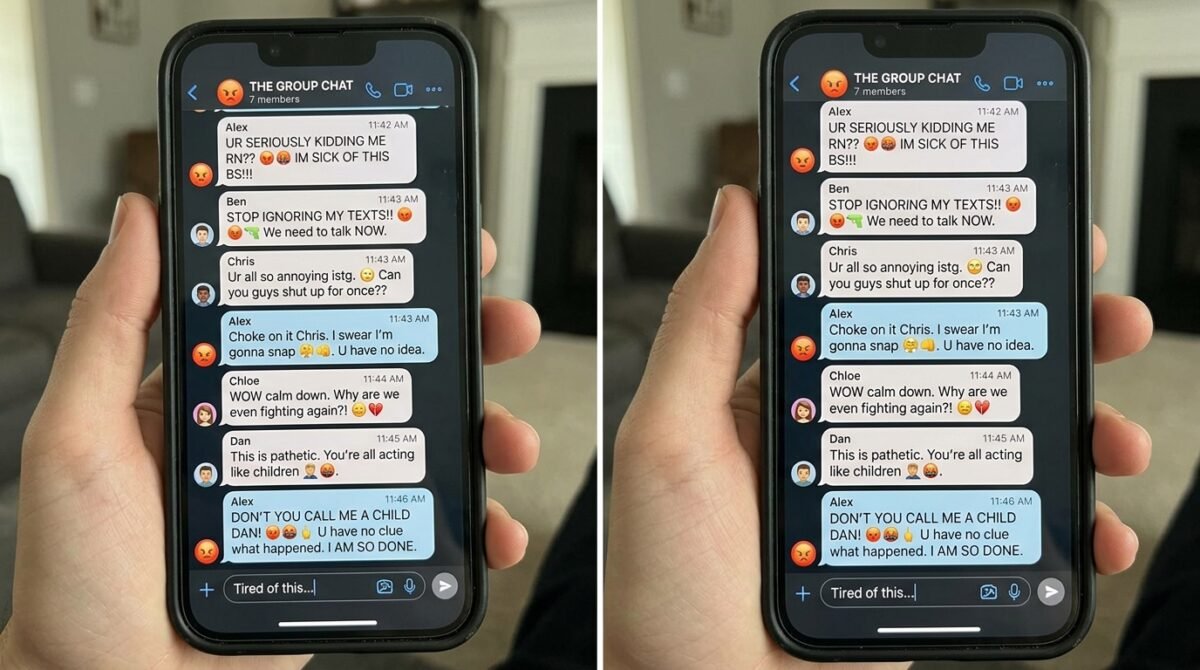
By the time I reached my apartment, my phone was vibrating incessantly. A stream of messages from Sarah—and a few from a group chat I didn’t even know we were in—flooded my notifications. The tone was aggressive, accusatory, and entirely devoid of any self-reflection. She was framing my actions as a betrayal, a cold-hearted move that ‘ruined’ our friendship over a ‘simple mistake.’
The group chat included two of our other friends, both of whom seemed to be siding with Sarah, likely based on her skewed version of events. She had sent a screenshot of the spa bill with a caption about how I had ‘abandoned her’ when she was in a bind. I sat on my couch, the phone in my hand, and read through the messages with a detached curiosity. It was fascinating to see how quickly the narrative shifted when someone is confronted with their own lack of accountability.
I didn’t respond immediately. I took a screenshot of our original texts, where we had clearly discussed splitting the bill 50/50, and I saved them. I knew I needed to maintain a record. The messages continued to pile up, moving from hurt to insults. It was a masterclass in deflection, and it confirmed everything I had been suspecting about the nature of our friendship.
I finally decided to reply, but not to the group chat. I sent a single, direct message to Sarah. I wanted to be clear, firm, and final. I didn’t want to get into a mud-slinging contest; I just wanted to state the reality of the situation and then remove myself from the line of fire.
“Sarah, we discussed the cost weeks ago. I paid my share, as agreed. Leaving your wallet at home is not a reason for me to cover your $600 expense. I’m not interested in being your bank. Please do not message me about this again.”
— My response to the group chat drama
The silence that followed was deafening. The group chat went quiet for a few minutes before one of the friends—who I thought was neutral—chimed in, questioning why I was being so ‘harsh’ over a friend who was clearly just having a rough day. The irony was palpable. They were all so invested in the image of the ‘forgetful friend’ that they couldn’t see the reality of the exploitation.
The Reddit Community Weighs In

That evening, I decided to post the story on a popular forum dedicated to interpersonal dilemmas. I kept it objective, focusing on the facts of the financial agreement and the subsequent events at the spa. Within an hour, the post had blown up. The community was surprisingly unanimous in their support, which validated the feelings I had been suppressing for so long.
The comments ranged from personal anecdotes about ‘leech’ friends to legal advice on how to handle similar situations in the future. It was a strange comfort to see that I wasn’t the only one who had dealt with someone who weaponized ‘forgetfulness’ as a means of control. The collective wisdom of the internet provided a perspective that made the drama feel smaller, more manageable.
One comment in particular stood out, capturing the exact nature of what had happened. It wasn’t about the money; it was about the lack of respect. The user pointed out that by ‘forgetting’ her wallet, Sarah was effectively deciding that my time and my savings were less valuable than hers. It was a power play, and I had finally refused to play the game.
“NTA. She wasn’t ‘forgetful,’ she was testing you to see if you’d cave. These types always ‘forget’ their wallet when they are with people they view as reliable ATMs. You didn’t leave her at the spa; you left her with her own bill. Big difference.”
— u/FinanceTruthSeeker (Top Comment, 32.5k upvotes)
Reading through the responses helped me reframe the incident. I stopped seeing myself as a ‘bad friend’ and started seeing myself as someone who had finally protected their boundaries. The validation from strangers—people with no stake in my life—was more powerful than the criticism from friends who had been enabling the behavior all along.
The Unraveling of the Friendship Circle

In the weeks following the spa incident, the tension within our friend circle became unbearable. The two friends who had sided with Sarah continued to make snide comments, treating me like I was the villain of the story. They organized outings without inviting me, and when we did cross paths, the atmosphere was thick with unspoken resentment. It was clear that the friendship was not going to survive the fallout.
I found myself questioning why I had held on for so long. Was it out of genuine affection, or was it out of a fear of being alone? The more I reflected on our time together, the more I saw the pattern of manipulation. It wasn’t just the money; it was the way she would make me feel guilty for having boundaries, the way she would constantly pull the focus back to her own struggles, and the way she would minimize my own achievements.
I started distancing myself from the group. I stopped responding to the group chat entirely. I found new activities, joined new social circles, and started investing my time in people who respected my boundaries. It was a painful transition, but it was necessary. I realized that keeping toxic people in your life is a form of self-sabotage, and I was finally ready to prioritize my own well-being.
There were moments of weakness, of course. I would see a photo of them together on social media and feel a pang of loneliness. But then I would remember the look on Sarah’s face at the spa, the way she had expected me to pay for her life, and the feeling would vanish. I knew I had made the right choice, even if it meant losing a portion of my social life.
“I’m sorry you feel that way, but I’ve moved on. I hope you find friends who are as comfortable paying your way as you want them to be. Best of luck.”
— My final text message to the group chat before leaving
The relief of deleting the chat history was immense. It was a symbolic act, a closing of a chapter that had been open for far too long. I wasn’t just leaving a friendship; I was leaving behind the person I had been when I was under her influence. I was growing, and that growth required me to leave behind the things that were holding me back.
Financial Lessons in Disguise

The $600 I spent on the spa day became the most valuable investment I ever made. It wasn’t just a payment for services; it was the cost of a hard-earned lesson. I learned that you cannot buy loyalty, and you certainly cannot purchase respect. I also learned that I need to be more transparent about my finances and less afraid to say ‘no’ when things don’t feel right.
I started keeping a more detailed budget, one that explicitly includes a ‘boundaries’ fund. If a friend suggests an outing that I’m not comfortable with, I now speak up immediately. I don’t wait until the bill comes to express my concerns. It’s a habit that has saved me both money and emotional energy. I have found that true friends are actually relieved when I set these boundaries, as it makes the relationship more honest and less transactional.
The incident also taught me to recognize the ‘red flags’ of financial manipulation. If someone is consistently ‘forgetting’ their wallet, if they are always pushing for more expensive options than I suggested, or if they react with anger when I say ‘no,’ those are warning signs. I don’t ignore them anymore. I address them immediately, and if the behavior persists, I distance myself.
It’s amazing how much more freedom I have now that I’m not worrying about subsidizing someone else’s lifestyle. I’ve been able to save for trips I actually want to take, and I’ve been able to invest in things that bring me genuine joy. The financial impact was temporary; the psychological shift is permanent.
“You shouldn’t feel bad about wanting to keep your own money. If she was a real friend, she would have been embarrassed and found a way to pay you back immediately, not tried to force you to pay for her.”
— My therapist, during our follow-up session
The validation I received from my therapist was the final piece of the puzzle. I had spent so long doubting my own instincts, wondering if I was the one who was being ‘too sensitive’ or ‘too stingy.’ Knowing that my reaction was reasonable, even expected, gave me the confidence to move forward without looking back.
The Myth of the ‘Selfless’ Friend

Society often pushes the narrative that a ‘good friend’ is someone who is endlessly self-sacrificing. We see it in movies and read about it in books, where the best friend gives up everything to help the protagonist. But in reality, true friendship is a partnership of equals. It’s about mutual support, not one-sided exploitation. When the concept of the ‘selfless friend’ is weaponized, it becomes a tool for abuse.
I had bought into that myth for far too long. I thought that by being the one who always paid, the one who always forgave, and the one who always stepped in to help, I was being a ‘good friend.’ In reality, I was just making it easier for someone else to take advantage of me. I was enabling a dynamic that was inherently unhealthy, and by refusing to participate, I was actually doing both of us a favor.
There is a fine line between generosity and enabling. I still love to treat my friends, to cover a round of drinks or a small meal, but that generosity comes from a place of choice, not obligation. It’s a gift, not a tax. When the act of giving becomes expected, it loses its meaning. I’ve reclaimed my generosity, and it feels much better to give when I want to, rather than when I’m being manipulated.
Reflecting on it now, I realize that I was playing a role in a script that Sarah had written. She needed an enabler, and I was all too happy to fill the part. Breaking the script was the most difficult thing I’ve ever done in a relationship, but it was also the most liberating. I’ve realized that I don’t need to be anyone’s hero to be worthy of friendship.
“The moment you stop being an ATM is the moment you find out who your real friends are. It’s a painful process, but it’s the only way to clear out the toxic relationships.”
— A comment from a reader on my original post
That sentiment has become a mantra for me. It’s not about being ‘stingy’; it’s about being selective. By being more discerning about who I let into my inner circle, I’ve found that the people who remain are the ones who truly care, the ones who value me for who I am, not for what I can provide.
Moving Forward Without the Guilt

The guilt that I felt in the days after the spa trip has completely evaporated. I realized that the guilt was never really mine—it was a projection of Sarah’s own lack of accountability. She wanted me to feel guilty so that I would return to the old dynamic, where she was the one in control. By refusing to accept that guilt, I effectively broke the power dynamic she had built.
I have started to embrace the freedom of my own decisions. If I want to go to a luxury spa, I go by myself or with people who I know will split the bill with me. If I don’t have the money, I don’t go. It’s that simple. There’s no more anxiety about who is going to pay, no more performative ‘forgotten’ wallets, and no more awkward confrontations at the front desk. It’s a level of peace I hadn’t realized I was missing.
I’ve also started to reach out to other, more supportive friends. We have a transparency in our relationships that I never had with Sarah. We discuss money openly, we talk about our boundaries, and we respect each other’s financial limits. It’s a refreshing, honest, and mature way of being that has completely changed my social life. I feel more secure, more valued, and more in control of my own life.
If there is one thing I’ve learned, it’s that the people who get angry when you set a boundary are the exact people who needed that boundary the most. Their reaction isn’t a sign that you did something wrong; it’s a sign that you finally did something right. It’s the ultimate litmus test for the health of a relationship.
“You aren’t responsible for someone else’s lack of preparation. Never feel guilty for expecting others to follow the same rules you do.”
— My sister, during a late-night phone call about the drama
I feel like I’ve finally stepped into my own adulthood. I’m not looking for validation from people who are clearly not looking out for me, and I’m not afraid to walk away from something that no longer serves me. It’s a powerful place to be, and I wouldn’t trade it for all the spa treatments in the world.
The Final Verdict

Looking back, the entire incident feels like a distant memory, a chaotic scene from a movie I once watched. I don’t harbor any anger toward Sarah anymore; I feel a strange sense of pity. She is still stuck in the same cycle of entitlement and manipulation, and that must be a very lonely way to live. I, on the other hand, am free.
I’ve learned to value my own boundaries as the foundation of my self-worth. If I don’t respect my own rules, no one else will. The spa incident was just the catalyst for a much larger transformation in how I handle my life and my relationships. I’m no longer the person who will sacrifice their happiness to maintain someone else’s comfort, and that is a realization I will carry with me for the rest of my life.
The friendships that have survived this transition are stronger than ever. They are built on mutual respect and shared values, not on who can pick up the tab. I have learned to cherish those relationships, and I have learned to recognize the difference between a friend who cares and a friend who consumes. It’s a vital distinction, and one that I now apply to every new person I meet.
If you are in a similar situation—if you feel like you’re constantly ‘forgetting’ your own needs to accommodate someone else’s greed—take this as your sign. You don’t have to stay. You don’t have to pay. You don’t have to apologize. Stand up for yourself, hold your ground, and see what happens. The truth is, you’ll be surprised at how much you gain when you stop losing yourself to satisfy others.
“I’m finally at a place where I know what I’m worth. And I’m certainly worth more than someone’s $600 spa bill.”
— My concluding thought on the matter
I’m happy, I’m independent, and most importantly, I am free. That is the best outcome I could have hoped for, and I wouldn’t trade this peace for anything in the world. The bill is paid, the account is closed, and the lesson is learned.
Conclusion
This experience served as a stark reminder that we are the final arbiters of our own boundaries. It is easy to get caught up in the social pressure to be the ‘nice’ one, the ‘forgiving’ one, or the ‘generous’ one, but those labels can quickly become traps. When we prioritize someone else’s entitlement over our own well-being, we aren’t being kind—we are being self-destructive.
The fallout from this incident was not a tragedy; it was a necessary housecleaning of my social circle. Sometimes, the most important thing you can do for your personal growth is to clear out the toxic relationships that are holding you back. I am better off now than I ever was when I was constantly walking on eggshells to please someone who never truly valued me.
I invite you to consider your own social circles. Are there people who constantly ‘forget’ their wallets, who always push the limits of your generosity, or who react with hostility when you establish clear boundaries? If so, it might be time to evaluate whether those relationships are serving you, or if they are simply draining you of your resources and your peace.
Have you ever had a friend who treated your finances like their own piggy bank? How did you finally manage to break the cycle? Share your stories below—let’s discuss the importance of financial boundaries in modern friendship.
What's your verdict on this dilemma?
Vote below to contribute to the official community consensus.

Have a Dilemma Keeping You Up at Night?
Share your real-life feud, wedding chaos, or relationship crossroads anonymously with our editorial team.
What do you think ?
0 Comments🛡️ Comments are moderated to protect community integrity. Your comment will appear once approved by the editorial team.