

Friendship is often described as a sacred bond, one built on mutual support, shared history, and the unspoken rule that you show up for each other in meaningful ways. For over a decade, Sarah and I had been inseparable. We survived college heartbreak, career pivots, and the messy uncertainty of our twenties together. I always believed our relationship was immune to the corrosive effects of money, but I was tragically wrong. When the tech startup I had been grinding at for four years finally reached a liquidity event, the resulting equity payout felt like the culmination of years of sleepless nights and missed holidays.
I was eager to celebrate, but I wanted to do it responsibly. I had student loans to clear and a down payment on a home to secure. I wasn’t looking to throw money at the wind, nor was I looking for a parade in my honor. However, when Sarah announced her engagement just weeks after my payout hit the headlines of our professional network, the atmosphere shifted. What began as an invitation to be her maid of honor slowly morphed into a calculated campaign to extract a massive, non-consensual financial contribution from me.
The dilemma wasn’t just about the money; it was about the fundamental change in how I was perceived. To Sarah, I wasn’t a person with goals and financial limitations anymore; I was a bottomless resource. The ten-day glamping trip to Joshua Tree was the centerpiece of her demands—a multi-thousand-dollar extravaganza that she expected me to subsidize for the entire bridal party. It wasn’t an invitation; it was a bill waiting to be signed.
This article chronicles the slow unraveling of our friendship, the boundary-crossing that left me reeling, and the final, explosive confrontation that forced me to choose between my own financial future and the toxic expectations of someone I once called my sister. It is a cautionary tale about how wealth, or even the perception of it, can act as a litmus test for those who are truly in your corner versus those who are just waiting for their turn to cash in.
The Champagne Toast That Tasted Like Debt

The dinner at the trendy downtown bistro was supposed to be a celebratory affair. Sarah had insisted on picking the venue, a place where the cocktails were twenty dollars and the appetizers were served on slate slabs. I had just finished my first week as a newly liquid asset holder, and I was feeling guilty about the sheer magnitude of the numbers in my bank account. Sarah was beaming, clutching a flute of vintage champagne, her engagement ring catching the dim light of the dining room.
I was so happy for her, genuinely. But as the night progressed, the conversation turned away from her fiancé and toward the wedding logistics. She spoke at length about her vision for the ‘Hen Experience’ in Joshua Tree. It wasn’t just a weekend; it was a ten-day immersive retreat in a luxury yurt compound, complete with private chefs, sound bath practitioners, and a professional photographer to document every moment of the ‘journey.’ I listened, nodding, until she reached the point of the conversation that made my stomach drop.
“I know the wedding is expensive for everyone, but since your payout, I’ve decided we don’t need to stress about the budget for the girls. I’ve put you down as the primary sponsor for the Joshua Tree week. It’s only a small fraction of what you made, and it’ll be a beautiful way to kick off this new chapter of your life.”
— Sarah
I felt the blood drain from my face. I had not been consulted, nor had I expressed any interest in being a sponsor. I tried to maintain my composure, setting my glass down with a deliberate, shaky hand. I attempted to explain that my money was tied up in investment accounts and that I had significant personal debts to settle before I could even consider such an extravagant expenditure. Her smile didn’t falter, but it became sharp, almost predatory.
She didn’t hear a word I said. To her, my explanation was just a ‘polite way of being stingy.’ She countered by listing all the times she had supported me during my lean years, effectively weaponizing our shared history to make me feel like a traitor to our bond. The dinner ended with the check sitting between us, and for the first time in ten years, we didn’t split it. I paid for it all, a silent, bitter down payment on the conflict to come.
The Group Chat That Became A Battleground
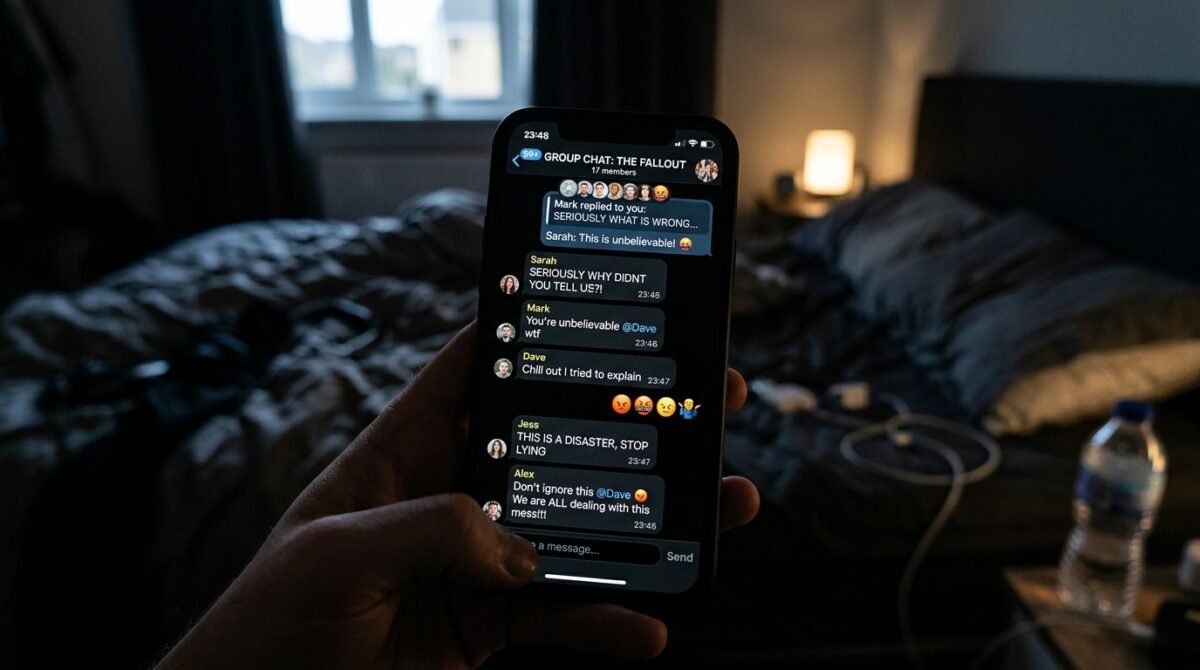
Two days after the dinner, I was added to a group chat titled ‘The Joshua Tree Dream Team.’ I didn’t recognize half the people in it, but the tone was already set. Sarah had been busy. She had already sent out a detailed breakdown of the costs per person, but next to my name, the column for ‘Remaining Balance’ was blank, marked only with a smiley face emoji. It was a digital shaming tactic, a public declaration of my ‘obligation’ to the group.
The messages started pinging at 6:00 AM. Bridesmaids and distant acquaintances were chatting excitedly about the retreat, tagging me to ask about the ‘exclusive experiences’ I was supposedly planning. I felt like an outsider in my own life. I sat on my bed, staring at the screen, watching as the projected costs climbed into the tens of thousands of dollars. They were discussing private yoga instructors and luxury catering, all assuming the check was already in the mail.
“Can’t wait to see what amazing surprises you have in store for us, OP! Sarah said you have some massive plans for the trip. Does this include the hot air balloon excursion?”
— Member of the Bridal Party (Group Chat)
I didn’t respond for hours. I was paralyzed by the audacity of it all. I felt like I was being robbed in broad daylight by people who didn’t even know the first thing about my financial reality. When I finally typed a message, I tried to be as diplomatic as possible, but the defensiveness of the group was immediate. They weren’t interested in my budget; they were interested in the benefits of my proximity to wealth.
The group chat quickly descended into a series of passive-aggressive remarks about ‘people changing when they get a little success.’ It was clear that Sarah had been talking about my payout to anyone who would listen, framing me as the wealthy friend who had suddenly forgotten where she came from. The isolation was swift and painful; my loyalty was being tested in a public arena where I was already framed as the villain.
The Unannounced Kitchen Intrusion

The breaking point came on a Saturday morning. I was in my apartment, still in my bathrobe, trying to work on my actual financial planning, when I heard the distinct sound of someone using a spare key. Sarah walked into my kitchen as if she lived there. She didn’t call, she didn’t knock; she simply walked in with a stack of brochures and a look of impatient determination. She walked past me, placed the brochures on my kitchen island, and opened my fridge.
I stood there, feeling a mix of rage and disbelief. The violation of my physical space was the final straw. She started talking about the ‘logistics’ again, ignoring my obvious distress. She wanted me to sign a contract for the glamping site that morning because, according to her, the ‘best slots were filling up fast.’ She spoke about the money as if it were play-money, something that would magically replenish itself.
“I don’t understand why you’re being so difficult. This is a once-in-a-lifetime opportunity for us to bond before I get married. Do you really want to be the person who let their best friend’s dream fall apart over a few thousand dollars?”
— Sarah
I told her, clearly and coldly, that she needed to leave. I told her that she had no right to my money, my home, or my peace of mind. Her expression shifted from entitled to shocked, and then to pure, unadulterated venom. She accused me of being selfish, of having ‘forgotten my roots,’ and of being a toxic presence in her life. The irony was so thick it was suffocating.
She eventually left, but she took the brochures with her. The silence that followed her departure was heavy. I realized in that moment that the person I had been friends with for a decade had been replaced by a stranger driven by a desperate, misplaced sense of entitlement. I spent the rest of the day blocking her number and removing myself from every digital space she controlled. The bridge hadn’t just been burned; it had been dismantled, brick by brick.
The Reddit Verdict: Echoes of the Internet

I turned to the internet not for validation, but for a reality check. I posted the story on a popular relationship advice subreddit, omitting names and locations to keep it anonymous. Within an hour, the post had blown up. Thousands of people weighed in, and the consensus was overwhelming. The sheer volume of support caught me off guard; it made me realize that I wasn’t the crazy one.
“You are not a walking ATM. The fact that she walked into your home with contracts is a massive boundary violation that goes beyond just ‘friendship drama.’ She’s not your friend; she’s an opportunist who saw a payday. Cut her off completely and don’t look back.”
— u/ReasonableObserver (Top Comment, 45.2k upvotes)
The comment section became a library of similar stories. People shared accounts of friends, family, and colleagues who had all experienced the same phenomenon: the moment you acquire money, the people around you stop seeing you as a peer and start seeing you as a resource. It was a sobering, collective realization of how fragile human relationships can be when money enters the equation.
Some users provided legal warnings about the group chat, suggesting I document everything in case she tried to sue for ‘breach of contract’ or something similarly absurd. The amount of support I received served as a protective shield against the guilt I had been harboring. I had been worried that I was the one failing the friendship, but the community reminded me that a true friend would never treat another person with such blatant disrespect.
The Financial Breakdown: Reality vs. Expectation

To understand the sheer scale of what was being demanded of me, I sat down and mapped out the costs. Sarah had provided a spreadsheet that, frankly, was a work of fiction designed to bleed me dry. She hadn’t just calculated the basics; she had included luxury add-ons that would have easily exceeded my initial budget for an entire year of living expenses. Seeing the numbers on paper made the absurdity of it all even clearer.
| Expense Category | Sarah’s Demand | My Actual Capacity |
|---|---|---|
| Glamping Site Rental | $12,000 | $0 |
| Private Chef & Catering | $5,500 | $0 |
| ‘Experience’ Packages | $4,000 | $0 |
| Transportation & Logistics | $2,500 | $0 |
| Total | $24,000 | $0 |
The $24,000 demand was just the beginning. She had also suggested that I cover the costs for three other bridesmaids who were ‘currently between jobs,’ effectively making me the sole benefactor for half the guest list. The sheer audacity of her planning—spending my money without my permission—was a level of entitlement that I still struggle to comprehend. It wasn’t about the wedding anymore; it was about power.
This spreadsheet became my internal evidence for why I had to say no. Every time I felt a pang of guilt, I looked at the table. It was a concrete reminder that her ‘vision’ was a fantasy built on my labor and my sacrifice. It wasn’t a party; it was a shakedown. The financial math was simple: her desire for a luxury weekend did not equate to a debt that I was required to pay.
The Aftermath: When Boundaries Are Final

After the confrontation, the fallout was inevitable. Sarah didn’t take the rejection well. She sent a series of increasingly frantic emails, first trying to ‘reason’ with me, then moving to emotional manipulation, and finally settling on outright threats to reveal ‘my secrets’ to our shared social circle. I had no secrets that I was afraid of, but the attempt at blackmail was the final nail in the coffin of our relationship.
I began to change my life to ensure she could no longer access me. I moved to a new apartment in a different part of the city, one that didn’t have a spare key hidden under a mat or a landlord who knew her name. I scrubbed my social media presence, locking down my profiles and removing anyone who was connected to her. It was a process of grief, a mourning for the person she used to be and the friendship I thought was indestructible.
I reached out to the other bridesmaids who had been in the group chat. Most of them were too afraid of Sarah to talk, but one, a woman named Elena, eventually reached out to me privately. She told me that Sarah had been telling everyone that I had ‘promised’ to pay for the trip months ago. It was a lie, a calculated piece of misinformation designed to paint me as the liar when I inevitably backed out.
“I’m so sorry I stayed quiet in the group chat. She told us all you were doing this as a gift for her. We didn’t realize you hadn’t agreed to it until you finally spoke up. She’s been playing us against each other for months.”
— Elena (Former Bridesmaid)
That conversation was the final piece of clarity I needed. It wasn’t just a simple misunderstanding or a difference of opinion; it was a deliberate, malicious campaign to exploit me. Knowing that she had lied to our mutual friends made it easier to let go. The guilt evaporated, replaced by a cold, hard resolve to prioritize my own well-being over the hollow image of a friendship that had been dead for a long time.
The Philosophical Cost of Wealth

This experience forced me to grapple with the philosophical weight of financial success. We are often told that money changes people, but we rarely talk about how it changes the people around us. I realized that my payout was a mirror; it reflected the true nature of everyone in my life. Some people, like my family and my real mentors, were happy for me. Others, like Sarah, saw an opportunity to offload their own responsibilities onto me.
I spent weeks reflecting on why I had been so blind for so long. Was I a pushover? Did I unconsciously cultivate an environment where I was the giver and she was the taker? Perhaps. In our twenties, I had been the one who was more successful, and I had often helped her out with small loans or favors. I had set a precedent, and when that precedent was challenged by a massive shift in my wealth, she felt entitled to maintain the status quo.
The lesson here is not that money is evil, but that relationships based on transactional utility are inherently unstable. When you have nothing to offer but your time and your presence, you know who really likes you. When you have resources, the mask slips. It is a harsh truth, but one that is essential for anyone who finds themselves in a position of sudden financial abundance.
I am now more guarded, more discerning, and far more protective of my boundaries. I don’t feel the need to justify my financial decisions to anyone, and I certainly don’t feel the need to subsidize the lifestyles of people who view me as a means to an end. My wealth has allowed me to invest in my own future, and in the people who truly care about me—not because of what I have, but because of who I am.
Moving Forward: Building a New Circle

Today, my life looks very different. I have a new circle of friends who don’t know about my startup or my payout, or if they do, they simply don’t care. We spend our time doing things that don’t require thousands of dollars in funding—hiking, cooking dinners at home, and having long, rambling conversations that don’t revolve around the next big expenditure. It is a quiet, peaceful life, and I cherish every moment of it.
I occasionally see photos of Sarah’s life on public feeds—she ended up getting married, though I heard the wedding was a much smaller affair than she had planned. I don’t feel anger when I see her face. I feel a sense of distance, a realization that we were just chapters in each other’s stories, and that hers needed to end for mine to truly begin. I am grateful for the lessons she taught me, even if the price of that tuition was higher than I would have liked.
I have learned to say no. I have learned to recognize the signs of manipulation before they escalate into full-blown demands. I have learned that a friendship that relies on your silence or your compliance is not a friendship at all—it’s a hostage situation. I am free now, and that freedom is worth more than any amount of money I could have spent on that desert retreat.
If you are in a similar situation, know this: you are not responsible for the expectations of others. You are not an ATM, and you are not required to fund someone else’s dream at the expense of your own security. Protect your peace, set your boundaries, and don’t be afraid to walk away from anyone who refuses to respect them. The right people will stay, and the wrong people will reveal themselves eventually.
The Lessons in Financial Boundaries

Reflecting on this, I have compiled a set of personal rules for how I handle money in my relationships. It’s not about being stingy; it’s about being sustainable. If I’m going to spend money on someone else, it’s because I want to, not because I am being coerced or shamed into it. I’ve realized that clarity is the best way to avoid conflict, but when that fails, distance is the only cure.
Never apologize for your success. It was your hard work, your sleepless nights, and your sacrifices that led to your payout. You don’t owe anyone a slice of your pie, and you certainly don’t owe them an explanation for why you aren’t sharing. Keep your financial details private, especially in the early days, until you know who you can truly trust. The less people know about your net worth, the less likely they are to see you as a target.
Finally, trust your gut. If a request makes you feel uncomfortable, pressured, or resentful, it’s not a request—it’s an infringement. You don’t need to be ‘nice’ at the expense of your own mental health or financial stability. Being a good friend doesn’t mean being a doormat. It means supporting each other in ways that are respectful, sustainable, and mutual. And if someone can’t handle that, they aren’t your friend.
The journey from the glamping disaster to my current state of mind has been long, but I am in a better place for it. I am no longer waiting for the next shoe to drop, and I am no longer living in fear of the next group chat notification. I am the author of my own life, and I have decided that my story will be defined by my own choices, not by the demands of others.
Why We Need to Talk About Money in Friendships

The final takeaway from my story is that we, as a society, have a massive, unspoken problem with talking about money. We treat it like a taboo, a topic that is too ‘vulgar’ to discuss, and that silence allows toxic expectations to flourish. If we were more open about our financial boundaries, maybe things wouldn’t have to escalate to the point of a friendship-ending confrontation. We need to normalize saying, ‘I don’t have the budget for that,’ without it being seen as a moral failing.
We also need to stop romanticizing the idea that best friends are obligated to support each other’s lifestyle choices. A wedding is a celebration of a commitment, not a justification for a mass-funded vacation. When we attach dollar signs to our milestones, we lose the essence of what we are celebrating. I hope my experience encourages others to set their boundaries early and firmly, and to prioritize the quality of their relationships over the performance of their milestones.
This isn’t about being bitter. It’s about being honest. If you are reading this and you feel that pressure, take a step back. Look at the balance sheet, look at the demands, and look at the person making them. Are they acting like a partner in your life, or are they acting like a client? The answer to that question will tell you everything you need to know about the future of your relationship.
I am grateful for the community that supported me, and I hope this story serves as a reminder that your worth is not defined by your bank account. You are enough, regardless of whether you have a large equity payout or nothing at all. And the people who truly love you will be there for you, regardless of the size of the check you can write.
Conclusion
The fallout from my decision to stop funding Sarah’s ‘dream’ was the most difficult period of my life, but it was also the most liberating. I learned that true friendship isn’t about proximity or shared history; it’s about mutual respect. When you have money, you learn the hard way who is there for the person and who is there for the potential. I am finally at peace with my choice, and I am stronger for having set these boundaries.
What about you? Have you ever had a friendship end because of money or mismatched expectations? Do you believe there is an ‘unspoken rule’ that friends should support each other’s luxury milestones, or is that a toxic myth? Share your experiences in the comments below—I’d love to hear how you’ve handled these delicate situations.
POLL: Did I handle the situation correctly by cutting her off entirely?
1. Yes, the boundary violation was unforgivable.
2. No, I should have tried one last conversation.
3. It’s complicated—we need more context on our history.
What's your verdict on this dilemma?
Vote below to contribute to the official community consensus.

Have a Dilemma Keeping You Up at Night?
Share your real-life feud, wedding chaos, or relationship crossroads anonymously with our editorial team.
What do you think ?
0 Comments🛡️ Comments are moderated to protect community integrity. Your comment will appear once approved by the editorial team.