
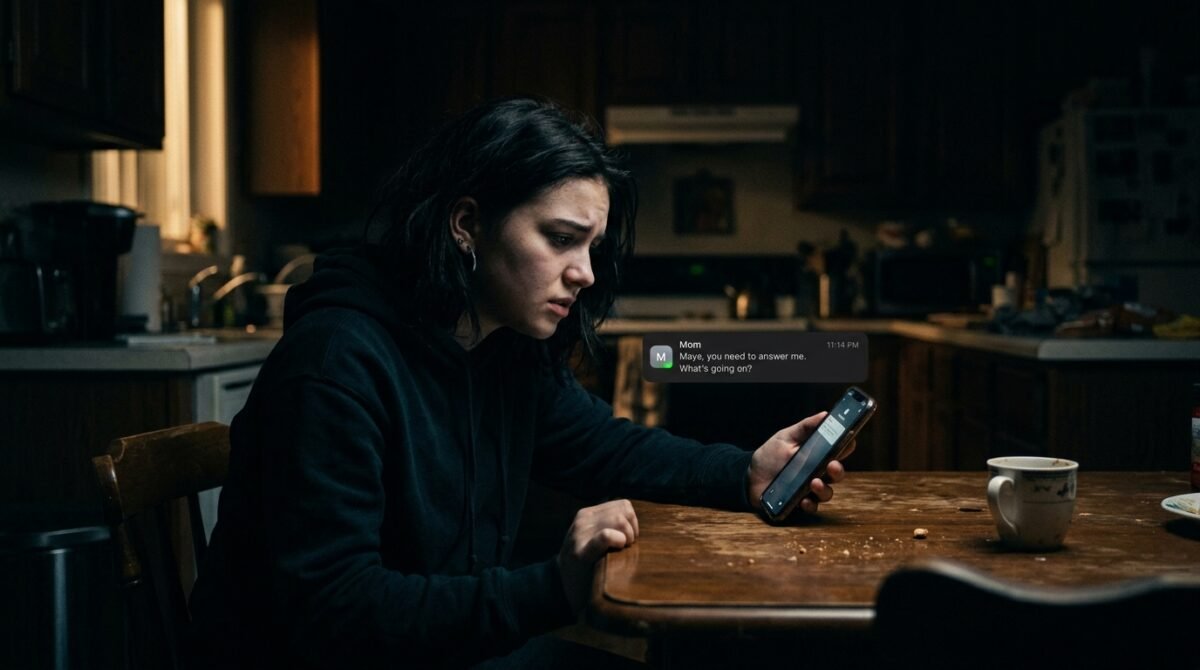
Growing up, the hierarchy in our house was never subtle. I was the ‘reliable’ one—the child who stayed in the library, balanced my checkbook by sixteen, and worked double shifts through college to graduate debt-free. My brother, Julian, was the ‘star.’ He was the charming, erratic, golden child whose mistakes were always viewed as ‘growing pains’ rather than character flaws. I had lived a life of quiet stability, saving every spare cent for a down payment on a modest condo, dreaming of the day I could finally lock my own front door and leave the chaos of my family behind.
That dream turned into a nightmare on a rainy Tuesday evening when my phone buzzed with an urgent notification from my father. It wasn’t a casual check-in. It was a summons. When I arrived at their house, the air was thick with a tension so sharp it felt like a physical weight. My mother was weeping into a tissue, and my father paced the living room floor like a caged animal. Julian was nowhere to be seen, but his presence hung over the room like a ghost. That was the night I learned the true cost of being the ‘responsible’ sibling.
They didn’t start with pleasantries. They started with a dollar amount: forty-five thousand dollars. It was exactly the amount I had accumulated over five years of grueling overtime and sacrificed vacations. They needed it to cover Julian’s mounting gambling debts before, as they put it, ‘dangerous people’ came knocking on their door. The demand wasn’t framed as a request; it was framed as a moral obligation. According to them, my stability was a luxury, while Julian’s survival was an emergency. It was the moment I realized that in my family, my hard work was merely a resource for them to exploit whenever the golden child hit a dead end.
The moral dilemma was laid out with surgical precision. If I refused, I was effectively ‘letting my brother suffer.’ If I complied, I would be sacrificing my future to subsidize his addiction. I sat there, listening to them justify the theft of my life’s work, realizing that the people who raised me saw me not as their child, but as an insurance policy for their favorite son’s failures. This wasn’t just a request for a loan; it was a demand for my autonomy, and for the first time in my life, I knew I had to choose myself.
What followed was a descent into a nightmare of manipulation, guilt-tripping, and absolute gaslighting. I was called selfish, cold, and ungrateful in the span of an hour. They didn’t see the sacrifice behind my savings account; they only saw the number. This is the story of how I stood my ground, the consequences of saying ‘no’ to family, and the brutal reality of what happens when you decide that your peace of mind is worth more than their expectations.
The Tuesday Night Intervention

The atmosphere in the living room was suffocating. My father, usually a stoic man, looked disheveled, his shirt untucked and his eyes bloodshot. My mother’s eyes were swollen, and she kept clutching a glass of water with trembling hands. I sat on the edge of the sofa, my heart hammering against my ribs, waiting for the other shoe to drop. I knew something was wrong, but I hadn’t expected the scale of the crisis they were about to drop on me.
“We have a situation,” my father began, his voice barely a whisper. “Julian has gotten himself into deep trouble. It’s gambling, and the people he owes… they aren’t the kind of people who send collection letters. They want their money, and they want it by the end of the week.” He paused, looking at me with a mix of desperation and expectation that made my skin crawl. He didn’t have to finish the sentence. I knew what he was asking for before he even opened his mouth.
“You have the money in your savings account, don’t you? It’s sitting there, earning next to nothing. This is a life-or-death situation for your brother. You can always save more money. You can’t save a life twice.”
— My Mother
I felt a cold wave of nausea wash over me. The money in that account represented my freedom. It was the result of thousands of hours of work, missed social events, and a level of discipline that my brother had never once demonstrated in his twenty-six years of life. To them, my hard-earned savings were just an ‘account’—a pool of liquid capital waiting to be drained for Julian’s next mistake. They hadn’t even asked how I felt about it; they had already spent my money in their minds.
“That is for my house, Dad,” I said, my voice shaking but firm. “That is not ‘extra’ money. That is my future. How can you even ask me to throw that away for his poor choices? He chose to gamble. He chose to take those risks. Why is it my responsibility to pay for his lack of self-control?” My mother let out a sharp gasp, as if I had personally slapped her. The look of betrayal on her face was almost theatrical, as if my desire for a home was a personal attack on their family dynamic.
They spent the next two hours cycling through every emotional lever they had. They talked about ‘family loyalty,’ ‘protecting our own,’ and how ‘hard it is for a parent to watch their son be ruined.’ They didn’t mention the hundreds of times they had bailed Julian out before—the crashed cars, the failed businesses, the lost rent money. To them, this was just another ‘stumble.’ But for me, it was the final straw. I walked out of that house with my money still in my account, but with the chilling realization that my parents would never truly see me as anything other than a safety net for Julian.
The Digital Campaign of Guilt
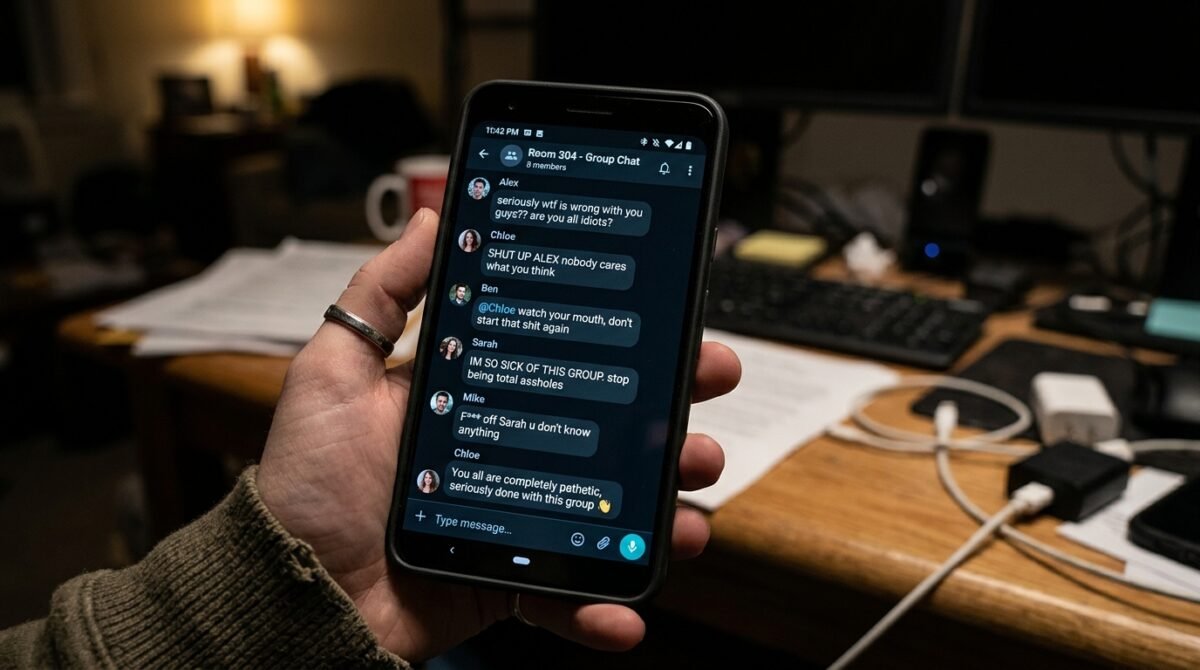
By Wednesday morning, the quiet of my apartment was shattered by the relentless pinging of my phone. The family group chat, which had been relatively dormant for weeks, was now a war zone. My mother had started, followed quickly by aunts and uncles I hadn’t spoken to in months. They were all piling on, painting me as the villain of the year. My phone became a repository for vitriol, with messages arriving faster than I could read them.
“I can’t believe you’d let your own brother face physical danger over money. Your selfishness is truly staggering. Family is supposed to come first. You are dead to us if you don’t help him.”
— My Mother (Family Group Chat)
I read the messages with a detached sense of horror. It was fascinating to see how they framed it: I was the one being selfish for wanting to keep what I had earned. Not one person asked if Julian was okay, or if he was seeking help for his addiction. The entire focus was on the money. It was a transaction. They were trying to bully me into submission, using guilt as a weapon to force me to surrender my financial security. I realized then that they didn’t respect my boundaries because they didn’t think I had any.
I took a screenshot of the messages and saved them to a secure drive. I knew I needed to document this. Not necessarily for legal reasons, but for my own sanity. When the waves of self-doubt hit, I needed to see that I wasn’t crazy. I wasn’t the one who had created this disaster; I was just the one refusing to be its collateral damage. I responded to the group chat only once: ‘I am not an ATM for Julian’s gambling habits. Please stop contacting me about this.’
The silence that followed was heavy, but it didn’t last. My aunt chimed in with a long diatribe about how I was ‘the most cold-hearted person’ she had ever known. She claimed that my ‘arrogant independence’ was why I was always ‘all alone.’ It was a classic projection. They were angry because I was no longer a participant in their dysfunctional system. I was the one person who had dared to say ‘no,’ and that made me a threat to the stability of their narrative.
I eventually muted the chat, but the damage was done. The psychological toll of being painted as the family pariah is something that doesn’t just go away. Every time my phone buzzed, I felt a spike of adrenaline and anxiety. I was being isolated, pushed to the periphery for the crime of being responsible. I started to wonder if I was really the bad guy, but then I looked at the bank statement I had printed out—the record of my five years of grinding. No. I wasn’t the bad guy. I was the target.
The Unexpected Kitchen Intrusion
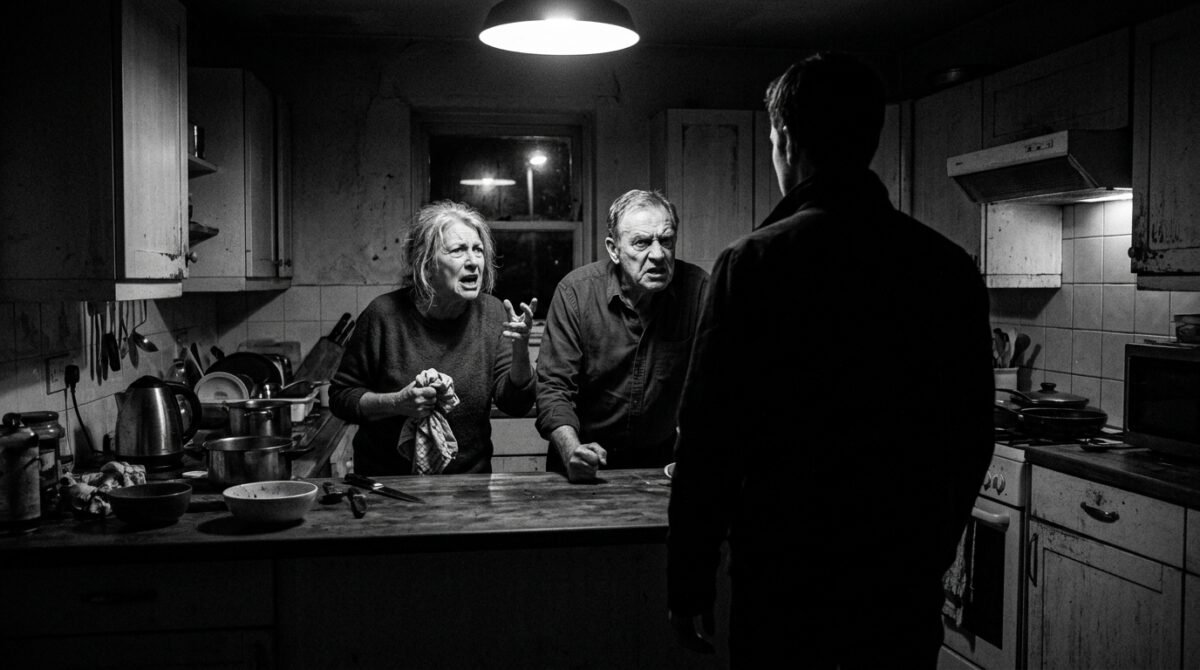
It was Friday, the day before the ‘deadline’ my father had mentioned. I was in my kitchen, trying to make a calm dinner, when I heard the distinct sound of a key in my front door. My landlord had given me permission to change the locks, which I had done a month prior, but I hadn’t changed the spare key I’d given my mother for emergencies. I heard the lock fail, and a moment later, my mother and father were standing in my living room.
They looked frantic. My father didn’t even say hello. He walked straight to the table where I was standing and slammed a folder down. “We aren’t leaving until you sign this,” he said, his voice hard. It was a loan agreement, drafted by some paralegal friend of theirs, designed to make it look like I was just ‘loaning’ the money to Julian. It was a farce, and we both knew it. Julian had no income, no assets, and no prospects. If I gave him that money, I would never see a cent of it again.
“You think this is just about money? This is about you being a part of this family. If you turn your back on your brother, you are turning your back on us. Do you understand the permanence of what you are doing right now?”
— My Father
I felt a surge of rage that was colder and sharper than anything I had felt before. They had broken into my home—my sanctuary—to intimidate me into financial ruin. “Get out,” I said, my voice steady. “Get out of my house right now, or I am calling the police. I don’t care if you’re my parents. You are trespassing.” My mother started to sob, a performative sound that I had heard a thousand times before when she needed to get her way.
“How can you be this way?” she wailed. “We gave you everything! We raised you to be a good person, and this is how you repay us? By watching your brother be destroyed?” I looked at them, really looked at them, and saw the profound selfishness behind their tears. They didn’t care about Julian’s health. They cared about the social shame, the embarrassment of his failure, and the inconvenience of having to deal with his creditors. They wanted me to be the sacrificial lamb so they could maintain the facade of a ‘perfect’ family.
I pulled out my phone and dialed 911, holding it up so they could see the screen. The change in their demeanor was instant. The righteous indignation evaporated, replaced by a sudden, frantic need to avoid a scene. They knew that if the police arrived, the optics would be terrible for them. They scrambled to leave, muttering curses and calling me every name in the book. As the door slammed shut behind them, I felt a strange, hollow victory. I had kept my money, but I had lost the last remnants of my faith in my parents.
The Reddit Trial: A Public Reckoning

That night, shaking and unable to sleep, I poured my story into a Reddit post. I didn’t hold back. I detailed the demands, the group chat abuse, and the home invasion. I needed to know if I was losing my mind, or if this was as insane as it felt. I hit ‘post’ and stared at the ceiling, waiting for the verdict. Within an hour, the notifications started pouring in. It wasn’t just a few comments; it was a deluge of support.
“OP, you are not a bank. You are not a charity. Your brother is an adult who made adult choices. The fact that your parents are enabling him by targeting your hard-earned money is financial abuse. Change your locks, go no-contact, and for the love of god, keep your money.”
— u/ReasonableObserver (Top Comment, 32.4k upvotes)
Reading the comments was like receiving a steady flow of oxygen. Hundreds of people, strangers from all over the world, were telling me that my boundaries were valid, my anger was justified, and my parents were wrong. One person shared a similar story about their own ‘golden child’ sibling and how it had taken them a decade to recover financially after giving in. Another person warned me about the legal implications of the ‘loan’ document my parents had tried to force on me, urging me to never sign anything under duress.
The community support was overwhelming. It helped me realize that the ‘family obligation’ they kept preaching was a lie—a social construct used to keep people trapped in abusive dynamics. I wasn’t a bad person for wanting to build a life for myself. I was a survivor of a system that had been designed to keep me small so that others could feel big. The reddit thread became my anchor, a place where I could check back in whenever the guilt-tripping started to get to me.
I spent hours replying to comments, finding solace in the shared experiences of others. Many people pointed out that my parents were not just failing Julian; they were actively harming me. They were teaching him that he could always rely on others to clean up his mess, and they were teaching me that my efforts were worthless. The consensus was clear: I was in the right, and the only way to protect myself was to create distance—a lot of it.
I also learned about the concept of ‘gray rocking’—a technique for dealing with toxic people by becoming as uninteresting and unresponsive as a rock. It was the strategy I needed. I didn’t need to argue anymore. I didn’t need to explain myself. I just needed to exist, to save, and to build my life without them. The Reddit thread wasn’t just a post; it was the start of my liberation. It gave me the validation I had been starved of my entire life.
The Silence that Followed

After the incident at my home, I went strictly no-contact. I changed my number, blocked them on every platform, and made it clear to the rest of the extended family—through a single, concise email—that I would not be discussing the matter. The silence that followed was deafening. It was a strange sensation, going from constant bombardment to the absolute absence of their voices. At first, I felt paranoid. I kept checking my windows, expecting them to show up again.
But as the weeks turned into months, the anxiety began to fade. I started to rediscover myself. I bought new furniture for my apartment, I started going to the gym, and I focused entirely on my career. I was no longer the ‘responsible’ one serving a family agenda; I was just a person, living a life that belonged to me. The money that they had tried to steal stayed in my savings, growing quietly, untouched by the chaos of my brother’s gambling.
“I’ve had to block four of my cousins this week. They keep trying to tell me that ‘family is blood’ and that I should ‘forgive and forget.’ It’s exhausting, but I’m finally sleeping through the night.”
— My Private Journal (Entry from Month 3)
The hardest part wasn’t the silence; it was the realization that they hadn’t really tried to contact me in a meaningful way. There was no ‘we are sorry,’ no ‘we want to understand.’ It was just anger, and then, a retreat into their own circle. They were waiting for me to break, to come crawling back with my checkbook and an apology. When I didn’t, they just moved on to the next person who would listen to their sob story.
I found out through the grapevine that Julian had eventually checked into a rehab facility, but only after he’d been kicked out of his apartment and had nowhere else to go. My parents were footing the bill, of course. They were still enabling him, just in a different way. It was a cycle that I had finally, painfully, stepped out of. I felt a pang of pity for them, but it was distant, like looking at a scene from a play that I was no longer a part of.
The silence allowed me to process the grief. I wasn’t just grieving the loss of my family; I was grieving the family I had *wished* I had. I was grieving the parents who should have been proud of my savings instead of resentful of them. It was a process of letting go of the child version of myself who had been waiting for their validation. In that silence, I finally became an adult, fully responsible for my own happiness, and entirely unburdened by their expectations.
The Financial Fallout and Legal Safeguards

With the dust finally settling, I took the step of consulting with a financial advisor and an attorney. I wanted to make sure that there was no way for my parents or my brother to access my accounts, even if they tried to claim I owed them something. The lawyer, a sharp woman who had seen it all, was incredibly reassuring. She explained that there was no legal precedent for my parents to demand my savings for my adult brother’s debts, regardless of his situation.
We drafted a series of documents to ensure my assets were protected. I also checked my credit report, fearful that they might have tried to open lines of credit in my name. Thankfully, everything looked clean. However, the process of ‘securing’ my life felt like cleaning up after a crime scene. I had to look at my financial habits, my passwords, and my emergency contacts, scrubbing any trace of my family from my life.
“You are not obligated to finance your brother’s mistakes. You have done the right thing by protecting your future. If they escalate, we have a clear path to a restraining order. Do not engage, do not explain, and do not apologize.”
— My Attorney
I realized that for years, I had been operating under the assumption that we were all ‘in this together.’ That was the trap. In reality, I was the one who had been carrying the weight for everyone else. By removing myself from the equation, the weight hadn’t disappeared; it had just shifted to where it belonged—on my parents and on my brother. It was a harsh truth, but it was necessary for my own survival.
I also started a new ‘freedom fund.’ Every month, I put in the money I would have spent on family gifts, birthday cards, and the occasional ‘bailing out’ expense I’d grown accustomed to. It was empowering to see the balance grow. It wasn’t just a number on a screen; it was a testament to the boundaries I had set. Every dollar was a reminder that I was in control of my own destiny, and no one—not even my parents—could take that away from me.
The legal protection gave me a sense of security that I hadn’t felt in a long time. I wasn’t just protecting my money; I was protecting my peace of mind. I knew that even if they showed up at my doorstep again, I had a plan. I had a team. I had the law on my side. The fear that had once paralyzed me was replaced by a calm, steady resolve. I was safe, and for the first time, I was truly free.
Reframing the Narrative of ‘Family First’

I spent a lot of time reflecting on the concept of ‘family first’ during those long, quiet months. We are taught from a young age that family is the bedrock, the one thing you can always rely on. But what happens when the bedrock is crumbling? What happens when the people who are supposed to protect you are the ones putting you in danger? I came to the conclusion that ‘family first’ is often used as a weapon to maintain status quos that are fundamentally abusive.
I started reading books on complex PTSD and familial estrangement. It was validating to see that what I had experienced—the guilt-tripping, the gaslighting, the weaponizing of my success—were textbook examples of toxic family dynamics. I wasn’t an anomaly. I was just the one who had finally decided to stop playing the game. I realized that the term ‘golden child’ wasn’t a compliment; it was a curse that had ruined my brother’s life and distorted my parents’ reality.
“Family is not just about blood. It’s about respect, boundaries, and mutual support. If a relationship is transactional and exploitative, it’s not a family—it’s a business deal where one side is getting screwed.”
— My Therapist
My therapist helped me understand that I didn’t need my parents’ approval to be a ‘good person.’ Their definition of a good person was someone who obeyed them and enabled their dysfunction. My definition was different: someone who acted with integrity, honored their commitments, and protected their own well-being. Once I internalized that, the guilt lost its power. I wasn’t being ‘bad’; I was being ‘healthy.’
I began to curate my own family—a circle of friends, mentors, and partners who respected my boundaries and celebrated my success. It was a different kind of love. It was a love that didn’t demand anything in return. It was a love that was based on mutual respect rather than obligation. I found that I was capable of being much more generous and kind when I wasn’t being forced to be so. The irony wasn’t lost on me: by cutting off the toxic parts of my life, I had become a better, more loving person.
This journey wasn’t about hate. It was about indifference. I didn’t want to hurt my parents; I just wanted to stop being hurt by them. I wanted to move on. And as I looked at the life I was building, I realized that I had succeeded. I wasn’t looking back anymore. I was looking forward, toward a future that I had earned, a future that was entirely mine, and a life that was finally, unequivocally, my own.
The Final Confrontation That Never Happened

There was a moment, about six months into my no-contact period, when I thought my parents might actually try to reach out in a genuine way. A distant relative sent me a message saying that my mother was ‘in a bad way’ and that she ‘missed me.’ My heart skipped a beat. For a second, I imagined the phone call: the apology, the acknowledgement of the pain they had caused, the promise to respect my boundaries. I even drafted what I would say.
But then I stopped myself. I looked at the reality of their behavior. They hadn’t reached out to *me*. They had reached out to a relative, hoping to use them as a proxy to guilt me back into the fold. It was the same old tactic. They weren’t looking for a reconciliation; they were looking for a return to the status quo where I was the reliable, obedient, and exploitable child. The realization made me sad, but it also made me firm.
“I miss who I thought you were, not who you actually are. I hope you find peace, but I cannot be the one to provide it for you.”
— A text draft I never sent
I didn’t send the text. I didn’t reply to the relative. I just continued with my day. I realized that waiting for an apology from them was just another way of staying trapped in their orbit. My healing wasn’t dependent on their realization; it was dependent on my own. I had to let go of the need to be understood by them. I had to accept that they were who they were, and that I couldn’t change them.
The ‘final confrontation’ that I had feared for so long had already happened. It was the moment I walked out of their house. It was the moment I said ‘no.’ Everything else was just the echo of that moment. I didn’t need a grand finale or a dramatic closing scene. I just needed to continue living my life, growing, and thriving. The power they once held over me had dissipated, not with a bang, but with a quiet, persistent refusal to participate in their dysfunction.
I am now in a place where I can look at their photos without feeling a spike of anger or a wave of grief. They are just people, flawed and broken, who were unable to give me the love I deserved. And that’s okay. I have found that love elsewhere, and I have found it within myself. I am free, and that is the greatest victory I could have ever asked for. The story of my life is no longer about them; it’s about me.
Lessons from the Financial Abyss
Looking back, the most important lesson I learned was the value of financial literacy as a form of self-defense. If I hadn’t had those savings, I wouldn’t have been able to stand my ground. I would have been desperate, vulnerable, and easy to manipulate. My financial discipline was the shield that saved me. It taught me that money isn’t just about ‘things’; it’s about options, security, and the ability to say ‘no’ when someone tries to compromise your integrity.
I also learned that boundaries are not something you ‘ask’ for; they are something you ‘enforce.’ You don’t ask for respect; you demand it by refusing to tolerate disrespect. If someone crosses a line, there must be a consequence. In my case, the consequence was my absence. It was the most powerful tool I had, and it was the only one that worked. It taught me that my presence is a privilege, not a right, and that I should be careful about who I allow into my life.
“You owe it to yourself to be the person you would have wanted to protect when you were a child. Don’t let anyone—not even your parents—take that away from you.”
— Advice from a mentor
I learned to trust my gut. Every time I felt that familiar sinking feeling in my stomach, I knew something was wrong. I had been conditioned to ignore that feeling in favor of ‘family duty,’ but that feeling was my internal compass. It was telling me that something was off, and it was usually right. Now, I listen to it. I don’t apologize for my intuition, and I don’t override it to make others comfortable.
Finally, I learned that it is possible to survive the fallout of setting boundaries. The sky didn’t fall. The world didn’t end. I was still here, stronger and more resilient than I had ever been. I learned that I am capable of building a life that is beautiful, secure, and entirely my own. The experience was painful, yes, but it was also the catalyst for the most transformative period of my life. I wouldn’t wish this kind of conflict on anyone, but I am grateful for the person I have become because of it.
My advice to anyone facing a similar situation is simple: protect yourself first. You cannot pour from an empty cup, and you cannot build a life on a foundation of exploitation. If your family demands that you sacrifice your future for their mistakes, it is not love. It is abuse. And you have every right to walk away. You have every right to protect your peace. You have every right to build a life where you are the priority.
The New Chapter: A Life Reclaimed

Today, I live in that condo I dreamed about. It’s not huge, but it’s mine. I have a key that no one else has. I have a front door that I can lock whenever I want. Every time I walk into my living room and sit on my couch, I feel a sense of profound gratitude. This wasn’t given to me; I earned it. I fought for it. And I protected it against people who didn’t understand the value of hard work.
My relationship with the world has changed. I am more confident, more decisive, and more appreciative of the people who are actually in my corner. I’ve realized that the ‘responsible’ label, which I used to hate, is actually a badge of honor. It means I am someone who can be trusted, someone who can handle their business, and someone who knows the value of a dollar. It is a strength that has served me well in my career and my personal life.
“You don’t have to set yourself on fire to keep others warm. Your light is your own, and you have every right to keep it burning for yourself.”
— A note I keep on my bathroom mirror
I still think about my brother sometimes. I hope he finds his way, but I also know that his journey is not my responsibility. I’ve reached a place of acceptance—that some people have to hit rock bottom to change, and that the best way to help them is to stop being the cushion that breaks their fall. It’s a hard truth, but it’s the truth.
My life is full now. Not with drama, but with meaning. I have friends who check in on me because they care, not because they need something. I have a job that rewards my efforts and a home that represents my autonomy. I am the architect of my own happiness, and for the first time, I am excited about what the future holds. I’ve left the shadow of my family behind, and I’m walking into a future that is bright, clear, and entirely my own.
If you take one thing from this story, let it be this: you are worth more than the chaos others try to impose on you. You are worth more than the guilt they try to make you carry. You are worth the life you are building for yourself. Protect it with everything you have, and never, ever apologize for choosing your own peace of mind.
Conclusion
The story of my family is one that many people recognize, unfortunately. The patterns of enabling, the weaponization of ‘family obligation,’ and the subtle—and sometimes not-so-subtle—financial abuse are common themes in dysfunctional dynamics. By speaking out, I hope I’ve encouraged even one person to recognize their own worth and to stand up for their own boundaries. You don’t have to be the martyr for your family’s failures.
The debate over family loyalty is a complex one, but at the end of the day, your primary responsibility is to yourself. You are the only one who has to live with the consequences of your choices. If those choices lead to a life of freedom, security, and integrity, then they are the right choices. I’ve found my path, and it’s one that I will continue to walk with my head held high.
What about you? Have you ever had to draw a hard line in the sand with family over money or expectations? How did you handle it, and what did you learn in the process? Share your stories in the comments below—the community support here is stronger than any family obligation.
What's your verdict on this dilemma?
Vote below to contribute to the official community consensus.

Have a Dilemma Keeping You Up at Night?
Share your real-life feud, wedding chaos, or relationship crossroads anonymously with our editorial team.
What do you think ?
0 Comments🛡️ Comments are moderated to protect community integrity. Your comment will appear once approved by the editorial team.