

Marriage is often described as a partnership built on the promise of mutual support, especially in moments of vulnerability. For Sarah, a thirty-four-year-old graphic designer, that promise was cemented three years ago during the exchange of vows. But the true test of a marriage isn’t found in the grand gestures or the sunny vacations; it is found in the quiet, painful moments where you are at your most fragile and in need of help. When Sarah scheduled her ACL reconstruction surgery, the plan was simple: her husband, Mark, would drive her to the outpatient center, wait through the procedure, and bring her home to begin her recovery.
However, the day of the surgery turned into a masterclass in selfishness that would ultimately lead to the dissolution of her five-year union. As the anesthesia wore off and the fog of the operating room began to lift, Sarah reached for her phone, expecting a flurry of worried texts. Instead, she was met with a deafening silence and a single, casual update posted to social media that would change the trajectory of her life. The realization that she was an afterthought in her own home hit harder than the post-operative pain radiating from her knee.
The moral dilemma here isn’t just about a missed ride; it is about the systemic patterns of neglect that had been festering beneath the surface of their relationship for years. For Sarah, the choice to call a cab and an attorney simultaneously wasn’t a rash decision born of temper—it was the final brick being placed on an already broken wall. She realized then that she was essentially living as a single person in a house with a roommate who prioritized his handicap over her health.
This is a story about the breaking point. It explores the dangerous intersection of entitlement and apathy, and the moment a victim finally stops waiting for their partner to show up. As we delve into the timeline of this betrayal, we will examine not only the events of that fateful Saturday but the months of emotional labor that preceded the surgical table. Sometimes, it takes a physical injury to finally reveal the emotional wounds that have been festering for far too long.
The Pre-Operative Agreement

Two weeks before the scheduled surgery, Sarah and Mark sat at their kitchen island, calendars spread out like a map of their shared obligations. The date was circled in red, and the logistics were clear. Mark had explicitly promised to take the day off work to be the primary caretaker during the first twenty-four hours of recovery. He had even joked about being the ‘nurse of the year,’ a comment that, in retrospect, carried a thin, self-serving veneer.
The agreement was not just about the surgery; it was about the necessity of having a reliable partner during the onset of anesthesia recovery, a time when Sarah would be groggy, in pain, and unable to drive. She had even prepped the house, clearing pathways and setting up a recovery station with ice packs and pain medication. She felt a sense of comfort knowing that, regardless of the stress of the surgery, she had a partner who was ‘on board’ with the plan.
However, the shift began just three days prior. Mark started mentioning an ‘unmissable’ charity golf tournament that had suddenly appeared on the club’s schedule. He framed it as a networking opportunity that could potentially lead to a promotion, playing on Sarah’s desire for their financial stability. He never explicitly said he was skipping the surgery; instead, he played a game of strategic ambiguity, leading her to believe he had found a way to do both.
“I’m just saying, it’s a huge deal for my career, and if I win, the prize money goes toward the new deck we talked about. I thought you’d be happy about that. I can drop you off and pick you up between holes if I really have to.”
— Mark, three days before the surgery
Sarah felt a knot of anxiety tighten in her stomach. The gaslighting was subtle, designed to make her feel like an obstacle to their shared success. She reiterated the surgeon’s orders: she would be heavily sedated, and she needed someone to be there for the duration. Mark nodded, kept his eyes on his phone, and walked away, leaving the conversation suspended in a state of unresolved tension that set the tone for the coming week.
By the night before the surgery, the communication had shifted from logistical planning to cold, transactional avoidance. Mark spent the entire evening in the garage ‘fixing his clubs,’ ignoring the pile of recovery supplies Sarah was organizing. She felt the isolation creeping in, a cold draft in the house that had nothing to do with the thermostat and everything to do with the emotional distance growing between them.
The Empty Waiting Room

The morning of the surgery began in silence. Mark left the house at 5:00 AM, leaving a note on the counter that said, ‘Need to get to the club early for practice. See you later.’ Sarah, already dressed and struggling with her brace, felt a sense of dread that outweighed her fear of the procedure itself. She had to call a ride-share app to get to the surgical center, her heart sinking with every mile they traveled away from the home she shared with a man who was supposed to be her support system.
The surgical center was cold and sterile. When the intake nurse asked who was picking her up, Sarah lied. She said her husband was coming. She couldn’t bring herself to admit that he had prioritized a tee time over her anesthesia recovery. She checked her phone repeatedly while in the pre-op bay, waiting for a message, a call, anything. Nothing came. The hours ticked by as she was prepped for the procedure, her mind racing with the realization that he truly wasn’t coming.
The surgery went well, but the recovery was a blur of confusion and nausea. When she finally woke up in the recovery suite, the nurse was hovering over her, looking concerned. The hospital staff had been trying to call her emergency contact for over an hour. Sarah’s phone was buzzing in her bag, but she was too weak to reach for it. When she finally managed to unlock the screen, the notification screen was a catalog of disappointment.
“Hey, hope it went well. The tournament is running long, and I’m currently in the lead. I’ll be home late, so just grab a cab or have your mom come get you. Don’t worry, the nurse will look after you.”
— Text from Mark, 1:45 PM
Sarah stared at the screen, the words blurring. Her knee throbbed, but the real pain was the cold, hard reality of his response. He hadn’t even checked if she was conscious. He was playing golf. She looked at the nurse, her eyes watering, and felt a sudden, sharp clarity. The haze of the anesthesia wasn’t clouding her judgment anymore; it was clearing the path for the decisions she needed to make.
She didn’t call her mother. She didn’t call a friend. She opened a tab on her phone and searched for the top-rated family law firm in her city. She didn’t need a ride home; she needed an exit strategy. The nurse, sensing the gravity of the moment, handed her a water and sat with her while she placed the call, her voice trembling but resolute as she requested a consultation for divorce proceedings.
The Silent Return Home
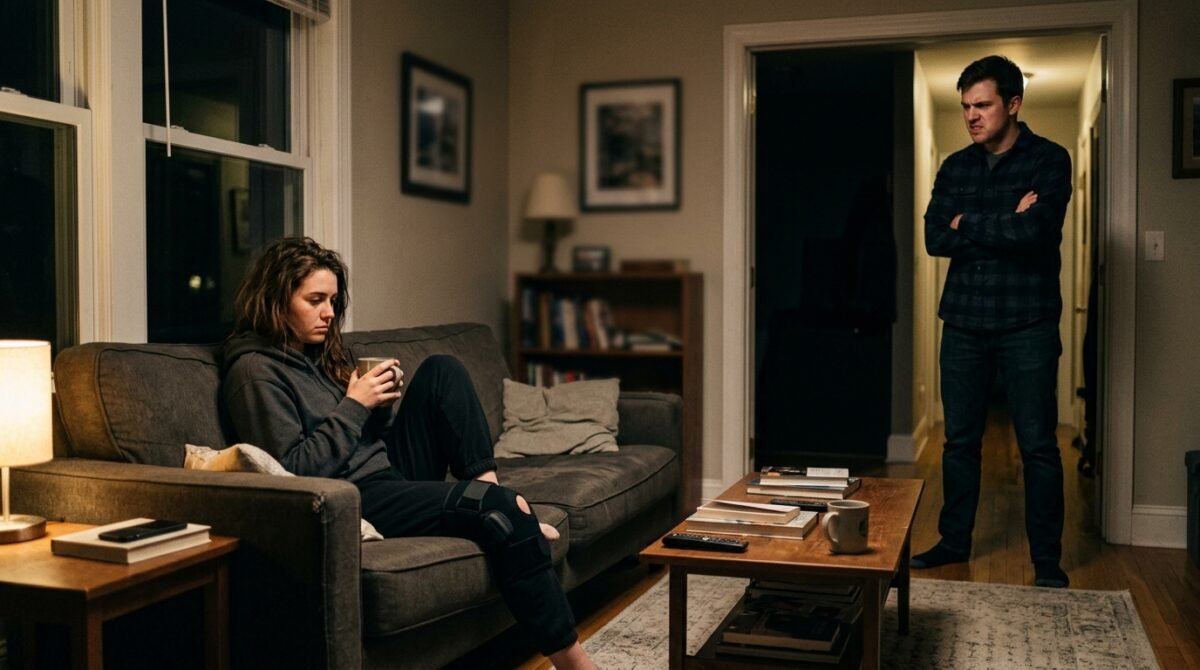
When Sarah finally made it home, she was in a state of physical and emotional exhaustion. She had taken a private car service, having to navigate the steps into her house with a knee brace and crutches, a process that felt like a marathon of pain. The house was empty. Mark’s car wasn’t in the driveway, and his golf bag was missing from the mudroom. The silence of the house was oppressive, a stark reminder that she had been left entirely alone to manage her post-operative recovery.
She spent the next few hours in a daze, alternating between icing her knee and staring at the wall. She had messaged her best friend, who arrived shortly after to help with basic needs, but the damage to Sarah’s spirit was already done. When Mark finally walked through the door at 9:00 PM, he was laughing, his face flushed from the sun and, presumably, a few drinks at the clubhouse. He stopped dead when he saw Sarah sitting on the couch with her leg propped up, his grin fading into a look of irritation.
“Are you kidding me? You’re just sitting here in the dark? You could have called your mom or anyone else to help you out. I had the best round of my life today, and you’re acting like a martyr sitting on the couch waiting for me to apologize.”
— Mark to Sarah upon returning home
Sarah looked at him, feeling absolutely nothing—no anger, no hurt, just a strange, detached observation of the person she had married. She realized she didn’t want to fight anymore. The confrontation she had rehearsed in her head died on her lips. She simply gestured to the phone on the table, which displayed the confirmation email for her legal consultation.
Mark looked at the phone, then at her, his expression shifting from defensive to genuinely confused. He couldn’t fathom that his behavior had consequences that extended beyond her annoyance. He began to pace the room, complaining about how unfair it was that she would ‘blow things out of proportion’ over a single day. He truly believed that his golf game was a valid excuse for leaving his wife to handle a surgical recovery alone.
The conversation was short. Sarah didn’t argue. She didn’t cry. She told him clearly and concisely that he needed to find somewhere else to stay for the night. When he pushed back, she didn’t raise her voice; she reminded him that he had already made his priorities clear, and that she was merely respecting his choices. She had reached a point of no return, and the house felt significantly lighter once he finally stormed out to his car, slamming the door behind him.
The Legal Reality Check

The next morning, Sarah arrived at the law office, her knee still aching but her resolve stronger than ever. The attorney was a stern, no-nonsense woman who listened to the story without interruption. As Sarah detailed the patterns of neglect—the missed anniversaries, the financial coercion, and finally, the surgical abandonment—the attorney took notes, her expression never wavering. It wasn’t just a divorce; it was an emancipation.
The consultation solidified the reality of her situation. She was advised to document everything, to secure her financial assets, and to prepare for the inevitable pushback from Mark. The attorney explained that behavior like Mark’s was rarely isolated; it was part of a larger personality structure that relied on the other person’s compliance and silence. By breaking that silence, Sarah had effectively dismantled the power dynamic that had kept the marriage afloat.
While sitting in the office, Sarah received a barrage of messages from Mark. They were erratic, oscillating between defensive excuses and outright threats. He was suddenly worried about the optics of a divorce, about what his friends at the country club would think, and about the financial implications of splitting their accounts. He was thinking entirely of himself, just as he had on the day of the surgery.
“You’re honestly going to ruin our life over one day? I already told you I won, I was going to buy us that new deck. You’re being incredibly selfish. I’m coming back tomorrow to talk about this, so don’t try anything funny with the bank accounts.”
— Text from Mark to Sarah
Sarah forwarded every single one of those messages to her attorney. She watched as her lawyer read them, a small, knowing smile appearing on her face. This was exactly what they needed. Mark’s own words were painting a picture of an entitled, emotionally abusive partner who saw no value in his wife beyond her utility. The legal process was no longer a vague threat; it was a concrete machinery starting to grind.
The contrast between her new professional reality and the chaos of her marriage was stark. For the first time in years, Sarah felt like she was being heard. She wasn’t an ‘interruption’ or a ‘burden’ to her attorney; she was a client whose well-being was the primary concern. The transition from being a neglected wife to a focused legal participant was empowering, and she felt the heavy weight of her previous life beginning to lift.
The Group Chat Exposure

The true scope of Mark’s behavior was revealed when Sarah gained access to a shared laptop they used. She hadn’t intended to spy, but she needed to check on some joint financial records. What she found was a group chat titled ‘The Boys’—the same group Mark had been bragging to about his golf tournament. The messages confirmed that not only had he abandoned her, but he had mocked her for needing his support.
The chat was filled with toxic banter. When a friend had asked if he was worried about Sarah, Mark had responded with a laughing emoji and a dismissive comment about how ‘wives always overreact to minor surgeries.’ He described her as a ‘ball and chain’ who was keeping him from his potential. Reading the words, Sarah felt a physical chill. This was the person she had spent five years loving, the man who had promised to support her in sickness and in health.
“Sarah is acting like I’m a monster because I chose the championship over her knee surgery. Who gets surgery on a Saturday anyway? It’s not like she’s dying. I’m currently winning the back nine, boys! Let’s celebrate tonight at the bar!”
— Message from Mark in ‘The Boys’ group chat
She took screenshots of everything. These weren’t just mean comments; they were evidence of a pattern of behavior that would be invaluable during the divorce proceedings. The group chat revealed that Mark’s entire social circle encouraged this behavior, validating his selfishness and cheering him on. It was an echo chamber of misogyny that had clearly influenced his decision-making.
Sarah shared these screenshots with her attorney, who confirmed that they could be used to demonstrate a pattern of emotional abandonment. It was a dark, jarring look into the reality of her marriage, but it provided her with the final, cold closure she needed. There was no ‘good Mark’ hiding behind the neglect; there was just a man who believed his wants were objectively more important than the needs of his spouse.
As she scrolled through the messages, she realized that she had been mourning a version of him that never really existed. The man she loved was a projection of her own empathy and hopes. The man in the group chat was the reality. She closed the laptop, feeling not a sense of betrayal, but a sense of liberation. She was finally done with the guesswork. The evidence was there, in black and white, and it made the decision to move forward with the divorce absolute.
Community Reaction: The Reddit Verdict

Sarah decided to share her experience on an anonymous forum to see if she was, as Mark claimed, ‘overreacting.’ The response was instantaneous and overwhelming. Within hours, the post had garnered thousands of comments, with the vast majority of users firmly in her corner. The collective voice of the internet provided the validation she had been starved of for months.
The community did not focus on the surgery alone; they focused on the pattern of behavior. Many users pointed out that the tournament was just the final catalyst in a long history of boundary violations. They analyzed the dynamic of the ‘charity tournament’ and noted how typical it was for narcissistic partners to use such ‘noble’ causes to justify their own self-centered choices.
“Girl, you didn’t overreact. You acted like a rational adult who realized that a partner who can’t even show up for a surgery is a partner who isn’t there for anything that matters. The surgery was just the test, and he failed spectacularly. Stay strong and get that lawyer to take him for everything he’s worth.”
— u/SupportiveSoul (Top Comment, 32.1k upvotes)
Others shared their own stories of surgical neglect, detailing how they had realized their marriages were over while sitting in hospital beds waiting for partners who never arrived. The common thread was the feeling of invisibility. The comment section became a support group, a testament to the fact that Sarah’s pain was not unique, but her decision to act was what set her apart.
There were a few contrarians, but they were quickly drowned out by the sheer volume of support. The community consensus was clear: marriage is a contract of mutual care, and by breaching that contract in a moment of physical vulnerability, Mark had rendered the marriage void. The advice was unanimous: prioritize the legal separation, maintain no-contact, and focus on healing.
Sarah spent hours reading through the comments, finding comfort in the shared experiences of others. She realized that she wasn’t alone in her struggle, and that her ‘extreme’ reaction was actually a healthy boundary. The Reddit post served as a mirror, reflecting her own reality back to her and confirming that the path she was on—toward independence—was the right one.
The Confrontation at the Country Club

Despite his initial threats, Mark seemed to believe that Sarah would eventually ‘calm down’ and come back to him. When she continued to ignore his texts and proceeded with the legal filing, he decided to make a scene. He showed up at the country club where Sarah was having lunch with a friend, assuming he could manipulate her in public where she wouldn’t want to cause a scene.
He walked over to their table, his face a mask of false concern. He tried to speak to her in a soft, condescending tone, as if she were a child who had done something naughty. He ignored her friend entirely, his focus solely on Sarah, whom he clearly expected to crumble under the weight of his public presence.
“Sarah, honey, let’s stop this nonsense. You’re making us look bad. People are talking. Just come home, we’ll talk about this like adults, and I’ll take care of you. You don’t need a lawyer for a little disagreement.”
— Mark to Sarah at the restaurant
Sarah didn’t stand up. She didn’t yell. She looked at him with a calm, steady gaze that clearly unsettled him. She had prepared for this moment, knowing that he would eventually try to use public pressure to force her back into submission. She simply pulled a business card from her bag and laid it on the table between them.
She told him, in a voice that was audible to the people at the nearby tables, that she was not coming home and that all further communication was to be handled through the attorney listed on the card. She didn’t mention the surgery, the golf tournament, or the group chat. She didn’t need to. Her indifference was a far more powerful weapon than any argument she could have made.
Mark was visibly shaken. He had expected an emotional outburst, a negotiation, or even tears. He hadn’t expected to be dismissed with such cold, clinical efficiency. He turned bright red, muttered something about her being ‘crazy,’ and stormed out of the club, leaving her and her friend to finish their meal. The public humiliation he had hoped to inflict on her backfired, leaving him exposed as the immature one in the situation.
Financial Deconstruction

The divorce process was not without its challenges. As they began to untangle their finances, Sarah discovered a trail of financial mismanagement that Mark had been hiding for years. He had been using their joint savings to fund his ‘investments’ in golf clubs, high-end memberships, and various get-rich-quick schemes that had yielded absolutely nothing. The deck he had promised? It was funded by money that was supposed to go toward their emergency fund.
The financial ledger was a disaster. Sarah’s attorney worked tirelessly to claw back what was rightfully hers, highlighting the disparity between their contributions. It was a wake-up call for Sarah, who had trusted Mark implicitly with their finances. She realized that his neglect wasn’t just physical or emotional—it was financial, a slow-motion drain of her security that he had been masking with superficial promises.
| Category | Mark’s Spending | Sarah’s Contribution |
|---|---|---|
| Golf Membership | $8,500/yr | $0 |
| Joint Emergency Fund | $12,000 (withdrawn) | $20,000 |
| Home Improvements | $0 (Promised) | $5,000 |
The table above represents the reality of their shared financial life. While Mark insisted that he was the ‘breadwinner’ who deserved the perks, the reality was that he was consuming the shared wealth to support a lifestyle that Sarah was effectively subsidizing. The revelation of his financial deception turned the divorce from a sad, emotional event into a necessary legal cleanup.
As the assets were divided, Sarah felt a sense of relief wash over her. Every dollar she recovered was a piece of her independence being returned. She stopped looking at the numbers as losses and started looking at them as the price of her freedom. The legal process was expensive, but the cost of staying in the marriage would have been far higher.
By the time the final settlement was reached, Sarah was in a much better position than she had ever been during the marriage. She had cut ties with the debt, the drama, and the deception. She had walked into the attorney’s office in pain and doubt, and she walked out with a clear path forward and a bank account that finally reflected her own hard work.
The Aftermath: Reclaiming the Self

Six months after the surgery, Sarah stood in her new apartment, looking out at the city skyline. Her knee had healed, and with it, her spirit. She was no longer living in a house of secrets and resentment. She had started a new project at work, reconnected with friends she hadn’t seen in years, and most importantly, she had learned to trust her own instincts again.
The divorce had been finalized, and with the legal paperwork behind her, she felt a profound sense of peace. She still thought about the surgery sometimes, but not with sadness. She thought about it as the moment she had finally stopped waiting for someone else to save her and realized that she was the one she had been waiting for all along. The pain of the recovery had become a metaphor for the pain of leaving—temporary, necessary, and ultimately healing.
Mark, she heard, was still at the club, still playing golf, and still telling anyone who would listen that his ex-wife was ‘unhinged.’ She didn’t care. His narrative no longer had any impact on her life. She had effectively removed his voice from her head, replacing it with her own. She was no longer defining herself by her role as his wife, but by her own capabilities and dreams.
She started therapy, which helped her unpack the years of subtle manipulation she had endured. It wasn’t about blaming herself; it was about understanding why she had stayed for so long and ensuring she would never find herself in a similar position again. She learned that self-love wasn’t just a buzzword; it was the ability to set boundaries, to demand respect, and to recognize when you were being devalued.
The transition was not linear. There were days of doubt and loneliness, but they were countered by the freedom of her own space. She found joy in the simple things—the quiet of her apartment, the ability to make plans without checking in with anyone, and the pride she felt in her own resilience. She was no longer a person waiting for a ride; she was a person driving her own life forward.
Lessons in Boundaries

Looking back at the trajectory of her marriage, Sarah realized that the surgery was not the beginning of the end, but the end of the beginning. It was the moment that the reality of the situation became impossible to ignore. She learned that boundaries are not meant to be tested, but to be enforced. If she had set firmer boundaries early on, perhaps she wouldn’t have reached such a breaking point, but she also wouldn’t have learned the depth of her own strength.
She now advocates for the importance of communication, not just about feelings, but about expectations. She learned that a partner who can’t handle a simple, critical request is not a partner at all. True intimacy is found in the ability to share the burden of life, and she now knows exactly what she is looking for in the future: someone who understands that being a partner means showing up when it matters most, not just when it’s convenient.
The experience taught her that it is okay to be ‘selfish’ in the defense of one’s own well-being. She had been conditioned to believe that her needs were secondary, that being ‘supportive’ meant sacrificing her own sanity. She now understands that a healthy relationship is one where both partners’ needs are prioritized, and where the welfare of the other is never treated as a secondary concern.
Sarah’s story serves as a cautionary tale for those who might be in a similar situation, but it also serves as an inspiration. It shows that it is never too late to take control of one’s life, and that the fear of being alone is nothing compared to the fear of being in a relationship that drains the life out of you. She is now living a life that she loves, one that is built on a foundation of self-respect and clear, healthy boundaries.
For those still trapped in cycles of neglect, Sarah’s advice is simple: pay attention to how your partner reacts when you are at your most vulnerable. Their response in those moments is the truest reflection of their character. If they choose their own comfort over your health, believe them. Don’t wait for the surgery, the accident, or the crisis to prove what you already know deep down. Protect your own peace, because at the end of the day, you are the only one who truly will.
Conclusion
The story of Sarah and Mark is not merely a tale of a missed surgical pickup; it is a profound exploration of how we define partnership and the critical thresholds of human endurance. Sarah’s journey from a neglected, confused spouse to an empowered, independent woman provides a roadmap for anyone currently navigating the isolation of a toxic marriage. By choosing to prioritize her recovery and her legal security over a failing union, Sarah reclaimed not just her finances, but her very identity.
The internet’s overwhelming response to this dilemma confirms that Sarah’s situation is far more common than it should be. Too many people suffer in silence, waiting for their partners to eventually ‘step up,’ only to find that the pattern of neglect is an inherent part of the partner’s character. Sarah’s decision to act—to call that cab and that attorney—was the radical self-love that saved her future.
As you reflect on this narrative, consider the ‘surgery tests’ in your own life. Have you been waiting for support that never arrives? Are you being asked to sacrifice your well-being for the comfort of another? It is never too late to draw a line in the sand and demand the dignity you deserve. We invite you to join the conversation below: What was the specific ‘breaking point’ that changed the trajectory of your own relationship, and what lessons did it teach you about the value of your own self-respect?
What's your verdict on this dilemma?
Vote below to contribute to the official community consensus.

Have a Dilemma Keeping You Up at Night?
Share your real-life feud, wedding chaos, or relationship crossroads anonymously with our editorial team.
What do you think ?
0 Comments🛡️ Comments are moderated to protect community integrity. Your comment will appear once approved by the editorial team.