
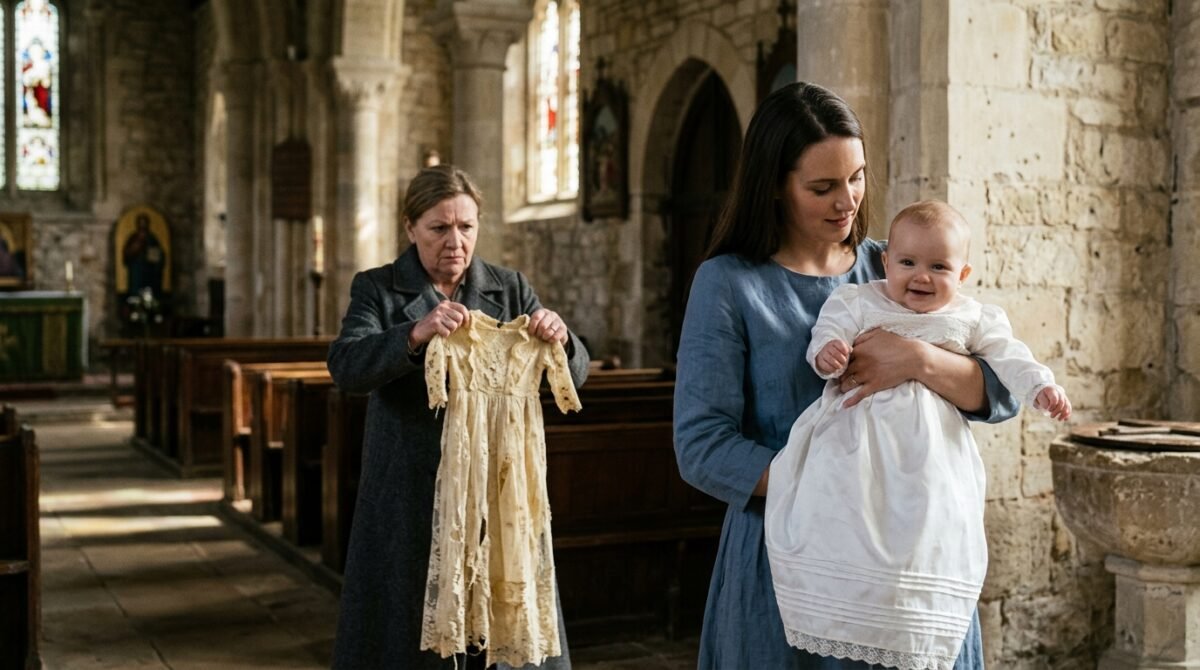
When we decided to have our son baptized, the vision in my head was one of peace, family, and a beautiful milestone in our lives. I wanted everything to be perfect, from the flowers at the front of the church to the quiet dignity of the ceremony. However, I severely underestimated the level of entitlement my sister-in-law, Brenda, felt toward our family traditions—specifically, a gown that looked like it had survived a war and lost.
Brenda, the self-appointed guardian of ‘family values,’ has always been the type to insert herself into our parenting choices. But this felt different. This was supposed to be a day for our son, not a performance piece for her nostalgia. The robe in question had been worn by her, her brothers, and her children. It was a yellowed, fragile relic of lace and silk that smelled perpetually of mothballs and neglect. When I told her I had purchased a new, elegant robe, I expected a minor grumble. I did not expect the war that followed.
The tension didn’t start at the church doors. It began weeks prior, in the quiet, passive-aggressive corners of our family group chat. Every mention of the christening was met with a reminder of the ‘tradition’ that I was apparently desecrating. I wanted to be respectful, but there is a point where respect stops and insanity begins. I was not going to dress my son in a piece of fabric that looked like it would disintegrate upon contact with holy water.
Little did I know that Brenda wasn’t just planning to sulk. She was planning a public intervention. The conflict was not just about a piece of clothing; it was about power, control, and the strange, suffocating grip that some family members feel they have over the lives of their siblings-in-law. By the time Sunday arrived, the air in the church felt heavy, not just with incense, but with the impending explosion of Brenda’s misplaced sense of superiority.
As we stood near the baptismal font, the scene unfolded in a way that I still find difficult to process. Looking back, I should have seen the signs. I should have realized that for people like Brenda, a boundary is just a suggestion. But as I held my son in his soft, clean, custom-made robe, I was entirely unprepared for the moment she would decide to tear the family apart over a handful of frayed threads.
The Initial Ultimatum over Messenger

The first sign of trouble arrived on a Tuesday evening, delivered via a passive-aggressive group chat notification. I had just finished putting the baby down for a nap when my phone buzzed with a message from Brenda. It wasn’t a question; it was a demand wrapped in the guise of a suggestion. She had clearly been waiting for me to make the first move, and the moment I posted a photo of the new robe I’d bought, the gloves came off.
The message was long, detailed, and dripping with the kind of condescension that only family members can truly master. She spoke about the ‘sanctity’ of the heirloom, claiming that my choice to buy something new was a direct insult to the entire lineage of our family. She argued that the gown represented decades of history and that by ignoring it, I was effectively erasing our child’s connection to his ancestors. It was dramatic, hyperbolic, and entirely exhausting to read.
“It is truly heartbreaking to see you discard the lace gown that has been in our family for over sixty years. It’s not just a robe; it’s our history. Don’t you care about your son having that connection?”
— Brenda, via Family Group Chat
I replied as politely as I could, noting that the gown was in poor condition and that I wanted something that felt clean and special for our child. I thought that would be the end of it. I was wrong. The argument escalated quickly, with Brenda calling me ‘selfish’ and ‘materialistic’ for prioritizing a store-bought item over a ‘meaningful’ heirloom. She seemed unable to comprehend that a piece of clothing that had literally developed holes was not a suitable garment for an infant.
My husband, Mark, tried to intervene, but his attempts to defend me only fueled her rage. She started sending photos of herself and her brothers in that same yellowed lace from the late 80s, as if the visual proof of past generations wearing it somehow negated the fact that the fabric was now decaying. The conversation devolved into a series of screenshots and voice notes where she accused me of trying to ‘rewrite’ the family narrative. I started to wonder if this was ever really about the christening at all, or if it was just about her being unable to let go of her perceived authority over my home.
The Morning of the Incident

Sunday morning dawned with a quiet, uneasy tension. We were running slightly behind schedule, which only added to the frantic energy in our house. Mark was trying to keep the baby calm, while I was double-checking our bags, desperately hoping that the day would go off without a hitch. I felt a knot of anxiety in my stomach that had nothing to do with the ceremony itself and everything to do with the looming presence of my sister-in-law. I knew she was the type of person who wouldn’t just accept defeat—she would double down.
When we finally arrived at the church, the air felt thick with anticipation. The sunlight streaming through the stained glass windows cast long, colorful shadows on the stone floor, but my focus was entirely on the church entrance. Brenda was already there, hovering near the vestibule with her husband and kids. She looked at me, then at my son, and finally, she looked at the robe. Her eyes narrowed in a way that made me instantly alert. She didn’t say a word, but her posture screamed judgment.
I kept my head held high, walking toward the pews with Mark by my side. I tried to ignore the way Brenda followed us with her gaze, her lips pressed into a thin, tight line. I felt like I was being hunted. I had spent so much time preparing for this day, imagining the joy and the celebration, and instead, I felt like a trespasser in my own family’s event. I gripped the baby a little tighter, hoping that the holiness of the space would keep the conflict at bay.
“I see you’ve decided to go through with it. Just remember, once you make this choice, you can’t take it back. You’re choosing to throw away your heritage.”
— Brenda, standing in the church entrance
Her words were sharp, whispered just loudly enough for me to hear as we passed. I didn’t respond. I kept walking, focused on finding our seats. The church was slowly filling up, and I could hear the low murmur of other families talking. It was a stark contrast to the cold, icy silence that Brenda had cultivated around me. I realized then that she hadn’t come to support us; she had come to witness what she considered a transgression.
The Moment the Fabric Failed
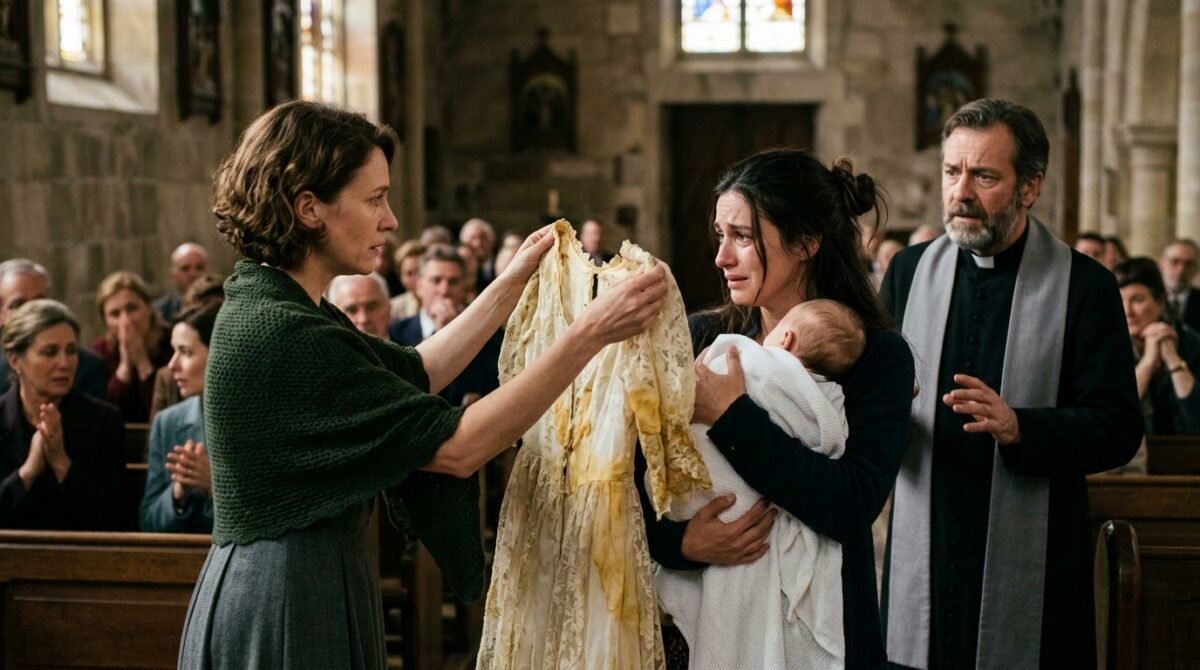
The ceremony began, and for a few minutes, there was peace. The soft chanting of the choir and the smell of frankincense helped to drown out the anxiety that had been building in my chest. I watched as the priest prepared for the baptism, his movements slow and deliberate. Everything felt sacred and meaningful, just as I had hoped. But then, as the priest turned toward us, I heard a sudden, sharp rustle behind me. I turned around to see Brenda holding that infamous moth-eaten robe, her hands shaking slightly.
She stepped forward, interrupting the flow of the ceremony, and held the garment out toward me. It was even worse in the daylight than it had been in the photos. The lace was yellowed to an almost brown hue, and I could clearly see the frayed edges where the fabric had begun to split. She stood there, in the middle of the aisle, demanding that I swap the robes right then and there. The entire congregation went silent, the tension in the room becoming palpable.
The priest paused, looking from me to Brenda with a mix of confusion and annoyance. I could see Mark’s face flushing with embarrassment, his hands clenching at his sides. I felt a surge of adrenaline, my heart pounding in my ears. I wasn’t going to let her ruin this. I stood my ground, clutching my son, and politely but firmly refused. She didn’t listen. She stepped closer, invading my personal space, and started to plead, her voice rising in pitch.
“You don’t understand! This is for the baby! You are being selfish, you are ruining the tradition! Just give him to me, let me put it on him, please!”
— Brenda, disrupting the baptismal service
The situation had gone from uncomfortable to absurd. People in the pews were whispering, and the judgment in the room was shifting from me to her. But Brenda seemed oblivious. She was so consumed by her own narrative, her own need to control the situation, that she had completely lost touch with reality. I didn’t back down, and I certainly didn’t hand over my son. That was the moment I realized she wasn’t just being difficult; she was truly unhinged.
The Public Meltdown
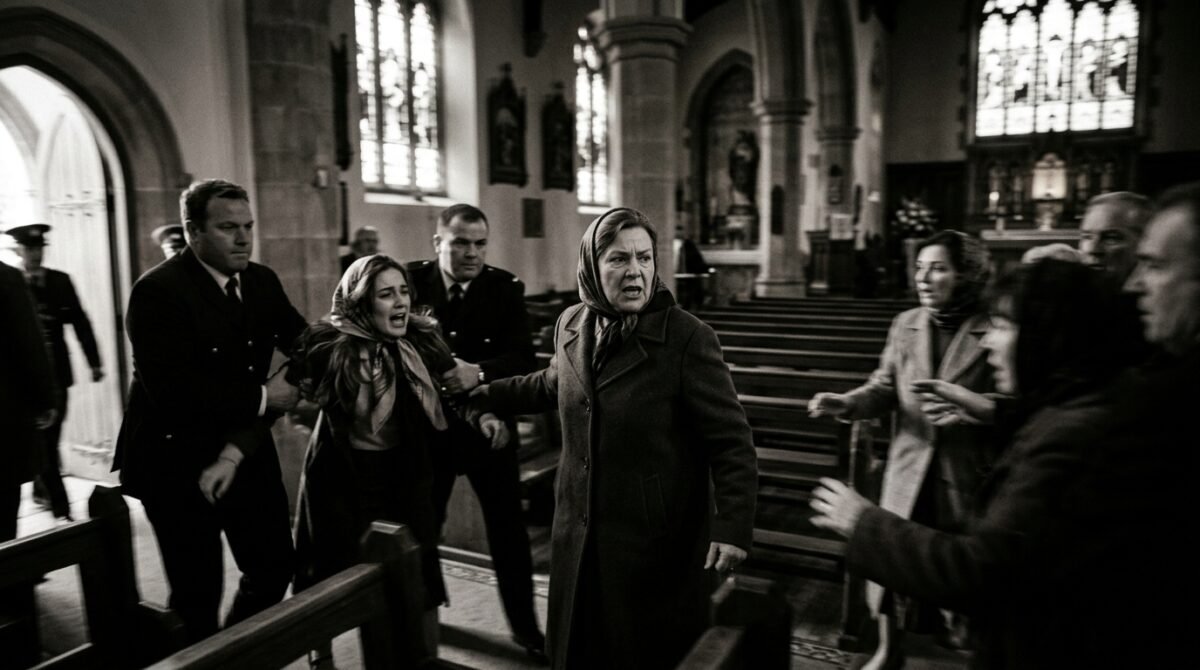
When I refused to swap the robes, Brenda didn’t just walk away. She snapped. It was as if a dam had burst, and all of her repressed anger, her entitlement, and her bizarre obsession with that crumbling piece of lace came pouring out in the middle of the church. She started shouting, her voice echoing off the vaulted ceilings. She accused me of being an ‘outsider’ who didn’t respect ‘real’ family, her words laced with a vitriol that left the entire room in shock.
I watched as she threw the robe onto the floor, the fabric hitting the stone with a soft, pathetic sound. It was the ultimate display of theater. She was sobbing, but it didn’t feel like genuine grief; it felt like a calculated move to humiliate me. The priest finally stepped in, his voice firm and authoritative, demanding that she leave the sanctuary. Mark grabbed her arm, trying to lead her toward the door, but she fought him, flailing and screaming that she was the only one who cared about the family.
The humiliation was absolute. I stood there, frozen, holding my son, while my sister-in-law made a scene that would be talked about in our family for decades. I felt a strange sense of detachment, as if I were watching a movie about someone else’s nightmare. The congregation was watching with a mix of pity and horror. It was the most public display of toxicity I had ever witnessed, and it was happening at my son’s baptism.
“You’ll regret this! You think you’re better than us? You’re tearing this family apart over a piece of cheap store-bought garbage! Everyone needs to see what you’ve done!”
— Brenda, screaming before being escorted out
When she was finally out, the silence that followed was heavier than the noise she had created. The priest looked at me, gave a brief, sympathetic nod, and then turned back to the altar to continue the service. We finished the baptism, but the magic had been completely drained from the day. I was shaking, my mind racing, trying to process exactly what had just happened and how we were supposed to move forward.
The Aftermath and the Family Fallout

The rest of the day was a blur of hushed conversations and awkward silences. We skipped the reception. I couldn’t handle the thought of being in a room full of relatives who had just witnessed Brenda’s meltdown. We went straight home, locked the doors, and sat in the quiet, trying to make sense of the debris left behind. My phone didn’t stop buzzing for hours. Messages, calls, voicemails—all of them from family members who felt the need to weigh in.
The family was divided. Some of them, mostly Brenda’s inner circle, were messaging me to tell me I should have just ‘given in’ to keep the peace. They argued that it would have been easier to just humor her for five minutes, that I had prioritized my own ego over family harmony. It was infuriating. I hadn’t asked for this. I hadn’t invited this drama. I had simply wanted my son to have a nice baptism in a clean, new robe.
Others were horrified by her behavior. They reached out to check on us, apologizing for her actions and acknowledging how completely out of line she had been. It was a strange, polarized experience. I realized then that Brenda had been manipulating the family dynamic for a long time, and this incident had finally forced everyone to pick a side. I didn’t want sides; I just wanted to be done with the entire situation.
“You just had to apologize. If you had just worn the robe for ten minutes, none of this would have happened. You’re just as responsible for this scene as she is.”
— A text from a family member, 4:30 PM
Mark was furious. He didn’t defend his sister once. He spent the evening calling his parents and telling them that we were going no-contact with Brenda until she apologized for the scene she caused. It was a hard boundary to set, but it felt necessary. We were done being the targets of her projections. The house felt like a tomb that night, and as I looked at my baby sleeping in his crib, I felt a deep sense of resolve. I had done the right thing, even if it cost us our peace for the time being.
The Reddit Community Weighs In

When I finally posted about the situation on a popular sub-reddit, I wasn’t expecting the outpouring of support. I just wanted to know if I was truly the villain for choosing a new robe. Within hours, the post had thousands of comments. The consensus was overwhelming, but the debate was fascinating. People from all over the world shared stories of their own ‘heirloom’ nightmares, highlighting how often family traditions are used as weapons of control.
The community was ruthless toward Brenda. Many pointed out that her behavior was a textbook example of boundary-stomping and that the ‘heirloom’ was just a prop for her need for attention. Some even analyzed the psychology of the situation, noting that by forcing me to wear the robe, she was trying to force me to acknowledge her status as the matriarch of the family. It was validating to see that I wasn’t the only one who saw through her ‘tradition’ defense.
“NTA. If a tradition is literally rotting, it is no longer a tradition—it’s a health hazard. She didn’t want a baptism; she wanted a stage for her main character syndrome. Good on you for not giving in.”
— u/FamilyDramaExpert (Top Comment, 18.2k upvotes)
There were, however, a few dissenting voices. A small minority argued that I should have been more sensitive to the history of the robe, even if it was in bad shape. They suggested that I could have perhaps worn the new robe for the pictures and then draped the old one over the baby for a quick moment to ‘appease the ghosts.’ I found these comments frustrating, but they gave me a window into the kind of thinking that had allowed Brenda to behave that way for so long.
The thread became a repository for stories of toxic family dynamics, and I found myself reading through them for hours. It was a strange comfort, knowing that so many people had navigated these kinds of waters. It also solidified my decision to keep the boundary firm. The internet, for all its chaos, had provided me with the objective perspective I needed to stop doubting my own choices.
Reflecting on the ‘Heirloom’ Narrative

Why did she care so much about that piece of cloth? I thought about it for days, long after the initial shock had worn off. It was never about the robe. It was about the fact that she couldn’t control me. She had a specific image of how she wanted our family to function, and I was not part of that script. The robe was a symbol—a physical manifestation of the expectations she placed on everyone in our circle. By rejecting the robe, I was rejecting her vision.
I looked at the photos of the old robe one last time, really looking at them. It wasn’t ‘historic’ in any meaningful way. It was just a thin, cheap piece of lace that someone had bought at a department store in 1960. There was no deep, magical connection to our ancestors. It was just an object. Brenda had romanticized it to the point of absurdity, creating a narrative that made it seem like a sacred relic. It was a classic case of emotional hoarding.
The realization was liberating. I had spent so much time feeling guilty for ‘ruining’ a tradition, but there was no tradition to ruin. There was only Brenda’s ego. Once I stripped away the drama and the sentimentality, the reality was stark and simple. I had not done anything wrong. I had made a practical, loving choice for my son, and I had stood up to someone who was trying to bully me into submission.
“Tradition is just peer pressure from dead people. Don’t let the past dictate your present, especially when that ‘past’ is just a moldy piece of fabric.”
— u/ClearPerspective (4.5k upvotes)
I felt a new sense of agency. The incident had changed the way I viewed my relationship with Brenda. It was no longer a relationship between two equals; it was a struggle for power, and I now knew exactly where I stood. I was not going to let her dictate my parenting choices, my traditions, or my sense of self-worth. It was the hardest lesson I had ever learned, but it was also the most valuable.
The Choice to Set Hard Boundaries

A week after the incident, we decided to take the next step. We sent a clear, firm message to Brenda. We told her that her behavior in the church was unacceptable and that we would be taking a step back from the relationship. We didn’t ask for her permission, and we didn’t offer any room for debate. We stated that we needed space to heal and that we would only consider re-engaging when she took full accountability for her actions.
The reaction was predictable. She didn’t apologize. Instead, she claimed that she was the victim, that she was just ‘trying to help’ and that we were the ones being cold and distant. It was a masterclass in gaslighting. She tried to enlist our mutual friends to intervene, but for the most part, they stayed out of it. They had seen the video that someone had recorded, and they knew exactly who was in the wrong.
We stayed firm. We didn’t engage in the back-and-forth. We knew that any response would just provide her with more ammunition. We kept our peace, focused on our family, and stopped checking the family group chat. It was a difficult transition, but it was also the most peaceful we had felt in months. We were finally living our lives on our own terms, without the shadow of someone else’s expectations hanging over us.
“The boundaries we set are not walls, but the doors through which we protect our peace. Do not feel guilty for closing them on someone who refuses to respect you.”
— A supportive message from a friend
We realized that we couldn’t change her. We couldn’t make her understand why her behavior was wrong, and we couldn’t make her care about our feelings. We could only control how we reacted to her. By setting this boundary, we were choosing our own sanity over her approval. It was a turning point, not just for the baptism, but for the future of our family.
The New Tradition Begins

Months later, I look back on the baptism not as a failure, but as a beginning. We have started our own traditions, ones that are meaningful to us and that we can share with our son as he grows. We bought a beautiful, high-quality christening gown that we will take care of, not because we are obsessed with it, but because it represents a happy day and a conscious choice. If he wants to wear it for his own children, he can, but I will never force it on him.
The dynamic with the rest of the family has shifted. Many of them have realized that they don’t have to follow Brenda’s lead, and they have started to distance themselves from her outbursts as well. It’s created a much healthier environment for everyone. We’ve found that by standing up for ourselves, we’ve actually empowered others to set their own boundaries. It’s been a ripple effect that I never anticipated.
I still think about that day in the church. I still feel a bit of embarrassment when I think about the screaming and the chaos. But then I look at my son, and I remember that he was safe, he was loved, and he was the center of our world that day. That is all that really matters. The drama was just noise; the love was the real story.
“Tradition is the gift we choose to pass on, not the burden we are forced to carry. You made the right choice for your family’s future.”
— A final note of support from a reader
We are in a good place now. We have learned that family isn’t just about blood or history; it’s about respect, boundaries, and the shared joy of the present. We aren’t perfect, but we are ours. And that is enough.
Reflecting on the Lessons Learned

Looking back, the most important lesson I learned is that people will only treat you the way you allow them to treat you. I had let Brenda walk over me for years, and it had culminated in that explosive scene at the church. I was so worried about not offending anyone that I lost sight of my own needs. I learned that you cannot keep everyone happy, and trying to do so is a recipe for disaster.
The secondary lesson was about the nature of ‘heirlooms’ and ‘traditions.’ They are often used as tools of manipulation, designed to make you feel guilty for doing things your own way. I have learned to look past the sentimentality and ask myself if something truly adds value to my life or if it’s just a weight. If it’s a weight, I’m not carrying it anymore. Life is too short to be burdened by other people’s expectations.
Finally, I learned the importance of having a united front. Mark and I had to be on the same page, and once we were, we were unstoppable. We faced the fallout together, we stood our ground together, and we moved forward together. That unity is the foundation of our family now, and it’s something I will never take for granted.
“When you stop trying to please everyone, you finally have the freedom to be yourself. Stand your ground and don’t look back.”
— A wise, final piece of advice from the community
We are stronger for having gone through it. It was a painful, humiliating experience, but it led us to a more authentic, independent life. I wouldn’t wish that kind of drama on anyone, but I am grateful for the clarity it brought us. We are finally in control of our own narrative.
Conclusion
In the end, the conflict wasn’t about a piece of lace; it was about the struggle for autonomy within a family dynamic. I chose to prioritize my son’s comfort and my own peace over the hollow, decaying traditions that were being forced upon me. The fallout was severe, but it was necessary to establish the boundaries that our family needed to thrive.
I hope that by sharing this story, others who are dealing with similar pressures will feel empowered to speak up for themselves. You are not a vessel for someone else’s nostalgia. You are the architect of your own family’s traditions. Sometimes, that means walking away from the things that others hold dear, and that is perfectly okay.
What about you? Have you ever had a family member attempt to force a ‘tradition’ on you that made you feel uncomfortable or disrespected? How did you handle it? Let’s keep the conversation going in the comments below—I’d love to hear your stories of boundary setting and family drama.
What's your verdict on this dilemma?
Vote below to contribute to the official community consensus.

Have a Dilemma Keeping You Up at Night?
Share your real-life feud, wedding chaos, or relationship crossroads anonymously with our editorial team.
What do you think ?
0 Comments🛡️ Comments are moderated to protect community integrity. Your comment will appear once approved by the editorial team.