
Grief is supposed to be a unifying force, a time when families set aside petty grievances to honor the person they lost. But in our family, grief was a weapon, and my brother, Marcus, had been sharpening it for years. When our mother finally passed away after a long, grueling battle with illness, I expected the typical emotional fallout. I didn’t expect to be told that she died destitute, a woman who had spent forty years building a successful real estate empire from the ground up.
Marcus stood in the center of our childhood living room, his face carefully composed into a mask of mourning, telling our extended family that mom had been forced to liquidate her assets just to cover her final medical bills. He even had the audacity to suggest a GoFundMe to cover the funeral costs. I watched him, sickened, knowing that he had spent the last two years systematically draining her accounts while she was too medicated to notice.
The moral dilemma I faced was simple but terrifying: Do I honor my mother’s dying wish to keep the peace, or do I burn the entire family structure to the ground to expose a thief? The weight of this choice pressed down on me for weeks leading up to the final reading of the will. I wasn’t just fighting for money; I was fighting for the truth of my mother’s legacy, which Marcus was attempting to rewrite into a tragedy of poverty and failure.
I began my investigation with nothing more than a hunch and a few misplaced bank statements I had found while clearing out her home office. The rabbit hole went deeper than I ever imagined, leading me to a complex web of offshore shell corporations based in the Cayman Islands. Marcus wasn’t just stealing; he was laundering, hiding millions in assets under the guise of ‘consulting fees’ paid to entities he secretly controlled.
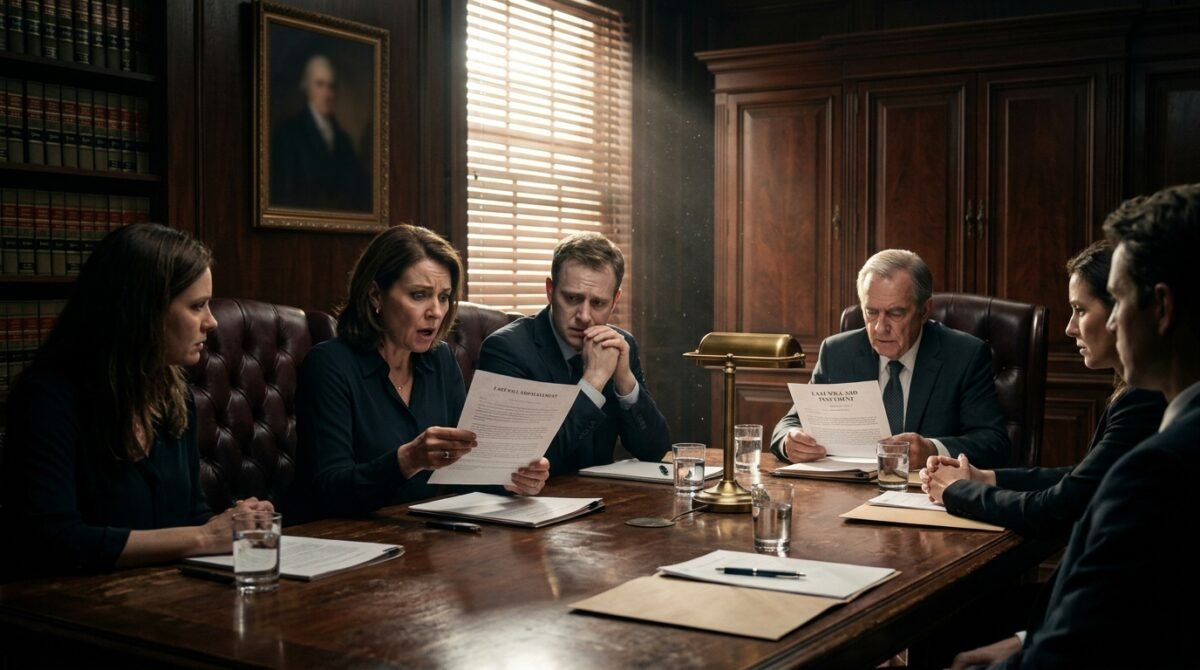
When the day of the will reading finally arrived, the air in the lawyer’s office was heavy with tension. Marcus arrived in a bespoke suit, looking every bit the grieving son, ready to finalize his dominance over our family’s assets. He didn’t know that I had spent the last seventy-two hours in a state of hyper-focused preparation, ready to deliver the evidence that would strip his mask away for good.
The Performance of the Destitute Son

Marcus’s performance was nothing short of Oscar-worthy. He sat at the head of the long, polished table, clutching a silk handkerchief that he frequently pressed to his eyes. He sighed heavily, looking at our aunts and cousins with a gaze of profound, manufactured exhaustion. He spoke in hushed, reverent tones about how hard it was to be the only one present for our mother’s final days, implying that I had been absent and uncaring.
“I just don’t know how we are going to manage the burial costs,” he whimpered to our Aunt Susan. “Mom spent everything—every last penny—trying to keep her head above water. The real estate market collapse in 2021 really destroyed her portfolio. It’s devastating to see her life’s work end in such a quiet, sad way.”
“I’ve had to make some incredibly difficult decisions just to keep the lights on in her house for the past three months. It breaks my heart that she had nothing left to leave us, not even a memento.”
— Marcus, during the pre-will reading gathering
I sat across from him, my hands folded tightly in my lap, feeling the sharp corner of the flash drive in my pocket. It contained the digital trail of a shell company named ‘Mar-Holdings Ltd,’ which had received over four million dollars in transfers from our mother’s primary holding company in the six months before she died. I had verified the registration, the directors, and the bank accounts. It was his company, and he had been bleeding her dry while she was in hospice.
The lawyer, Mr. Henderson, entered the room with a stack of documents that seemed far too thin for the estate I knew existed. Marcus gave him a tight, knowing smile, a look that suggested they were already on the same page. I felt a surge of adrenaline, the kind that happens just before a long-expected storm breaks. My heart was pounding, but my resolve was absolute; today, the lie ended.
The Lawyer’s Manufactured Reality

Mr. Henderson cleared his throat and adjusted his spectacles. He looked at us with a practiced, somber expression, the kind of face he likely practiced in the mirror before coming to work. He began to read the preamble of the will, a document that contained legal boilerplate about the ‘diminished estate’ and the ‘unforeseen financial hardships’ that had supposedly plagued my mother in her final years.
“Due to the exhaustive medical expenditures and the lack of liquid assets remaining in the estate,” Henderson drone on, “the deceased has expressed that there is no property or capital to distribute to the heirs. All debts incurred during the final year are to be settled by the executor, Marcus, via the sale of remaining personal effects.”
“This is standard for these types of cases, I’m afraid. The medical system is a vacuum. Your mother’s portfolio was simply not as robust as you all believed.”
— Mr. Henderson, the estate attorney
I watched as Marcus nodded solemnly, his hand resting on the table as if he were carrying the weight of the world. It was a masterclass in manipulation. My cousins were whispering, expressing their sympathy for the ‘poverty’ of our aunt, unaware that they were being played by a man who had already bought a new Porsche with their potential inheritance. I knew that if I waited any longer, the estate would be declared insolvent, the house would be sold, and the evidence would be buried forever.
I stood up slowly, the silence in the room becoming suffocating. Mr. Henderson looked annoyed at the interruption, his voice trailing off mid-sentence. Marcus looked at me, a flicker of genuine irritation crossing his face, his ‘grieving’ persona momentarily slipping. He didn’t know what was coming, but he knew I wasn’t there to sign off on his fabricated poverty.
The Flash Drive Heard ‘Round the World

I walked over to the AV system in the corner of the room. I didn’t care about the decorum of the lawyer’s office anymore. I plugged the flash drive into the HDMI-linked television mounted on the wall. Marcus stood up, his face reddening. “What are you doing? This is a private legal proceeding. Sit down right now, you’re making a scene.”
I ignored him, my fingers flying across the laptop keyboard. “You’re right, Marcus. This is a legal proceeding. And since you’ve presented a document claiming the estate is bankrupt, I think the heirs have a right to see the forensic accounting that proves otherwise. Or should I say, the accounting that proves where the money actually went?”
“I have the bank records for Mar-Holdings Ltd. It’s an interesting name, Marcus. Does it stand for Marcus or Mother? Because it seems to have swallowed four million dollars of her money.”
— My statement to the room during the will reading
The screen flickered to life, showing a spreadsheet of bank transfers, offshore routing numbers, and signatures on digital documents that bore his IP address. The room went dead silent. Mr. Henderson’s face went pale; he must have known about the transfers, or perhaps he had been incompetent enough to miss them, but the look of shock on his face suggested he was as blindsided by my preparation as anyone else.
Marcus lunged for the laptop, but I had already locked the screen. He was panting, his composure shattered, the veneer of the ‘destitute son’ replaced by the frantic energy of a cornered animal. He looked at the family members in the room—our aunts, our cousins—who were now staring at the screen with mouths agape, their sympathy turning into a cold, hard confusion.
The Collapse of the Shell Game

The fallout was immediate. My aunt Susan stood up, walking toward the screen to read the figures herself. She was a retired accountant, and the moment she saw the routing numbers, she knew exactly what she was looking at. “These are offshore accounts, Marcus. These aren’t medical bills. These are private equity injections into a shell company. You stole from her.”
Marcus tried to stammer out an excuse, something about ‘investment hedging’ and ‘tax protection,’ but the words fell flat. He looked around the room, hoping for an ally, but he found none. Even the lawyer was pulling his files away, sensing that he was about to be implicated in a massive fraud case. The room felt like a battlefield, the casualties being Marcus’s reputation and his freedom.
“I was protecting her assets! The market was going to crash! You don’t understand, I was trying to save it for the family!”
— Marcus, attempting to justify the theft
I didn’t let him finish. I walked back to my seat, feeling a strange, hollow sense of peace. The truth was out, and for the first time in years, the crushing weight of his lies was lifted. I had the evidence, the witnesses, and the legal standing to initiate a full audit. The estate was not bankrupt; it was merely hidden, and I had the map to find it all.
Marcus left the room shortly after, chased by the questions of his own family. He didn’t even pack his things; he just walked out, leaving his briefcase and his pride on the floor. I watched him go, knowing that the real legal battle was just beginning, but for this moment, in this room, justice had been served in the most spectacular, public fashion possible.
The Aftermath: Legal Tides Turning

The following weeks were a whirlwind of activity. I had to retain an independent forensic accountant to track every cent that Marcus had moved. The investigation revealed that the shell company wasn’t just a simple holding account; it was a sophisticated operation that Marcus had been running for years. He had even used our mother’s credit lines to fund speculative trades, leaving the estate with massive liabilities he had intended for us to pay off.
My relationship with Marcus had reached the point of no return. He sent me dozens of messages, ranging from pathetic pleas to outright threats, all of which I forwarded to my legal team. He tried to claim that mom had signed off on every transfer, a claim that was easily debunked by the medical records showing her cognitive decline during the months in question.
“You’re going to destroy the family name, you realize that, right? If you press charges, we all lose. The media will have a field day with the ‘Real Estate Empress’ scandal. Is that what you want?”
— A text message from Marcus, 2:00 AM
I realized then that his only strategy was fear. He thought that by threatening me with ‘scandal,’ I would back down and let him keep his ill-gotten gains. He didn’t realize that I had already prepared a statement for the press, a detailed account of his actions that would ensure he was seen as the villain, not our mother. I wasn’t just holding the cards; I was the one shuffling the deck.
The legal process, while slow, was relentless. The court froze the assets of the shell company within ten days of the filing. It was the first time I felt like I could breathe. The money was being recovered, and more importantly, the truth of my mother’s final months was becoming clear. She had been a victim of financial abuse, and we were going to make sure that the world knew she had been exploited by her own son.
Reddit Weighs In: The Community Verdict

I posted a summary of the situation on a popular legal-advice forum, wanting to see if I was missing any obvious pitfalls before the trial. The response was overwhelming. Within hours, the post had reached the front page, with thousands of people weighing in on the situation. The consensus was clear: I had done the right thing, and I needed to be absolutely ruthless in my pursuit of justice.
“This is textbook financial abuse of the elderly. Do not show mercy. If you back down now, he will just continue to do this to others. You are not the one destroying the family; he destroyed it the moment he decided his mother’s health was less important than his offshore accounts.”
— u/LegalEagle88 (Top Comment, 32.1k upvotes)
The community was a source of unexpected strength. People shared their own stories of inheritance theft, and the advice I received regarding forensic experts and probate law proved to be invaluable. It was a reminder that even when you feel isolated by your family, there is a global community of people who understand the value of truth and accountability. I wasn’t alone in this, and that made all the difference.
I also encountered some ‘devils’ advocates’ in the comments who suggested that I should have handled it ‘privately’ to keep the family together. But these comments were quickly drowned out by the reality of the situation. You cannot keep a family together when one member is actively stealing the lifeblood of the others. The damage was done long ago; my actions were simply the necessary response to a long-standing poison.
The Final Confrontation

The final confrontation happened at the local courthouse, a place I had hoped never to visit again. Marcus looked hollow, his expensive suit now rumpled, his confidence replaced by a twitchy, nervous energy. He tried one last time to speak to me, whispering that we could ‘fix this’ if I just told the judge that it was a misunderstanding. I looked at him, not with anger, but with a profound, clinical pity.
“The time for fixing things ended when you decided to drain mom’s accounts while she was dying, Marcus. There’s nothing to fix. There’s only the accounting, and the judge will take care of that.” I didn’t raise my voice; I didn’t need to. The weight of the evidence spoke for itself, and he knew it.
“You’ve ruined everything. Everything! You think you’re so righteous, but you’re just a spiteful person who couldn’t handle that she trusted me more than you.”
— Marcus, outside the courtroom
It was his final attempt to gaslight me, a tactic that had worked for twenty years. But he was wrong. She hadn’t trusted him more; she had been vulnerable, and he had been a predator. The judge’s ruling, when it finally came, was decisive. The assets were ordered to be returned to the estate, and Marcus was removed as executor. He was also facing a criminal investigation that would likely lead to prison time.
Walking out of that courthouse, I felt a sense of clarity I hadn’t known in decades. The money was just money, but the truth—the truth was everything. I had stood up for the woman who raised me, and in doing so, I had finally broken free from the shadow of my brother’s manipulation. The family structure might be permanently changed, but it was now built on the bedrock of reality rather than the shifting sands of his lies.
The Healing Process

The aftermath of the trial was a long, slow period of healing. The estate was settled, the money returned, and I took the lead in ensuring that my mother’s wishes were finally carried out. We donated a significant portion of the inheritance to a charity that focuses on elder advocacy and fighting financial abuse. It felt like the perfect way to honor her legacy—turning a tragedy of theft into a source of protection for others.
I had to cut ties with some family members who still sided with Marcus, people who preferred the comfortable lie to the painful truth. It was difficult, but necessary. I learned that boundary setting isn’t just about what you say; it’s about who you choose to keep in your inner circle. My life became quieter, but it was also more authentic. I was no longer defined by the drama of my brother’s machinations.
“I don’t miss the chaos. I don’t miss the suspicion. I miss the mother I knew before the illness, but I have found a new way to honor her memory that isn’t dependent on family approval.”
— Reflection from my personal journal
I started therapy to deal with the years of gaslighting I had endured. It was a slow process, but it helped me understand that I was never the problem. My brother’s actions were always about him, his greed, and his need for control. Understanding that allowed me to let go of the anger and focus on building a life that was entirely my own, one that wasn’t subservient to the needs of a toxic family unit.
Today, I am in a good place. I have a career I love, a home that feels like my own, and a sense of peace that I once thought was impossible. The story of what happened during the will reading has become a lesson for others, a reminder that the truth is always worth fighting for, no matter how uncomfortable it might make the people around you.
The Lessons Learned

If I could go back and change anything, I would have started the forensic audit the moment I suspected something was wrong. I wasted so much time trying to be ‘nice,’ trying to keep the peace, and trying to believe the best in my brother. I learned that ‘keeping the peace’ is often just a code word for letting someone else walk all over you. When it comes to family, the truth is the only thing that actually protects you.
I also learned the importance of financial literacy. If I hadn’t taken the time to understand the basics of corporate filings and offshore accounts, I never would have been able to expose him. Education is the ultimate form of self-defense. Everyone should know how to read a balance sheet and understand the basic principles of estate management; it’s not just about money, it’s about independence.
“Don’t wait for permission to stand up for yourself. If your gut is telling you that something is wrong, trust it. The people who tell you to ‘be the bigger person’ are usually the ones who want you to stay small.”
— My advice to anyone facing a similar situation
I am grateful for the outcome, even if the road there was painful. The experience forced me to grow in ways I didn’t think possible. I am stronger, more independent, and far more discerning about the people I allow into my life. The story of the shell corporation is behind me, but the lessons I learned are a permanent part of who I am today.
Looking back, I see the whole ordeal as a turning point. It was the moment I stopped being a passive observer of my own life and started being an active participant. It was the moment I realized that my voice mattered, that my actions had weight, and that the truth, no matter how explosive, is always worth the cost of the fire it creates.
Moving Forward: New Chapters

The final chapter of this story isn’t about the court case, but about what comes next. I am currently working on a project to help other families navigate the complexities of inheritance without falling into the traps of financial abuse. It’s a way to turn my own experience into something positive, a way to help others avoid the pain and the betrayal that I had to live through.
I have reconnected with family members who were willing to listen and understand, and we have built a new, healthier dynamic. It’s not the same as it was, and it never will be, but it’s real. We have moved past the drama and into a space of mutual respect. It’s a quiet, slow-moving change, but it’s exactly what I needed.
“Integrity is not about what you do when everyone is watching. It’s about what you do when you know you can get away with the lie, and you choose to tell the truth anyway.”
— A quote that defines my current philosophy
I still get the occasional message from Marcus, but I don’t respond. I have blocked him on every platform, and I have no interest in hearing his version of the truth. He is a part of my past, not my future. I have reclaimed my name, my mother’s legacy, and my own life. That is more than enough for me.
Thank you for listening to my story. It’s been a long journey, and sharing it feels like the final piece of the puzzle. I hope this helps anyone who is currently standing at their own crossroads, wondering if the truth is worth the explosion. Trust me—it is. The fire burns, yes, but what rises from the ashes is something much, much stronger.
Conclusion
My story serves as a stark reminder that beneath the surface of seemingly normal family interactions, greed and deception can fester for years. I chose to prioritize the truth over the comfort of a lie, and while the fallout was intense, it was the only way to ensure that my mother’s legacy remained intact. Sometimes, you have to be the one to light the match to see clearly in the dark.
Reflecting on this, I realize that the most important thing I gained wasn’t the money, but the ability to stand tall in my own reality. I am no longer afraid of the consequences of speaking the truth. I hope this account encourages you to trust your instincts, protect your interests, and never settle for a version of the truth that feels inherently wrong.
What about you? Have you ever had to choose between family peace and the hard truth? How do you think you would handle a betrayal this deep if it happened to you? Let’s talk about it in the comments below—I am curious to hear your experiences and your take on this explosive chapter of my life.
What's your verdict on this dilemma?
Vote below to contribute to the official community consensus.

Have a Dilemma Keeping You Up at Night?
Share your real-life feud, wedding chaos, or relationship crossroads anonymously with our editorial team.
What do you think ?
0 Comments🛡️ Comments are moderated to protect community integrity. Your comment will appear once approved by the editorial team.