
Living with roommates is a gamble, an exercise in tolerance, and often, a slow-motion car crash of differing expectations. I thought I had struck gold with Mark. He was quiet, worked in civil engineering, and seemed focused on his professional certification exams. We had a system: keep common areas clean, respect the personal boundaries of our private spaces, and stay out of each other’s culinary stash. That was the rule. It was simple, logical, and, I thought, foolproof.
The heirloom sourdough starter—affectionately named ‘Matilda’—was not just flour and water. It was a living, breathing connection to my great-grandmother, a bubbly, fermented relic that had crossed an ocean and survived wars. It lived in a hand-thrown stoneware crock that had been in our family for over a hundred years. I fed it every Friday like clockwork. It was a ritual of heritage, a quiet moment of mindfulness in a chaotic city life, and the secret behind the loaves I baked for family gatherings.
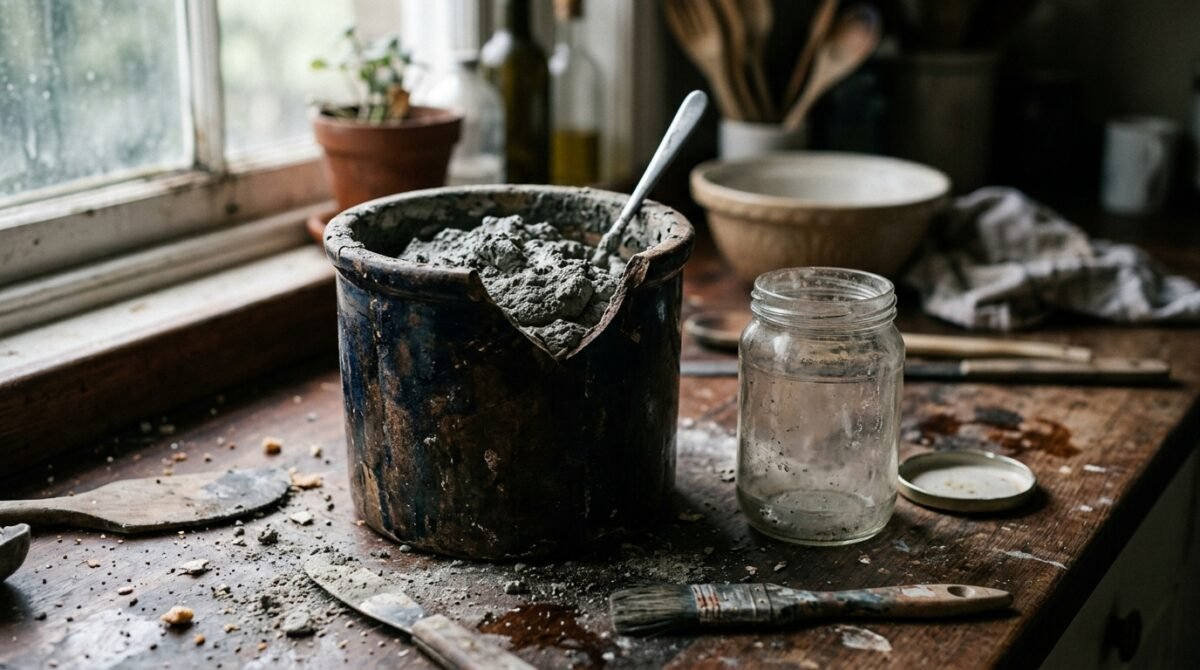
But for Mark, the crock was just another ‘container’ in a shared kitchen he clearly didn’t respect. I came home on a Tuesday afternoon to find my kitchen transformed into a hazardous materials zone. Dust—fine, grey, and ubiquitous—covered every surface. And sitting right there, on my butcher block island, was my precious, ancestral crock, now brimming with a hardened, industrial sludge of concrete samples he had been ‘testing’ for his upcoming project certification.
The silence in the apartment was deafening as the gravity of the situation settled in. The starter? Dumped into the sink. The crock? Permanently bonded to high-strength Portland cement. My heart didn’t just sink; it shattered into a thousand pieces. This wasn’t just a kitchen mishap; it was a profound act of erasure. And as I stared at the ruined vessel, I knew that our roommate agreement—and our relationship—was officially dead.
The Grey Dust of Betrayal

I walked through the door after a long shift, expecting the familiar scent of yeast and perhaps a lingering aroma of the coffee I’d brewed that morning. Instead, I was met with the dry, acrid smell of dust. My eyes tracked the mess from the entryway to the kitchen, where a fine layer of grey particulate covered everything: the toaster, the spice rack, and the pristine white countertops I had scrubbed just that morning. It looked as if a construction site had exploded in our modest apartment.
My feet crunched on the floorboards as I approached the center island. That’s when I saw it. My grandmother’s stoneware crock, the one with the slight chip on the rim that told a story of a move across the Atlantic in 1948, was sitting there. But it wasn’t holding Matilda. It was filled to the brim with a thick, hardening grey paste. Concrete. Industrial-grade, rapid-set concrete, currently binding itself to the porous interior of my family’s heirloom.
I felt a physical wave of nausea. I scrambled to the sink, hoping against hope that he had perhaps moved the starter into another container, but my heart dropped when I saw the drain. A thick, gelatinous grey film coated the stainless steel, swirling with the remnants of my great-grandmother’s legacy. It had been washed away, as if it were nothing more than spoiled milk or old dishwater. The sheer, calculated disregard made my hands shake with a rage I hadn’t felt in years.
“Mark? Are you home? What in the hell is this on my counter, and where is my sourdough starter?”
— Me, screaming into the empty apartment
I didn’t wait for him to arrive. I took photos—dozens of them. I documented the concrete-filled crock, the mess on the floor, the remnants in the drain, and the empty space in the fridge where my dedicated flour supplies used to sit. I needed evidence, because I knew that when Mark walked through that door, he would try to gaslight me. He would tell me it was just ‘some yeast,’ or that he thought it was ‘garbage,’ or worse, that he was doing me a favor by cleaning the crock for me.
I retreated to my room, locking the door behind me. I could hear the faint sound of his key in the lock about twenty minutes later. He didn’t say hello. He didn’t call out. He just walked straight into the kitchen, whistling a tune, oblivious to the fact that his ‘work project’ had just triggered a total breakdown in our cohabitation. I sat there in the dark, clutching my phone, waiting for the inevitable confrontation that would define the rest of our lease.
The Audacity of the Explanation
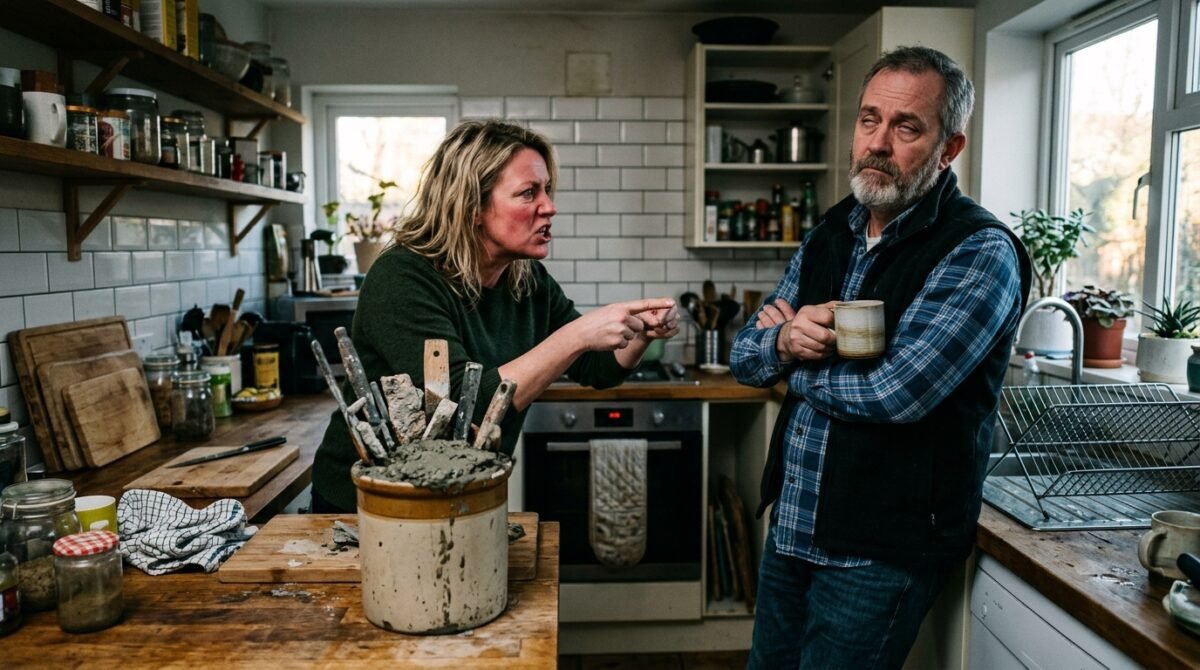
When I finally emerged from my room, Mark was busy scraping the edge of the counter with a putty knife. He looked up, his face painted with a look of mild annoyance, as if my presence were the inconvenience. I stood there, arms crossed, waiting for him to notice the absolute carnage he had unleashed. I had the photos saved in a folder marked ‘Evidence,’ and I was ready to use them.
“Oh, hey,” he said, not pausing his scraping. “The kitchen’s a bit of a disaster, I know. I had a deadline for my certification lab, and I needed a sturdy container for these cure-rate samples. I found this old jar in the back of the pantry—looked pretty sturdy, so I used it. I’ll scrub it out once the samples finish setting tomorrow. No big deal, right?”
I felt my pulse spike. ‘No big deal?’ He had genuinely convinced himself that he had just liberated a bit of cupboard space. He had no idea that he had destroyed something older than both of us combined. I walked over to the island and tapped the side of the crock. The sound was a dull, heavy thud—the sound of concrete, not stoneware.
“Mark, that was not an old jar. That was a 100-year-old heirloom. It held a sourdough starter that has been in my family for over a century. You didn’t just ‘use’ it; you destroyed an irreplaceable piece of my history.”
— Me, trying to keep my voice from cracking
He stopped scraping and looked at the crock, then back at me. A smirk tugged at the corner of his mouth—the kind of patronizing, ‘you’re being dramatic’ expression that makes your blood boil. He actually laughed. He chuckled, a low, dismissive sound that filled the room. ‘It’s flour, man. It’s literal yeast and water. You’re acting like I burned down the house. You can just go to the store and buy a packet of Fleischmann’s, can’t you? Or just start over. It’s not like it’s rocket science.’”
The sheer ignorance was staggering. He didn’t understand the concept of a lineage culture, or the time, effort, and care that goes into maintaining a living ecosystem. To him, everything in life was a commodity that could be bought or replaced. He looked back at his concrete samples as if they were the true priority, completely dismissing my grief as a minor annoyance. That was the moment I realized I wasn’t just dealing with a messy roommate; I was dealing with a person who lacked the basic fundamental respect required for shared living.
I turned around and walked back to my room, not saying another word. Any argument I could have made would have fallen on deaf ears. He had his concrete, he had his ego, and he had his utter lack of conscience. I needed a different strategy, one that involved legal advice, landlord intervention, and perhaps the coldest version of ‘silent treatment’ he had ever experienced. I wasn’t going to win this by yelling; I was going to win it by making sure he knew exactly how much his stupidity was going to cost him.
The Digital Paper Trail

That night, I didn’t sleep. I spent the hours between midnight and 5:00 AM drafting a detailed timeline. I logged every interaction we’d had regarding kitchen usage, the initial house rules I’d typed up when we moved in, and the specific cost of replacing the stoneware—which, being an antique, was essentially priceless. I even started searching for similar crocks on eBay to get a baseline value for ‘damages.’ The price was high, but the sentimental value? That was something I had to articulate for the landlord.
I decided to reach out to our mutual friends and, eventually, our landlord, via email. I kept it professional, attaching the photos I had taken earlier. I knew Mark would try to spin this as a ‘small mishap,’ so I needed to frame it as a ‘violation of shared property’ and ‘property destruction.’ The language had to be precise, cold, and undeniable. I wasn’t being dramatic; I was being a victim of someone who treated common space like his own private workshop.
“Hey guys, quick update on the living situation. Mark decided to use my century-old heirloom stoneware for a construction project, effectively destroying it and the starter inside. I’m currently looking into my options regarding the lease and property damage. Keep this in mind if you ever consider sharing a space with him.”
— My message to our shared group chat
The response was immediate. The group chat, which usually only buzzed with memes and bar invitations, went nuclear. A few of our friends were horrified—they knew how much that sourdough meant to me. They had tasted the bread I baked for potlucks. But there were others, the ‘enablers,’ who started chiming in with the ‘it’s just sourdough’ defense. The divide was instantaneous and ugly.
Mark’s response in the chat was the final straw. He didn’t apologize. He doubled down. He claimed I was ‘harassing’ him over a ‘kitchen accident’ and threatened to go to the landlord himself to complain about my ‘hostile environment.’ He was trying to get ahead of the narrative, painting me as the aggressor. He didn’t realize that in the world of shared living, the person who destroys the other’s property is never the one who wins the sympathy of the group.
I watched the messages roll in—some supportive, some shocked, some gaslighting. I didn’t reply to a single one of them. I just let the silence sit, letting the facts speak for themselves. The photos were there, the evidence was clear, and the moral high ground was firmly in my court. I was going to turn this into a learning experience for everyone involved, especially for the guy who thought he could use my life as a utility closet.
The Landlord’s Intervention

Our landlord, Mrs. Gable, was an older woman who valued order above all else. She was the type of person who did quarterly inspections herself, checking the baseboards for dust and the sinks for leaks. When I sent her the photos of the concrete mess, I knew exactly which button to push. I didn’t talk about the sourdough; I talked about the structural integrity of the kitchen island, the potential for permanent damage to the plumbing, and the violation of the ‘no unauthorized construction’ clause in our lease.
She arrived at the apartment the next day at 9:00 AM sharp. Mark was at work, blissfully unaware that his laboratory was about to be dismantled. Mrs. Gable walked into the kitchen, her eyes widening as she took in the scene. She touched the hardened concrete on the counter, then looked at the crock, shaking her head. She had been the one to sign off on the granite countertops during the last renovation, and seeing them covered in construction dust was apparently her breaking point.
“This is unacceptable,” she muttered, pulling out her notebook. “The lease clearly states that no alterations or heavy industrial work is permitted inside the unit. And this damage to the countertop and the sink… this is coming out of the security deposit, or worse, I’m looking into legal remedies for property devaluation.”
“I am not responsible for his career choices, Mrs. Gable, but I am certainly not going to sit by while he destroys the things that make this house a home. I want this addressed immediately.”
— Me, speaking to the landlord
I felt a small, vindictive rush of satisfaction as she started writing down a list of violations. She was going to charge him for a professional cleaning crew, the potential repair of the granite, and a heavy fine for the violation of the house rules. He had wanted to save money by using my crock for his ‘lab,’ and now he was going to be paying for a high-end restoration project he couldn’t afford.
When Mark returned home that evening, he wasn’t met with my anger. He was met with a formal notice from the property management company, taped to his bedroom door. It detailed the fines, the requirement to vacate the common area immediately, and a stern warning that any further ‘industrial activities’ would result in immediate eviction. I watched from my doorway as his face fell, the smug confidence replaced by a look of sheer, panicked realization.
The Silent Treatment Warfare

Following the landlord’s intervention, the atmosphere in the apartment became thick enough to cut with a knife. Mark tried to initiate conversations, usually starting with a defensive ‘Can we just talk about this?’ or ‘You really had to call the landlord, didn’t you?’ I didn’t even look his way. I put on my noise-canceling headphones, fixed my dinner, and went back into my room. The silence wasn’t just a mood; it was a weapon.
He stopped trying to be the ‘cool, laid-back roommate’ and started acting like the petulant child he truly was. He began leaving his dishes in the sink for days, playing loud music late at night, and intentionally slamming doors. It was a pathetic display of a man losing control of his environment. Every move he made felt desperate, an attempt to provoke a reaction that I was simply not going to give him.
I kept a meticulous record of every passive-aggressive move he made. If he left a mess, I took a photo. If he was loud, I recorded the time and the noise level. I was building a case, not just for the landlord, but for my own exit strategy. I knew I couldn’t live here much longer. The trust was gone, the space felt violated, and the memory of Matilda—my sourdough—was tied to every inch of that kitchen. I wanted out, but I wanted to make sure he paid for the transition.
“He thinks he’s winning by being loud. He doesn’t realize that every noise he makes is just more evidence for the eviction report I’m sending on Monday.”
— My notes to myself
I began looking for new apartments, ones with soundproof walls and, most importantly, no shared kitchen space. I looked at the housing market with a new lens: security, privacy, and, above all, the safety of my kitchen items. I found a great studio apartment, one where I wouldn’t have to worry about anyone else’s concrete samples or lack of basic decency. But I couldn’t leave yet. I had to ensure that the security deposit refund, which was rightfully mine, wasn’t going to be swallowed up by his mess.
I started documenting the state of the common areas even more intensely. I made sure every single scratch, every speck of dust, and every piece of furniture he had compromised was cataloged. I was going to be the most annoying, precise, and unmovable roommate he had ever had, right up until the day I handed in my keys. I didn’t hate him; I was simply past him. He was a temporary obstacle in a life I was now carefully curating to avoid people exactly like him.
The Unintended Reddit Fame

I didn’t intend to post about this online. I honestly just wanted to vent to a few friends. But one of my friends, who happens to be a long-time member of a popular relationship-drama subreddit, told me that my story was ‘peak disaster’ and needed to be seen. Against my better judgment, I posted the whole thing—the crock, the concrete, the landlord, the silent treatment—as a throwaway account post. I didn’t expect the response it got.
Within three hours, the post was sitting at the top of the subreddit with five thousand upvotes. People were outraged. They weren’t just mad about the sourdough; they were mad about the blatant disrespect, the entitlement, and the gaslighting. The comments section became a massive, multi-threaded debate about boundaries, the value of heirlooms, and the worst roommate stories imaginable. It was, in a strange way, cathartic.
“This is the most infuriating thing I’ve read all week. A 100-year-old starter? That’s not just yeast, that’s a legacy. NTA, and honestly, I hope you find a way to get every cent of that deposit back from him.”
— u/BreadWinner67 (Top Comment, 12.5k upvotes)
Reading the comments helped me realize that I wasn’t being ‘dramatic.’ I was reacting to a genuine violation. Thousands of strangers were validating my feelings, sharing their own experiences with similar ‘roommate nightmares,’ and offering legal advice on how to handle the lease agreement. It felt like a global support group, all rallying behind me and my ruined sourdough.
Mark found out about the post. I have no idea how—maybe a mutual friend sent it to him, or maybe he just stumbled upon it. He confronted me in the living room, fuming. ‘You put our business on the internet? You’re making me look like a villain to strangers?’ I didn’t say a word. I just kept my face neutral, grabbed my keys, and walked out the door. The look of disbelief on his face was enough of an answer for me.
The internet fame didn’t solve the problem, but it did make me feel less isolated. I saw that there was a collective understanding of what was wrong, even if Mark didn’t possess the capacity to see it. It gave me the confidence to stand my ground, to demand what was fair, and to accept that sometimes, you just have to burn the bridge down to keep yourself safe. I had an army of strangers on my side, and that was enough to get me through the rest of the lease.
The Financial Reckoning
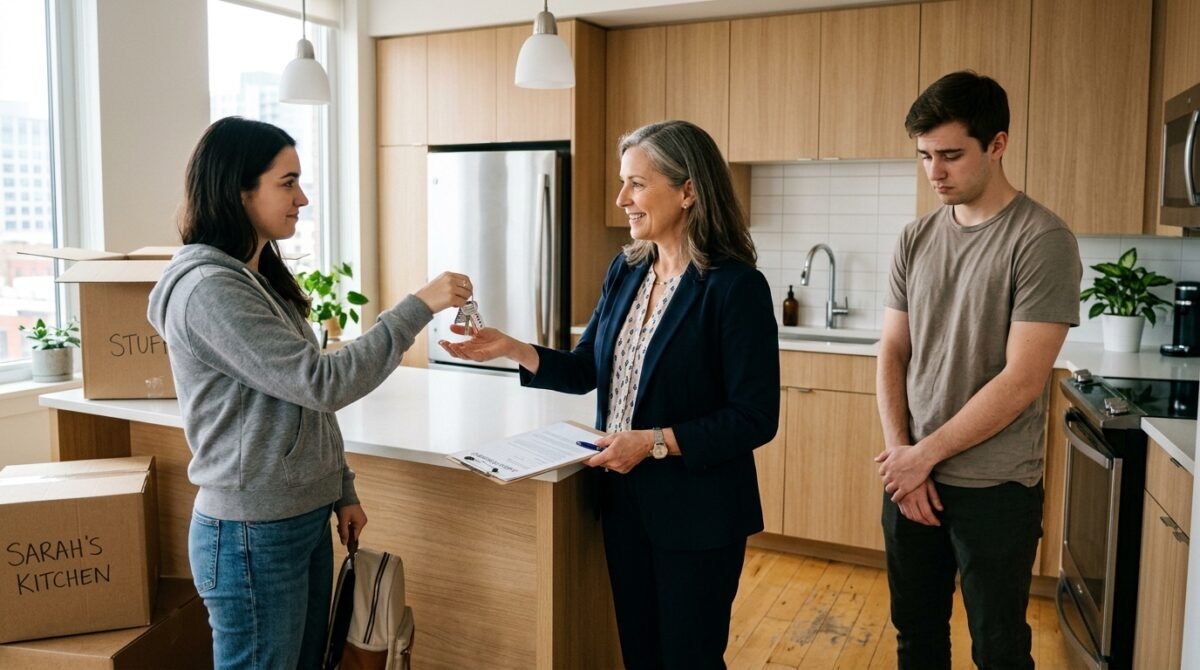
The day of the move-out inspection arrived. I had scrubbed the entire apartment, including the areas Mark had damaged. I had the photos, the logs, and the communication history with Mrs. Gable. I was ready. When Mrs. Gable walked in, she didn’t look at the decor or the cleanliness—she walked straight to the kitchen island. She ran her fingers over the granite, checking for any remnants of the concrete dust.
Mark was there, looking sheepish. He had spent the last week trying to ‘fix’ the damage, but the concrete had pitted the stone and left permanent stains that no amount of scrubbing could remove. He had even tried to use heavy-duty chemicals that ended up discoloring the finish. He was in way over his head, and he knew it. Mrs. Gable sighed, a sound that carried the weight of a thousand lost security deposits.
“Mark, you’ve done permanent damage to this countertop. This is going to require professional refinishing, which is well above the cost of your security deposit. I’m afraid I’ll have to invoice you for the remainder.”
— Mrs. Gable, the landlord
The look on Mark’s face was priceless. He had thought he could just move out, lose his deposit, and walk away. He hadn’t accounted for the fact that his ‘small project’ had caused thousands of dollars in property damage. He started arguing, trying to negotiate, but Mrs. Gable wasn’t having it. She pointed to the photos I had provided, the ones showing the initial state of the kitchen, and the ones showing his work in progress.
I stood back, watching the whole thing unfold with a sense of calm detachment. I had already removed my name from the lease, and I had ensured that my portion of the security deposit was protected by the documented proof that the damage was solely his fault. I wasn’t just walking away; I was walking away clean. The money, the drama, the headache—it was all his now, and I was finally free.
As I walked out of the apartment for the last time, I didn’t look back. I had my things, I had my life, and I had the peace of mind that comes with knowing I had stood up for myself. The sourdough was gone, and the crock was lost, but the lesson was learned. I was done with bad roommates, done with shared kitchens, and definitely done with people who thought their convenience was worth more than someone else’s history.
The Aftermath and Reflection
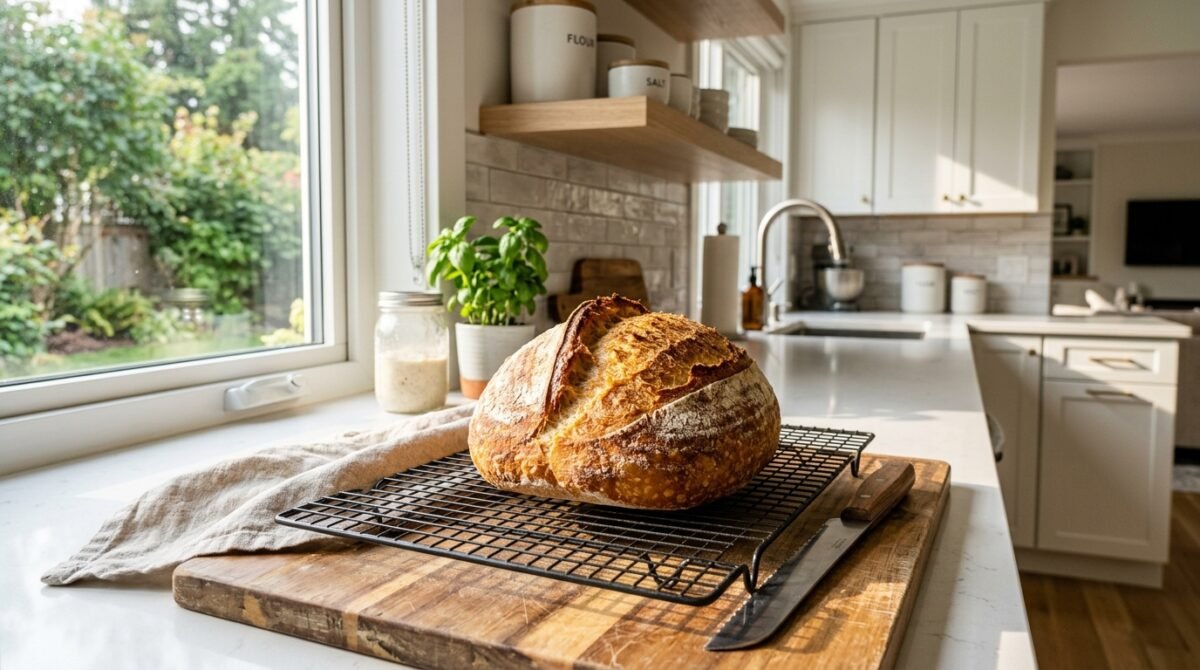
Looking back, it’s easy to focus on the loss. The sourdough starter was a physical connection to my past, a daily rhythm that grounded me. But as I settled into my new, smaller, but perfectly private studio, I realized that the loss was also a catalyst. It forced me to establish boundaries I had been too passive about for years. It taught me that it’s okay to be ‘that’ roommate—the one who cares about the details, the one who protects their space, and the one who refuses to be gaslit.
I’ve started a new starter. It’s not Matilda, but it’s mine. I named it ‘Hope,’ and I feed it every Friday, just like I did with the old one. Every time I bake a loaf, I think about the history of the process, the care that goes into it, and the resilience required to keep something alive. It’s a hobby, yes, but it’s also a way of remembering that some things are worth the effort, no matter what anyone else thinks.
I still talk to some of the friends I made through this. We laugh about the concrete disaster, and they tell me that my story has become a legend in our circles—the ‘Sourdough-Concrete Incident.’ It’s a funny story now, a piece of folklore that reminds us all of the importance of vetting who we live with. I’ve become much more selective about my inner circle, and my living situation is now a sanctuary, a place where no one would ever dream of touching my things.
“You know, I still think about that crock. But mostly, I think about how glad I am that I didn’t stay and fight for a place that didn’t respect me. The best revenge is living well, and my sourdough bread has never tasted better.”
— Me, reflecting on the experience
I’ve realized that the conflict wasn’t really about the starter, or the crock, or even the kitchen. It was about respect. It was about the difference between someone who views the world as a place to share and someone who views it as a place to conquer. I don’t need to conquer anything anymore. I just need a kitchen that is mine, a starter that is healthy, and the knowledge that I am strong enough to walk away from anyone who thinks otherwise.
For those of you dealing with a ‘Mark,’ take this as your sign: you aren’t overreacting. Your boundaries are yours, your history is yours, and your home should be your safe space. If someone can’t respect that, they don’t deserve the privilege of your presence in their life. Don’t let them dump concrete on your sourdough. Stand your ground, document everything, and don’t be afraid to walk out the door.
Community Perspectives: The Reddit Verdict

The Reddit thread didn’t just end with the initial post. It spawned a series of follow-up discussions on other subreddits about the ethics of shared spaces, the legal ramifications of roommate damage, and the ‘red flags’ of entitled housemates. The community was surprisingly unanimous in its verdict. Almost every single comment emphasized that the OP was well within their rights to be furious, and many provided concrete (no pun intended) advice on how to handle similar situations in the future.
The consensus was clear: the roommate’s actions were a deliberate disregard for the OP’s personal property and the sanctity of the home. The ‘it’s just yeast’ argument was widely mocked as a classic example of invalidation. People shared their own ‘roommate horror stories,’ creating a sense of solidarity that was both comforting and, at times, absolutely terrifying. It turned out that many people had lived through similar, if less dramatic, violations of their personal boundaries.
“I had a roommate who used my cast iron skillet to boil pasta. It’s not just about the item; it’s about the fact that they don’t value your belongings. OP, you did the right thing by getting out. People like that don’t change.”
— u/CastIronQueen (Top Comment, 8.2k upvotes)
Some users even chimed in with legal perspectives, suggesting that the OP could have filed a small claims case for the value of the heirloom. While I ultimately decided against it—the stress of a court case wasn’t worth the monetary return—it was validating to know that the law was on my side. The thread served as a repository of knowledge for anyone else currently dealing with a roommate who thinks ‘shared’ means ‘free for the taking.’
The thread also sparked a debate about the ‘silent treatment’ tactic. While some argued that it was immature, the vast majority of commenters defended it as a necessary survival mechanism in a toxic environment. When you’re dealing with someone who refuses to acknowledge their mistakes, silence is often the only way to protect your peace. The verdict was a resounding ‘NTA’ (Not The Asshole), with a side of ‘Get out and never look back.’
Ultimately, the digital reaction was a testament to the fact that we all crave respect in our living situations. We all want to feel that our things, our habits, and our history are safe in the places we call home. The ‘Sourdough-Concrete Incident’ became a cautionary tale that resonated with thousands of people, reminding us all that sometimes, the most important thing you can save from a bad living situation is your own dignity.
Lessons in Living Well

If there is one thing I took away from this entire ordeal, it’s that boundaries are not negotiable. I used to think that being a ‘good roommate’ meant being flexible, accommodating, and avoiding conflict at all costs. I was wrong. Being a good roommate means having clear, documented expectations and holding people accountable when they fail to meet them. It’s not about being ‘difficult’; it’s about being responsible for your own safety and sanity.
I’ve also learned that the value of an object is not just in its price, but in the memory it holds. When we let others treat our things with carelessness, we are, in a sense, letting them treat our memories with carelessness. I won’t make that mistake again. I now keep my most precious items in a secure place, and I am much more vocal about the rules of my space. If someone doesn’t like it, they can find somewhere else to live.
The most important lesson, however, was about my own worth. I spent too much time worrying about what Mark thought, about whether I was being ‘too much,’ or if I should have just ‘let it go.’ I realized that my voice is the most important one in my life. I don’t need validation from the person who is actively disrespecting me. I need to be my own advocate, my own protector, and my own best friend.
“You are the CEO of your own home. Never apologize for setting boundaries, and never let someone else’s lack of character make you feel like your needs aren’t important.”
— My internal mantra during the move-out process
So, here I am, in a new apartment with a new starter, and a newfound sense of self. The concrete is long gone, the crock is a sad memory, and the roommate is a cautionary tale I share at dinner parties. But I am still here, still baking, and still finding joy in the small, fermented things that make life worth living. And that, in the end, is the best possible outcome.
If you’re in a situation where you feel your boundaries are being ignored, or your space is being violated, take this as your wake-up call. You deserve better. You deserve to feel comfortable in your own home. Don’t wait for a concrete-filled crock to realize that you need to make a change. Stand up, set your boundaries, and if necessary, find a new path. Your peace of mind is worth more than any lease, and your life is worth more than any roommate’s convenience.
Conclusion
The story of Matilda and the concrete crock is one I’ll carry with me for a long time. It serves as a reminder that the things we cherish—whether they are centuries-old starters or simply the peace of a quiet home—are worth protecting. Life is far too short to spend it with people who don’t understand the value of the things that make us who we are. I’ve learned that the most important ingredient in a good life isn’t yeast or water; it’s self-respect.
I often wonder what became of Mark. Does he still use random kitchenware for his experiments? Has he learned that respect is a two-way street? I suppose it doesn’t matter. He’s no longer part of my story, and that’s exactly how it should be. The sourdough is rising, the kitchen is clean, and for the first time in years, the space I occupy feels truly, unequivocally mine.
What about you? Have you ever had a roommate who completely crossed the line? How did you handle it, and what did you learn about your own boundaries in the process? Share your stories in the comments below—I’d love to hear how you navigated your own ‘roommate wars’ and what wisdom you gained from the experience. Let’s start a conversation about what it really means to create a home.
What's your verdict on this dilemma?
Vote below to contribute to the official community consensus.

Have a Dilemma Keeping You Up at Night?
Share your real-life feud, wedding chaos, or relationship crossroads anonymously with our editorial team.
What do you think ?
0 Comments🛡️ Comments are moderated to protect community integrity. Your comment will appear once approved by the editorial team.