
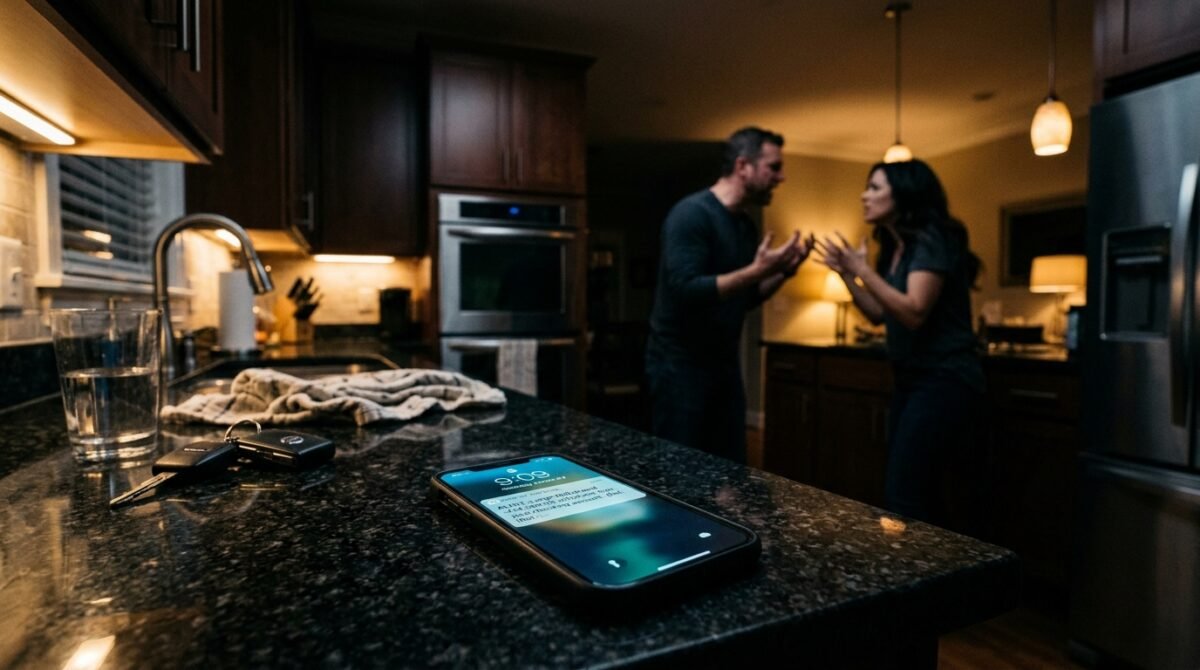
Marriage is built on trust, but beneath that foundation lies the bedrock of financial security. For years, my husband, Mark, and I lived by a simple, sacred rule: the ‘Safety Net’ fund. It was our sanctuary—a high-yield savings account meticulously nurtured through overtime shifts, skipped vacations, and the quiet sacrifices of two people trying to build a future. We called it our contingency for the unpredictable, the medical emergencies, or the sudden layoffs that haunt every working-class household.
That all changed on a rainy Tuesday afternoon. When I opened our banking app to check a routine transaction, the numbers staring back at me didn’t make sense. A withdrawal of forty-five thousand dollars. My heart didn’t just sink; it plummeted into a void of confusion and rising panic. I assumed it was a system error or perhaps identity theft, but as I scrolled through the transaction history, the recipient name made my blood run cold: ‘Luxury Motors – Automotive Sales’.
Mark’s sister, Sarah, had been complaining for months about her ‘downtrodden’ commute and her desperate need for a status symbol SUV. I had laughed it off as entitlement, assuming Mark understood that our money was strictly off-limits. I was wrong. As I sat at the kitchen island, the cold reality crystallized: my husband hadn’t just dipped into our savings; he had liquidated our security to bankroll his sibling’s vanity project without a single word of discussion.
The moral dilemma here wasn’t just about the money—it was about the utter erasure of my voice in our partnership. When he walked through the door later that evening, whistling, his tie loosened, he had no idea that the life we had built together had just fractured irreparably. This wasn’t just a purchase; it was a unilateral declaration that my security was secondary to his family’s whims. And I knew, in that exact moment, that I had to protect myself in ways I never imagined possible.
The Tuesday Afternoon Bank Notification

The notification popped up on my watch while I was in the middle of a conference call. It was a standard alert from our joint savings account, but the amount—a staggering five-figure sum—halted my train of thought mid-sentence. I apologized to my team, muted my microphone, and frantically checked the app. The sheer audacity of the transaction was almost impressive, if it hadn’t been so devastatingly destructive.
I spent the next hour calling the bank, terrified that our account had been hacked. The representative was calm, almost annoyingly so, as they verified the transaction. ‘The transfer was authorized through a verified login on a known device, ma’am,’ the voice on the other end said. I felt the color drain from my face. My hands were shaking so hard I could barely type my password to log in again. This wasn’t a hack. This was a targeted, calculated decision made by the man I married.
I looked at the transaction details again. It was a down payment for a high-end, luxury SUV. Sarah, his sister, had been posting photos on social media of this specific car for weeks, captioning them with hashtags about ‘manifesting’ and ‘deserving luxury.’ I had commented with a polite, generic ‘nice car’ emoji back then, never once suspecting that my hard-earned money was destined to become the down payment for her leather-seated obsession.
“I don’t understand, Mark. Did you really think I wouldn’t notice forty-five thousand dollars missing from our account? Was I supposed to just wake up one day and find you’d decided our emergency fund was better spent on your sister’s vanity project?”
— Me, during the initial confrontation
When I finally heard the lock click and the door swing open, my adrenaline was peaking. I didn’t greet him. I didn’t ask about his day. I simply stood in the kitchen with the laptop open, the bank statement clearly visible on the screen. The look on his face shifted from casual annoyance at the dark house to something entirely different when he saw me standing there, stone-faced, waiting for an explanation that I knew would be insulting.
The Excuse of Family Loyalty

Mark’s defense was immediate and rehearsed, as if he had anticipated this conversation for days. He didn’t deny it; he didn’t even try to hide the transaction. Instead, he launched into a tirade about how Sarah was ‘struggling’ and needed a reliable vehicle to get to her new job. When I pointed out that a luxury SUV was hardly a requirement for a commute, he scoffed, calling me petty and unsupportive of his family.
He argued that we were ‘doing fine’ and that the money would be ‘paid back’ eventually. He talked about loyalty, about the ‘bond between siblings,’ and about how I had ‘always been cold’ toward his family. The irony was suffocating. I had been the one to help them move, the one to buy groceries for their dinners, and the one who had spent years acting as the mediator between Mark and his sister’s constant, frantic crises.
I asked him specifically when he planned to tell me. His silence was the most damning answer of all. He hadn’t planned to. He had hoped that by the time I noticed, the car would be in her possession, the money would be gone, and I would be forced to accept it as a ‘done deal.’ It was a move of pure cowardice, a betrayal of the partnership we had forged over six years of marriage.
“You call it loyalty, Mark, but I call it theft. You didn’t ask me. You didn’t even give me the dignity of a conversation. You just decided that my work, my overtime, and my security mattered less than your sister’s lifestyle upgrade. That isn’t family loyalty. That’s just you using me.”
— My response to his initial excuse
By the time the argument ended, the air in the room was stale. He retreated to the living room, convinced he was the victim of my ‘unreasonable’ anger. I, meanwhile, retreated to our home office, where I kept the physical files for our assets. I knew then that the dynamic of our marriage had changed forever. I wasn’t just angry; I was coldly, calculatingly focused on my own survival.
The Quiet Move Toward Legal Independence

The next morning, I didn’t engage. I left for work early, but I didn’t go to the office. Instead, I drove to the bank. I had been an authorized user on that account, but in our state, the laws regarding joint accounts were clear. I didn’t need his permission to protect my share of the remaining funds. I spent the morning meeting with a financial advisor and a lawyer, documenting every single deposit I had made over the last three years.
I learned that since the house we shared was titled in both our names, but I was the sole provider for the down payment and the mortgage payments for the first two years, I had a significant claim. But it was the car—the luxury vehicle now sitting in his sister’s driveway—that presented the most interesting legal hurdle. If I couldn’t get the money back, I was going to make sure the legal reality of our assets reflected his choice.
I went home that evening and quietly began gathering my documents. I didn’t change the passwords yet; I wanted him to think things were ‘settling down.’ I needed him to be comfortable. I needed him to believe that I was just ‘cooling off.’ The level of deception required to navigate this felt unnatural, but so did the theft of my savings. I was simply mirroring the reality he had created.
I checked my phone and saw a group chat notification. It was the family group chat. Sarah was posting photos of the new car, thanking Mark for his ‘incredible generosity’ and calling him the ‘best brother in the world.’ There were dozens of heart emojis from his parents and aunts. It was a gut-punch that cemented my decision. He was a hero to them, at the expense of my security.
“Look at the new ride! So blessed to have a brother who truly cares. Thanks for everything, Mark! Can’t wait to show you all this weekend.”
— Sarah’s text in the family group chat
I didn’t reply to the group chat. I just watched, like a ghost in my own life, as the people I thought were my family celebrated a betrayal I wasn’t even supposed to talk about. I felt a strange sense of clarity. The marriage wasn’t just a union of hearts; it was a contract. And Mark had just breached it beyond repair.
The Sunday Dinner Silence

Sunday dinner was always a mandatory affair. Usually, I enjoyed the banter with his parents, but this time, the tension felt like a physical weight on the dining room table. Mark was beaming, clearly expecting me to play along, to smile, and to be the ‘supportive wife’ who was just a little bit grumpy for a few days. He hadn’t realized that the moment I walked in, I had already initiated the transfer of my remaining personal funds to an account he couldn’t touch.
The conversation turned to the new car. His mother was gushing, asking Sarah how it handled on the highway. I sat there, methodically cutting my roast beef, listening to them talk about the features of a car I had effectively paid for but would never sit in. When his father turned to me and asked, ‘So, how do you like the new set of wheels?’ I didn’t flinch.
I looked at Mark, who was watching me with a mixture of fear and bravado. I knew exactly what he wanted me to say: a polite, fake comment that validated his choice. Instead, I leaned back and smiled—a slow, genuine, terrifying smile. I realized then that my power wasn’t in screaming; it was in the absolute refusal to play the part of the submissive partner.
“It’s a beautiful car, Sarah. Really, it’s a shame that the money used for it was supposed to cover our house insurance and property taxes for the next two years. I hope it drives as smoothly as it feels to take someone else’s security away.”
— My statement at the dinner table
The silence that followed was absolute. The clinking of silverware stopped. Mark looked like he wanted to vanish into the floorboards. His mother looked shocked, her fork hovering halfway to her mouth. Sarah had the decency to look uncomfortable, but only for a second before she pivoted to her phone. I didn’t say another word for the rest of the meal.
The Legal Pivot

After the dinner, the dynamic in the house changed. Mark was no longer defensive; he was panicked. He tried to argue that I had ’embarrassed him’ in front of his parents. He accused me of being vindictive and petty. I didn’t argue back. I simply opened my laptop and showed him the document I had filed earlier that day: a legal separation of our financial assets and a request for a formal audit of our joint accounts.
I told him clearly: the money was gone, but the consequence was that he no longer had access to my income, my credit, or our joint assets. I had already contacted the bank and frozen the remaining liquidity. He was stunned. He thought this was all bluster, a temporary tantrum. He didn’t understand that I had been planning for this outcome since the moment I saw the withdrawal.
He begged me to reconsider, claiming he would ‘find a way’ to pay it back. He talked about taking out a loan. I told him he was more than welcome to take out a loan, but that it would be in his name alone, and that it would have no impact on the boundaries I had set. I was no longer his financial partner; I was a person who was protecting her future from a man who prioritized his sister’s convenience over our life together.
The next few days were a blur of meetings and paperwork. I learned just how much leverage I actually had. Because I had contributed sixty percent of the savings and the primary income for our household, I was able to secure a legal hold on our joint properties pending a full review. It was the ultimate ‘checkmate’ in a game he thought he was winning.
“You think this is about the money, Mark. It isn’t. It’s about the fact that I can’t trust you with the future we’re supposed to be building together. If you can take our security for a car, what will you take when we have children? What will you take when I get sick?”
— My confrontation with Mark after the legal filing
He finally started to cry. It wasn’t the kind of crying that comes from regret; it was the kind that comes from losing control. He realized he had burned down the house to keep his sister warm, and now he was left standing in the ashes, wondering why I wasn’t there to help him rebuild.
The Viral Reddit Thread

I didn’t tell anyone in real life at first, but I needed to know if I was losing my mind. I wrote a post on a popular sub-reddit detailing the situation, omitting the specific names but leaving the facts clear: the emergency fund, the sister, the car, and my subsequent reaction. The response was immediate and overwhelming. Thousands of people weighed in, with the overwhelming majority siding with me, calling the act ‘financial abuse’ and ‘unacceptable.’
It was surreal to see my life analyzed by strangers. Some commenters were harsh, detailing the exact legal steps I should take next. Others shared their own horror stories of partners who had prioritized their families over their own spouses. It made me realize that I wasn’t alone, and more importantly, that my reaction—while extreme to Mark—was actually a standard, healthy defense mechanism.
“This isn’t just about a car. This is financial infidelity on a massive scale. OP, please consult a lawyer immediately. You aren’t being vindictive; you are saving your financial future from someone who clearly doesn’t respect your boundaries. The fact that he thinks this is ‘no big deal’ is the biggest red flag of all.”
— u/FinancialFreedomSeeker (Top Comment, 32.5k upvotes)
Reading the comments gave me the strength to follow through. Every time I felt a pang of guilt or a desire to ‘just work it out,’ I would re-read the threads. It reminded me that the ‘family loyalty’ Mark kept preaching was just a mask for his own lack of respect for me. The community support was the validation I needed to stop apologizing for protecting myself.
I started keeping screenshots of the most helpful advice, creating a kind of ‘battle plan’ for the divorce proceedings. It wasn’t a path I wanted to take, but it was the one I was on. The internet, for all its toxicity, provided a mirror that helped me see the situation for what it was: an unsustainable, toxic environment that I had to escape.
The Sister’s Unannounced Visit

Sarah showed up on our porch two weeks later, driving the new SUV. She looked triumphant until she saw the packed boxes by the door. She tried to act like nothing was wrong, asking if I wanted to ‘take it for a spin.’ I didn’t even open the door fully. I stood in the doorway, feeling a strange sense of detachment. She was just a person who had benefited from someone else’s moral failing.
She started to complain about how ‘stressed’ Mark was, how he was ‘beating himself up’ over my ‘reaction.’ I laughed, a short, sharp sound that seemed to surprise her. I told her that she was welcome to keep the car, but that she should probably start looking for a way to pay Mark back, because he wouldn’t be able to afford the insurance or the maintenance once our joint accounts were fully liquidated.
Her face fell. It was clear she hadn’t considered the consequences for her own life. She had assumed the money was free, a gift from a brother who had an endless supply. When I explained that I was the source of that supply, and that I had cut the line, the reality of her ‘luxury’ purchase started to look like a debt she couldn’t afford to service.
“You think this is a gift, Sarah. It isn’t. It’s a liability. You took money that was meant for our mortgage and our future. If you want to keep that car, you’re going to have to find a way to make it work without our help. I’m done being the silent sponsor of your lifestyle.”
— My words to Sarah on the front porch
She tried to defend herself, saying she ‘didn’t know’ where the money came from. I didn’t believe her for a second. Everyone in that family knew how we lived, how we saved, and how hard I worked. She left in a huff, and I watched her drive away, feeling not a shred of guilt. I had finally set the boundary, and it felt like breathing clean air for the first time in years.
The Final Breakdown

The final confrontation happened in the living room, surrounded by half-packed suitcases. Mark was trying one last time to convince me that we could ‘fix this’ if I just ‘dropped the legal stuff.’ He looked small, tired, and completely out of his depth. He didn’t understand that the ‘fix’ wasn’t about the money anymore—it was about the fact that he was a stranger to me. I didn’t know this man who would steal from his own wife to satisfy his sister.
I laid out the timeline for him: the moment he took the money, the moment he hid it from me, the moment he lied to his family, and the moment he realized I wasn’t going to be the silent victim he expected. I told him that I loved the man I thought he was, but that the man standing in front of me was a shadow of that person. It was the most honest I had been in our entire relationship.
He tried to make excuses about ‘pressure’ and ‘being a good brother,’ but I didn’t let him finish. I told him that being a good brother didn’t require being a bad husband. The two things weren’t mutually exclusive, but he had chosen to make them so. There was no going back from that. I wasn’t angry anymore; I was just done.
“You didn’t just steal money, Mark. You stole my trust. You stole the safety I felt in this home. You might think you can just apologize and move on, but you can’t apologize for a character flaw. And that is what this is. A fundamental difference in how we value each other.”
— My final words to Mark before leaving
I walked out of the house that night. I didn’t take much—just my clothes, my files, and my peace of mind. As I drove away, I looked in the rearview mirror at the house I had helped build, and for the first time in months, I didn’t feel a shred of regret. I felt free.
The Aftermath of Freedom

It has been six months since I left. The divorce process is ongoing, but I have my own apartment, my own accounts, and, most importantly, my own life. I see Mark occasionally through our lawyers, and he looks like a man who has lost his grip on reality. He’s struggling with the financial burden of the car, and his relationship with his family has soured because they can no longer rely on him for handouts. It’s a tragic, self-inflicted collapse.
I have spent these months focusing on myself—rebuilding my savings, reconnecting with friends I had neglected while I was busy mediating Mark’s family crises, and rediscovering what it means to be happy on my own terms. The silence in my new apartment isn’t lonely; it’s peaceful. It’s the sound of a life that is entirely my own, without the hidden agendas and the financial betrayals.
I have learned that boundaries are not acts of aggression; they are acts of self-preservation. When you allow someone to cross your lines repeatedly, you aren’t being kind—you are teaching them that they have permission to mistreat you. I am a different person now. I am more cautious, yes, but I am also more confident. I know what I bring to the table, and I know exactly what I am worth.
Looking back, I don’t regret the money. It was a high price to pay for the truth, but it bought me my freedom. I would pay that forty-five thousand dollars a hundred times over if it meant knowing that I am the architect of my own future. I am no longer waiting for someone else to validate my needs or respect my security. I am doing it myself.
“I used to think that being part of a couple meant merging everything until you couldn’t tell where one person started and the other ended. Now I know that a real partnership requires two whole people. I’m finally whole again.”
— My reflection on my current life
The lessons were hard, but the outcome is everything I needed. I am not waiting for a happy ending; I am living one, one day at a time, on my own terms.
Reflecting on the Trust Gap

The aftermath isn’t just about the money or the house; it’s about the psychological shift that occurs when you realize your partner was living a double life. For months, I felt like a detective in my own home, constantly looking for signs of further deception. That level of hyper-vigilance is exhausting, but it taught me to listen to my intuition. My brain had been trying to warn me for years, but I had suppressed it in favor of ‘keeping the peace.’
I’ve started attending therapy to unpack the ‘why’ behind my tolerance. I wanted to understand why I stayed as long as I did, why I minimized his behavior, and why I allowed myself to be sidelined in my own financial life. The answer wasn’t comfortable, but it was necessary. I had tied my self-worth to being the ‘easygoing, supportive partner,’ and that identity had become a trap.
Moving forward, I know that any future relationship I enter will have a completely different structure. Financial transparency won’t be an option; it will be a prerequisite. We will have clear, documented boundaries, and we will have regular, uncomfortable conversations about our future before any major decisions are made. I have set a high bar for myself, and I refuse to settle for anything less than complete, mutual respect.
“The most important thing I’ve learned isn’t about banking; it’s about self-worth. You are allowed to demand respect. You are allowed to walk away from people who don’t prioritize your well-being. And you are definitely allowed to protect your own future.”
— My takeaway from the past year
It’s strange to think that such a painful event could lead to such profound growth. But that’s the reality of hitting rock bottom—once you’re there, the only way out is to build a foundation that is truly, unshakably your own.
Conclusion
This experience taught me that the greatest wealth we have isn’t found in a bank account, but in the clarity of our own boundaries. The financial betrayal was simply the catalyst that forced me to see the reality I had been avoiding. Today, I am stronger, more independent, and entirely in control of my future. I hope my story serves as a reminder to anyone reading this: your security matters. Your voice matters. And you are never obligated to sacrifice yourself for someone else’s entitlement.
What would you have done if you found yourself in my position? Would you have stayed to try and ‘fix’ it, or would you have walked away as soon as you saw the transaction? I’d love to hear your thoughts in the comments below.
What's your verdict on this dilemma?
Vote below to contribute to the official community consensus.

Have a Dilemma Keeping You Up at Night?
Share your real-life feud, wedding chaos, or relationship crossroads anonymously with our editorial team.
What do you think ?
0 Comments🛡️ Comments are moderated to protect community integrity. Your comment will appear once approved by the editorial team.